Selected Works · 1985–2020
Barbara
Darmstadt
Objects of Desire · Rocks · Gourds · Fence · Male Figure · Early Works · Abstraction
III
Catalog Three
Princeton, New Jersey
Works in Mixed Media, Oil, Installation & Sculpture
Section One
Rocks:
Fetal Futures
Between 1985 and 2020, Barbara Darmstadt assembled one of her most concentrated bodies of work: painted river stones bearing the image of the fetus, presented within an ever-shifting array of found containers, medical documents, cultural detritus, and natural materials. Each rock is both talisman and accusation — a small, hard fact about bodies and the law, medicine and morality. The stones do not argue. They simply persist.
1985–2020 / Mixed Media: Painted River Stones, Found Objects, Text
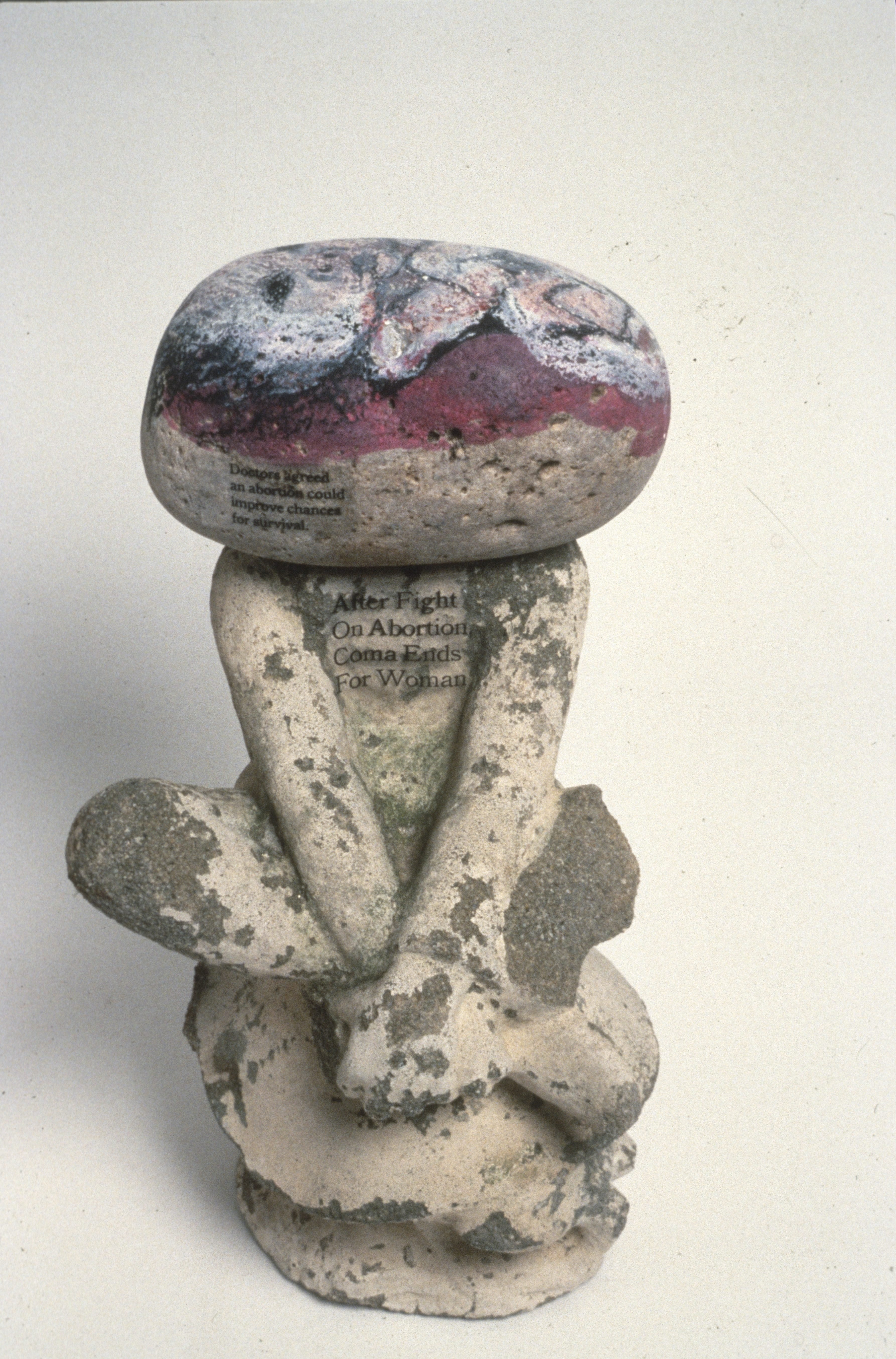
1.1
After Fight On Abortion, Coma Ends For Woman
A painted stone bearing the curled image of a fetus is stacked upon a sculpted concrete figure in the posture of grief or prayer. Newsprint headlines are embedded in the surface: "Doctors Agreed an Abortion Could Improve Chances for Survival." The ceramic base — rough, lichen-mottled, humanoid — cradles the painted stone as though offering it, or restraining it.
Painted river stone, concrete sculpture, embedded newsprint · c. 1988
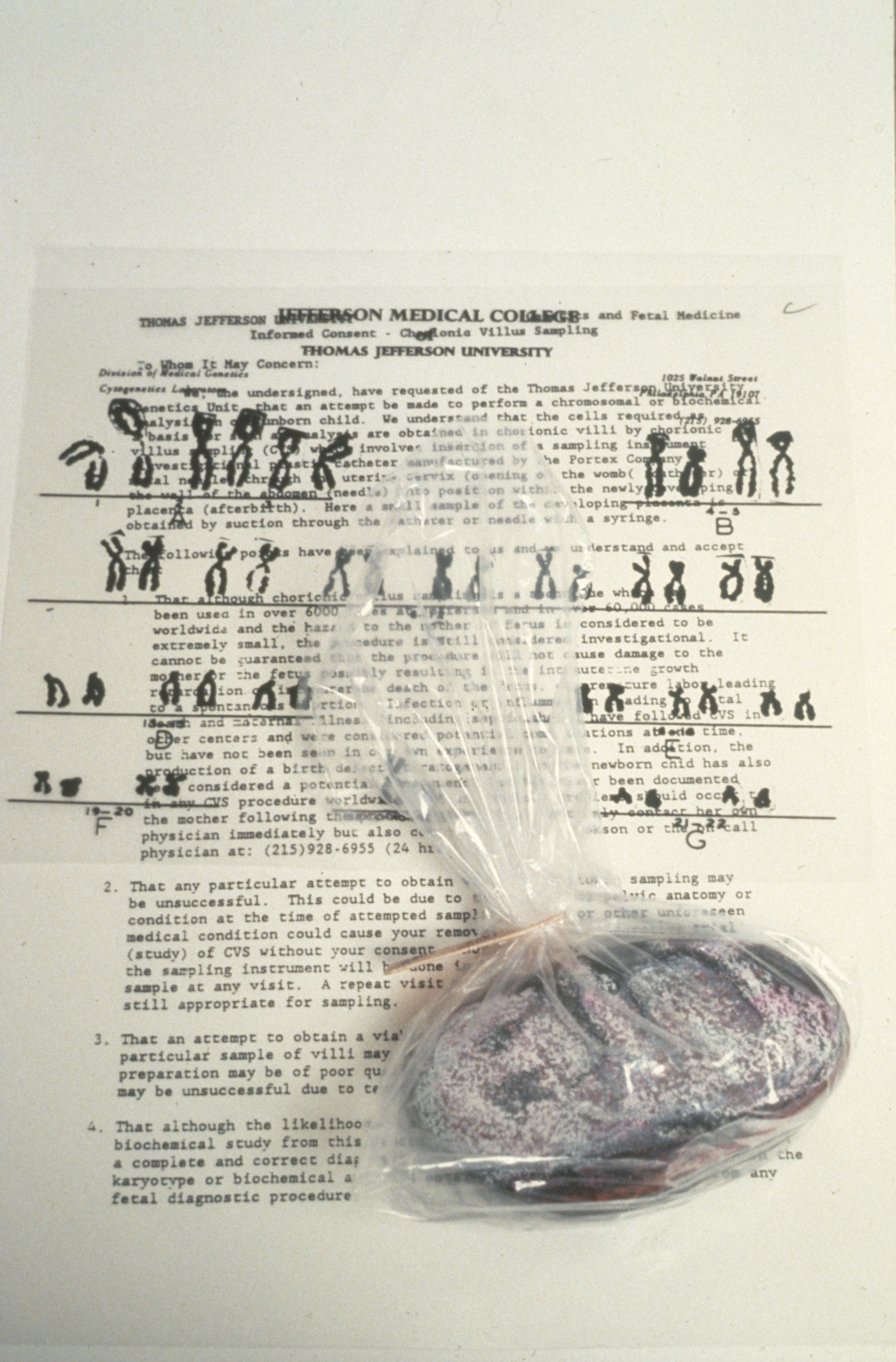
1.2
Results for DNA Trisomy
A painted fetal stone is placed directly atop a photocopied Thomas Jefferson University informed consent document for Chorionic Villus Sampling. Chromosome diagrams — the raw data of genetic testing — have been overprinted across the form. The stone rests in a sealed plastic bag like a tissue sample, like evidence. What the laboratory reveals, the artist transforms back into image.
Painted river stone, medical consent document, plastic bag · c. 1990
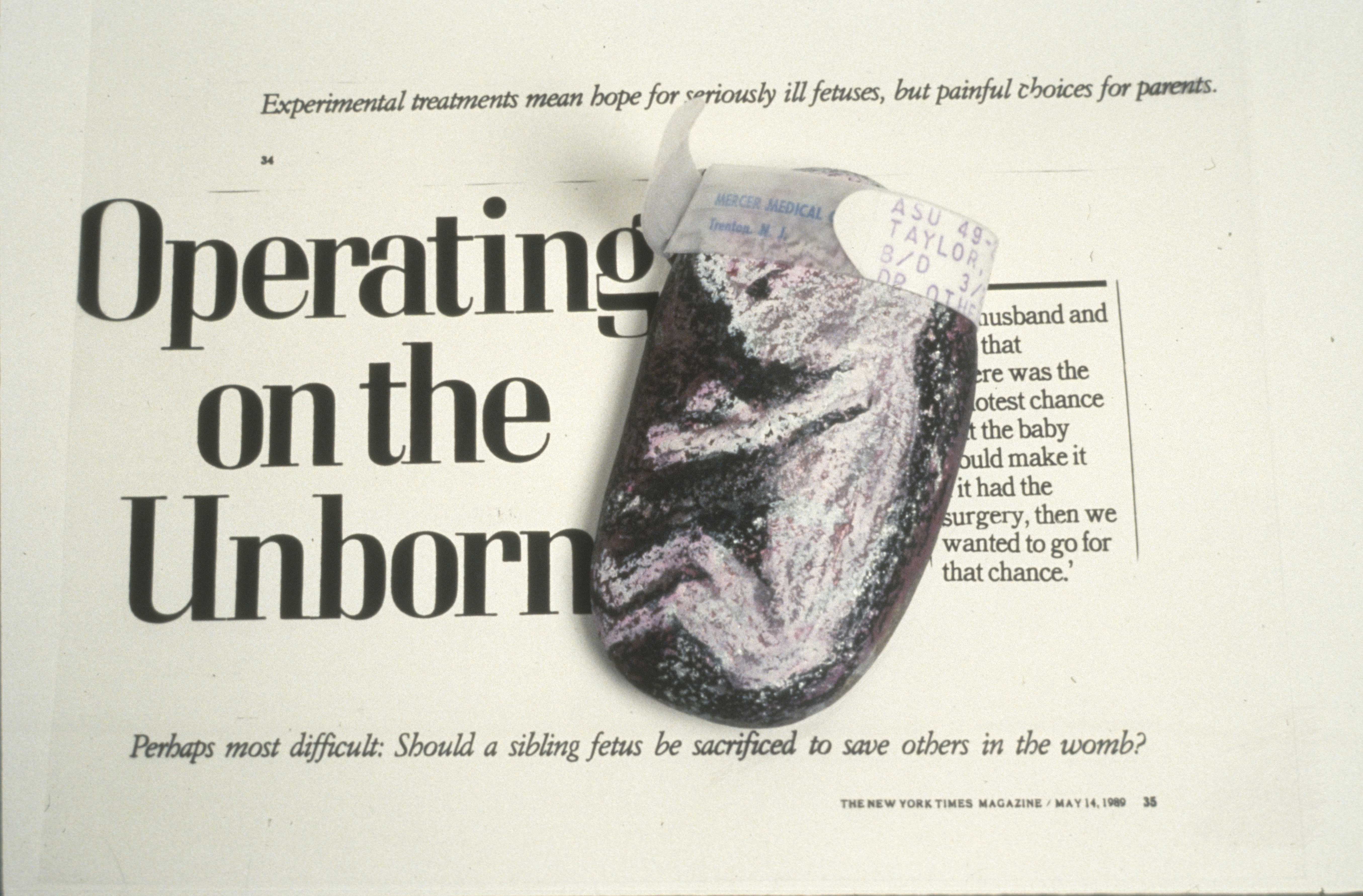
1.3
Treating the Fetus
Against a New York Times Magazine spread — "Operating on the Unborn" — Darmstadt places a stone whose painted surface renders a fetus in dark, swirling pigment. A Mercer Medical hospital label clings to the stone's upper edge. The magazine asks impossible questions about hope and sacrifice; the stone answers with its silence and its weight. "Perhaps most difficult: Should a sibling fetus be sacrificed to save others?"
Painted river stone, magazine page, hospital label · c. 1989
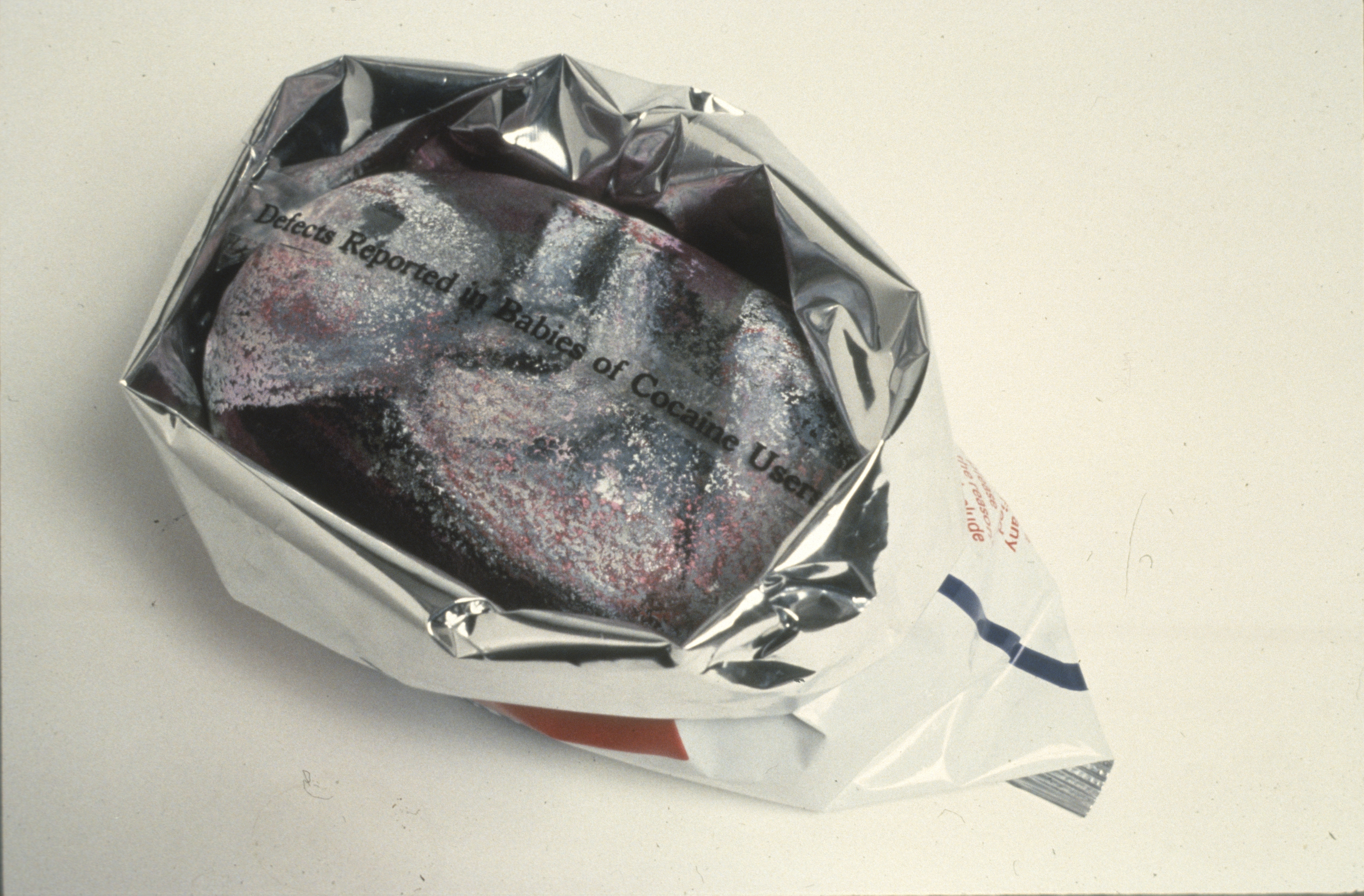
1.4
Defects Reported in Babies of Cocaine Users
The fetal stone rests inside a crumpled mylar bag — the kind used to protect evidence, to preserve specimens. Stamped across its surface: "Defects Reported in Babies of Cocaine Users." The packaging transforms the stone from art object into medical or legal exhibit, implicating the viewer in a system of surveillance and judgment directed at pregnant women.
Painted river stone, mylar evidence bag, printed text · c. 1989
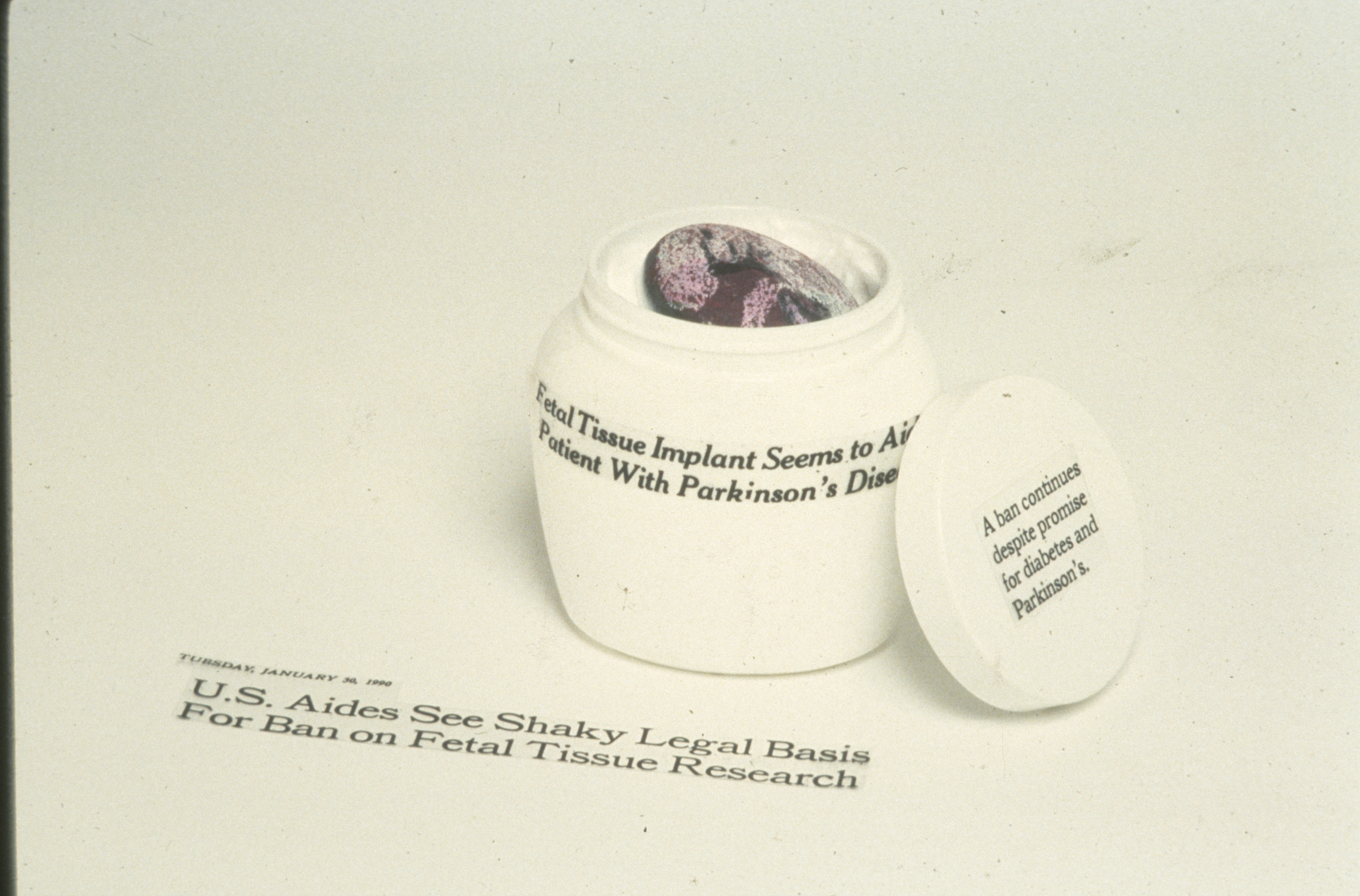
1.5
Fetal Tissue Implant
A white plastic pharmaceutical container — the kind for ointments or tissue samples — cradles a painted fetal stone within its open lid. The canister reads: "Fetal Tissue Implant Seems to Aid Patient With Parkinson's Disease." The detached lid bears a secondary note: "A ban continues despite promise for diabetes and Parkinson's." Below, a Times headline questions the legal basis for the research ban. Promise and prohibition in a clinical white jar.
Painted river stone, pharmaceutical container, newsprint · c. 1990
"The rocks do not argue for a position. They argue for the weight of it all — each stone a small planet of meaning pressed into the hand."
— On Darmstadt's rock series
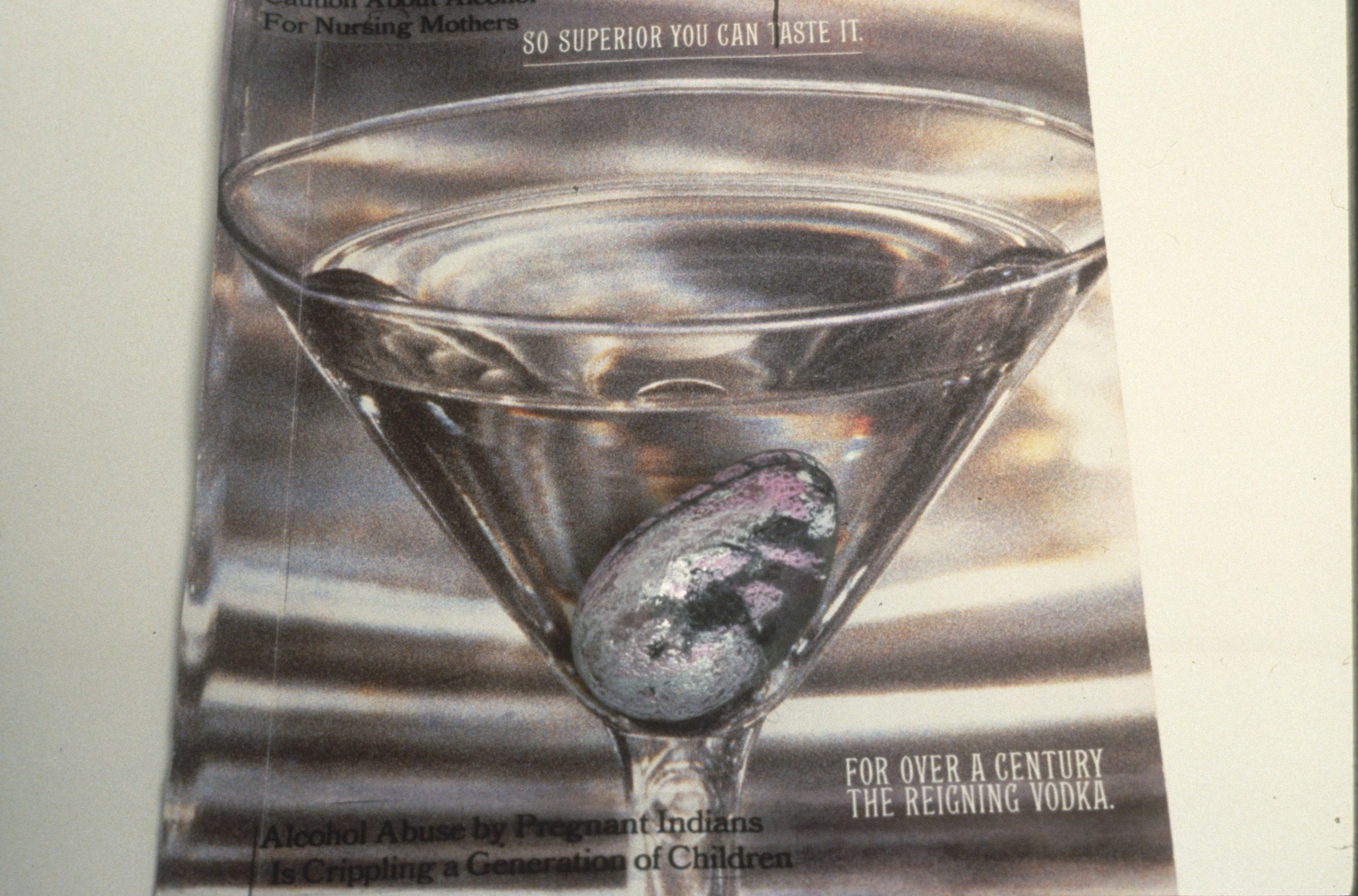
1.6
Effect of Alcohol
The painted stone rests inside a martini glass in a liquor advertisement: "So Superior You Can Taste It." Below the glamour, a newspaper headline reads: "Alcohol Abuse by Pregnant Indians Is Crippling a Generation of Children." A tiny caution note is printed at the top: "Caution About Alcohol for Nursing Mothers." The collision of seduction and consequence is total — the fetus as olive in a culture that refuses to see it.
Painted river stone, liquor advertisement, newsprint · c. 1991
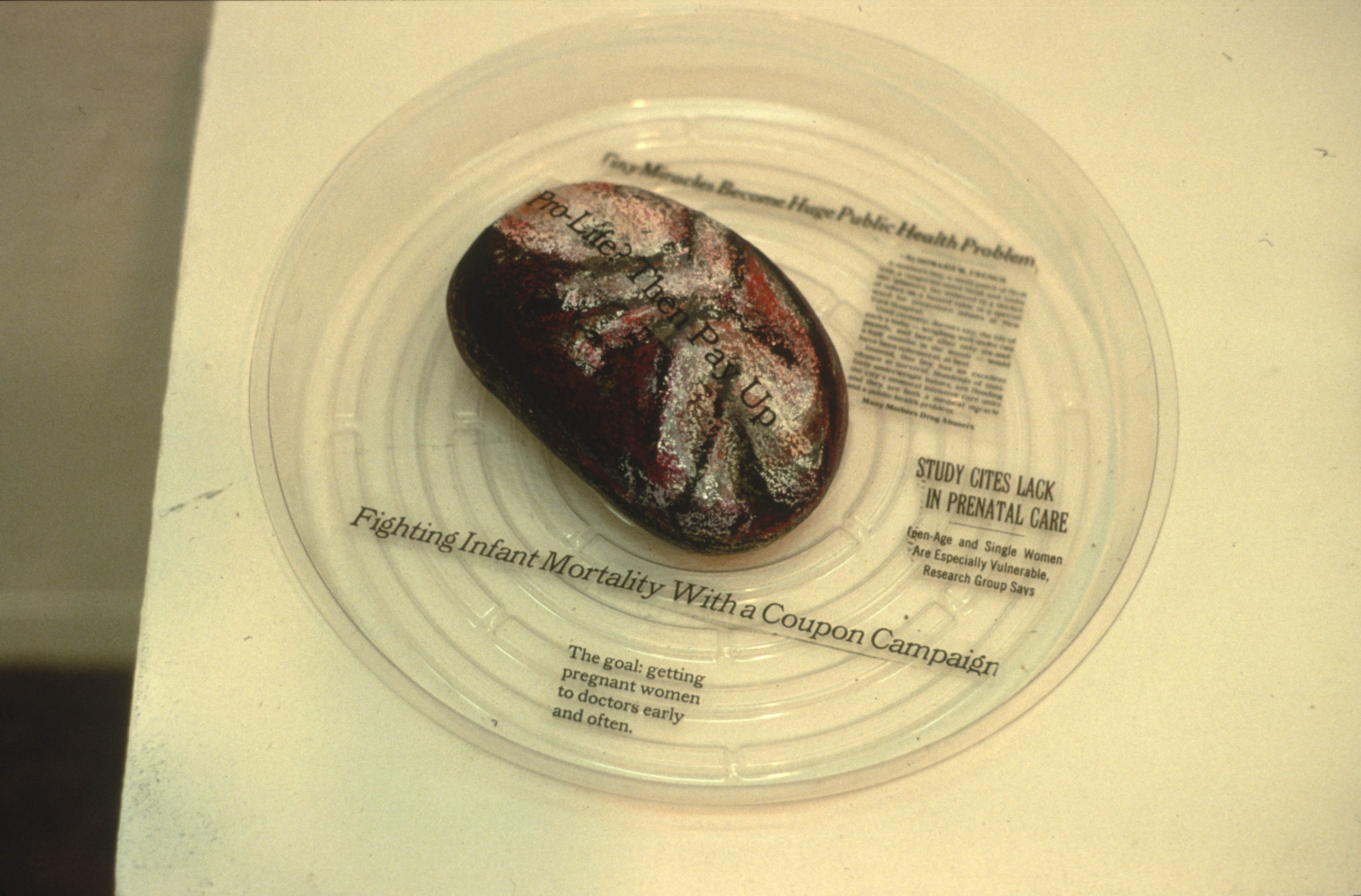
1.7
Pro-Life? Then Pay Up
A dark, lacerated stone rests on a circular plastic tray printed with headlines: "Fighting Infant Mortality With a Coupon Campaign," "Study Cites Lack in Prenatal Care," "Tiny Miracles Become Huge Public Health Problem." The stone itself reads "Pro-Life? Then Pay Up." Around it, the plastic netting of the tray amplifies the rhetoric of containment — care promised, care withheld.
Painted river stone, plastic tray, newsprint · c. 1992
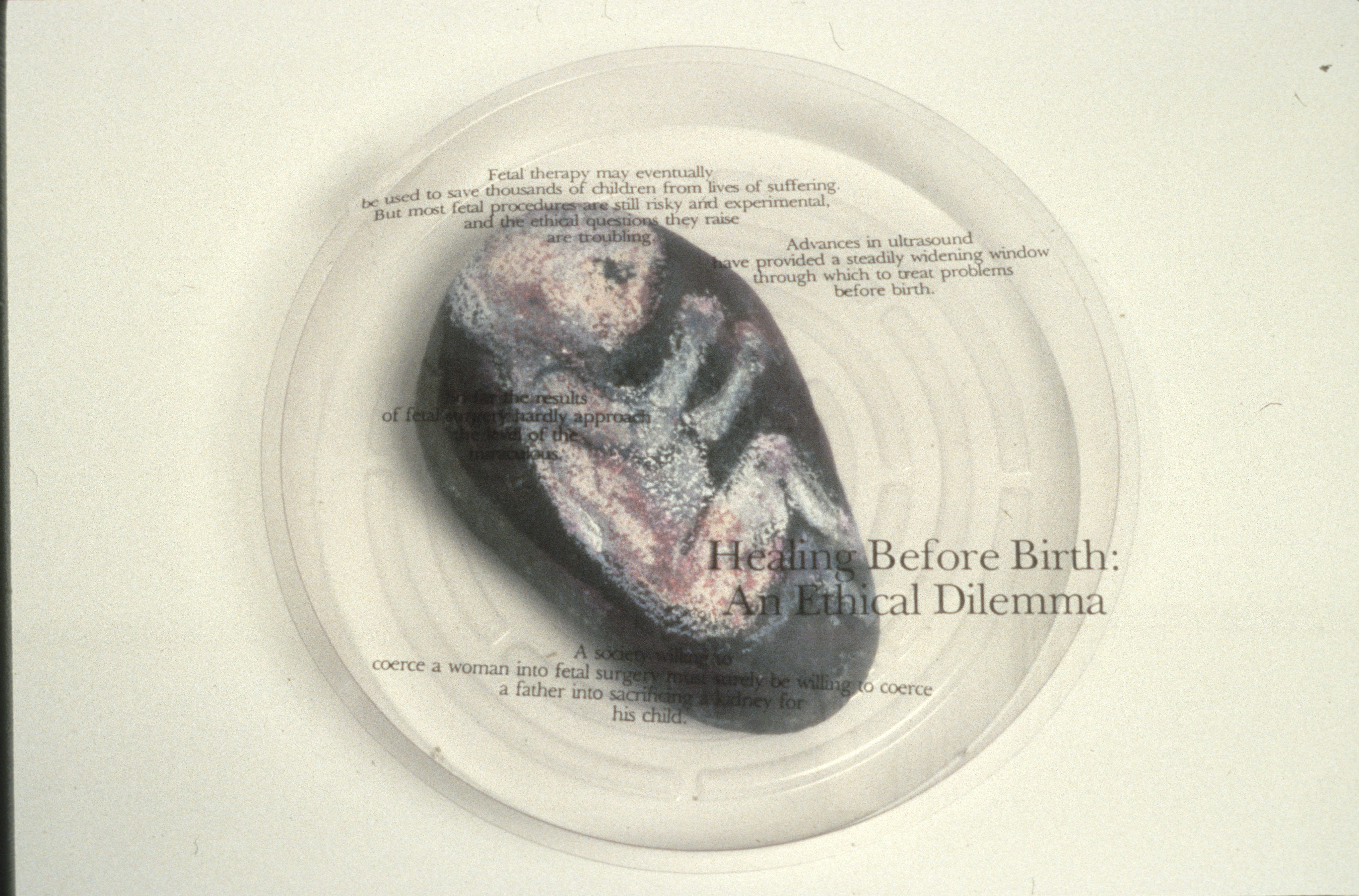
1.8
Ethical Dilemmas
A large fetal stone dominates a circular plastic tray covered in text about fetal surgery: "Healing Before Birth: An Ethical Dilemma." Text encircles the stone — on fetal therapy's promise, on the troubling consent questions it raises: "A society willing to coerce a woman into fetal surgery must surely be willing to coerce a father into sacrificing a kidney for his child." The arrangement is nearly judicial in its symmetry.
Painted river stone, circular plastic tray, embedded text · c. 1992
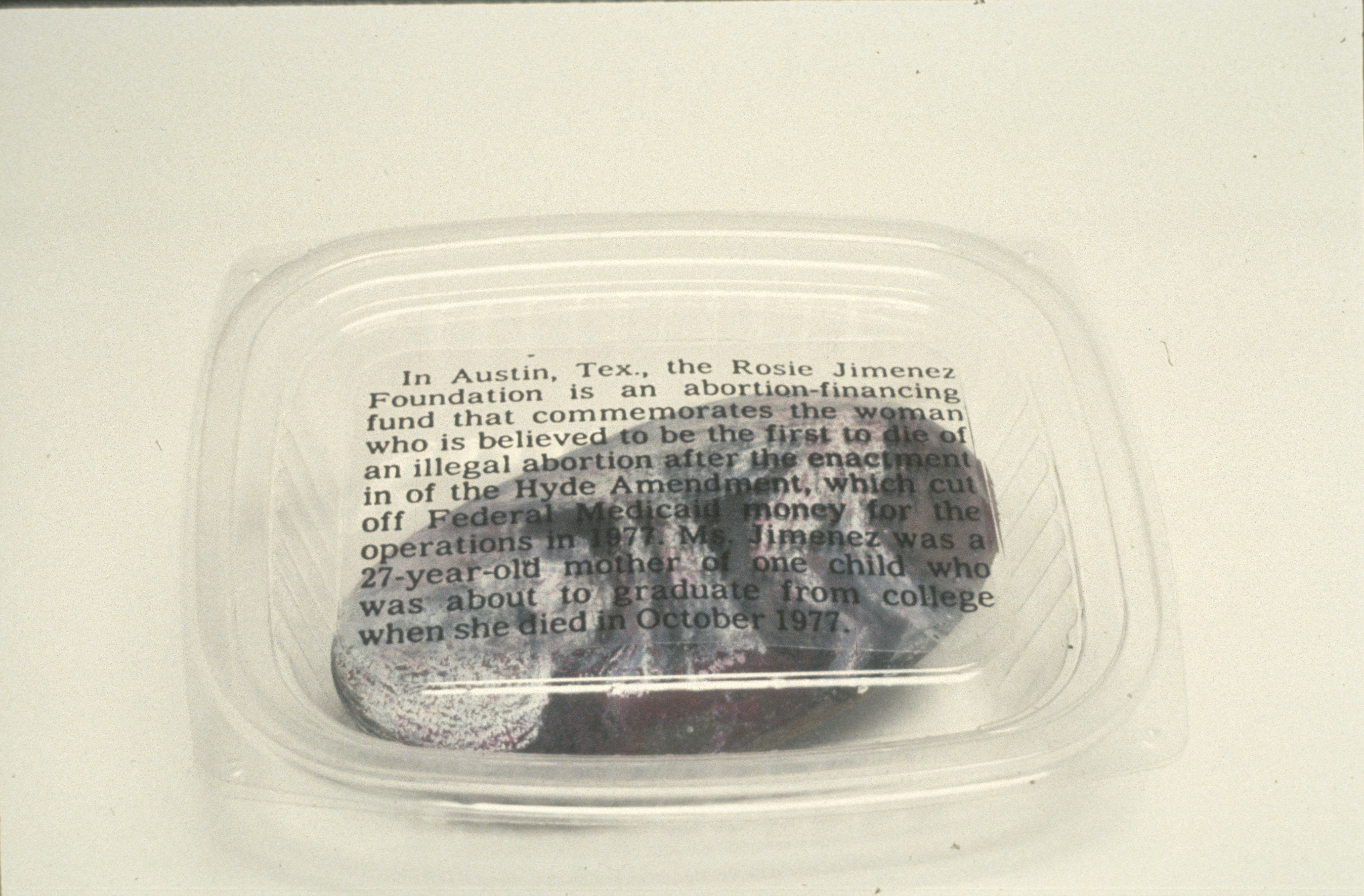
1.9
Results of Hyde Amendment
A painted stone is sealed in a clear rectangular plastic food container — the transparency deliberate, the domesticity pointed. Text printed across the lid recounts the story of Rosie Jimenez: the first woman believed to have died from an illegal abortion after the Hyde Amendment cut federal Medicaid funding in 1977. She was 27, a mother of one, about to graduate college. The ordinary container holds an extraordinary weight of policy and consequence.
Painted river stone, plastic food container, text · c. 1993
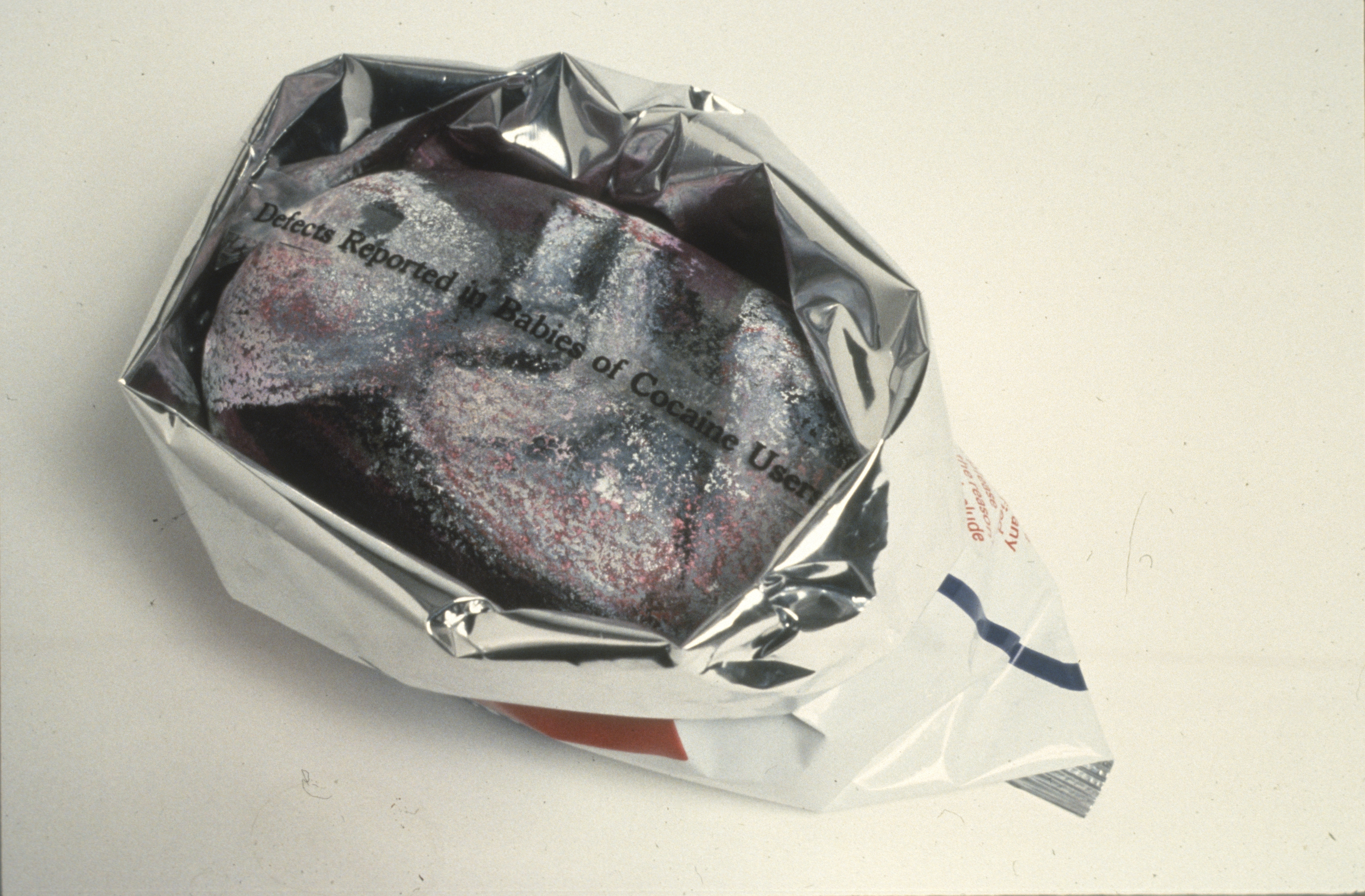
1.10
Cocaine
A variation on the mylar bag series: the same fetal stone — "Defects Reported in Babies of Cocaine Users" — is photographed from a lower, more confrontational angle. The bag is open now, crumpled, discarded-looking. The difference in framing shifts the work from specimen to crime scene, from hospital to street.
Painted river stone, mylar bag, printed text · c. 1989
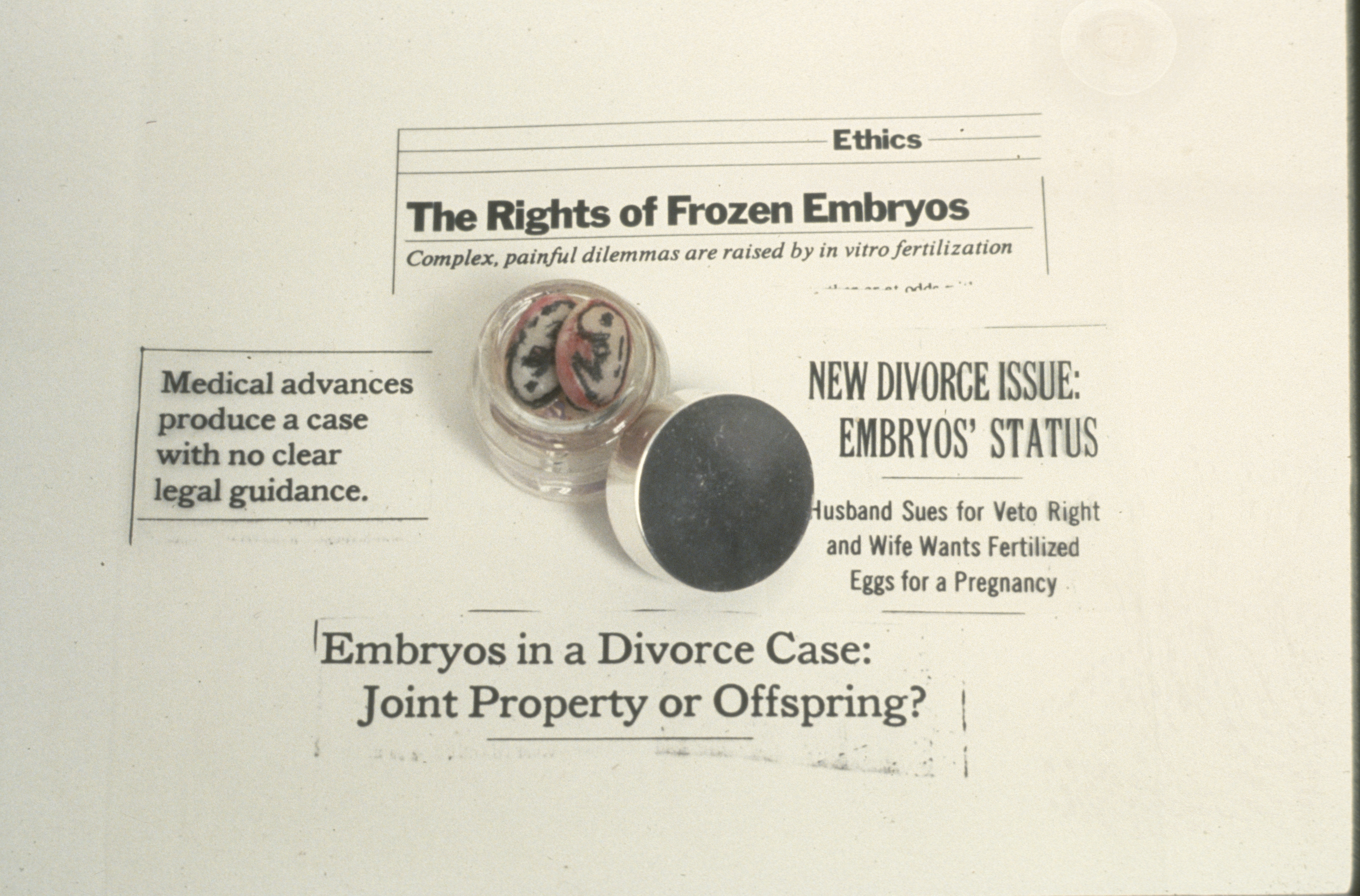
1.11
Joint Property
Two tiny embryo-painted stones float inside a glass specimen jar — its lid a plain gray disc — atop a white background covered in inverted headlines: "Embryos in a Divorce Case: Joint Property or Offspring?" "New Divorce Issue: Embryos' Status." "The Rights of Frozen Embryos." "Medical advances produce a case with no clear legal guidance." Darmstadt prints the text upside down, as if the legal system itself has been overturned by the questions it cannot answer.
Painted river stones, glass specimen jar, inverted newsprint · c. 1993
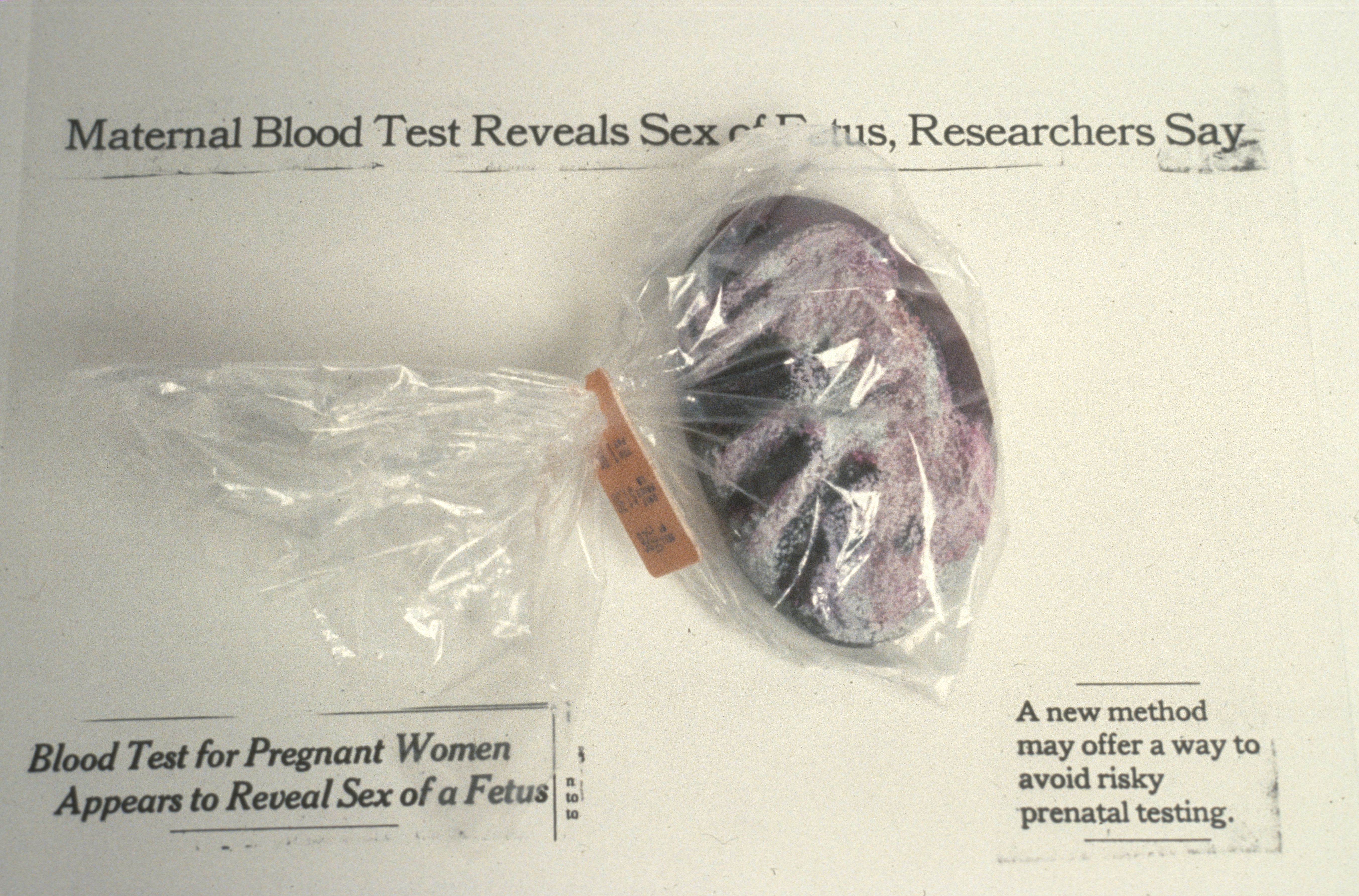
1.12
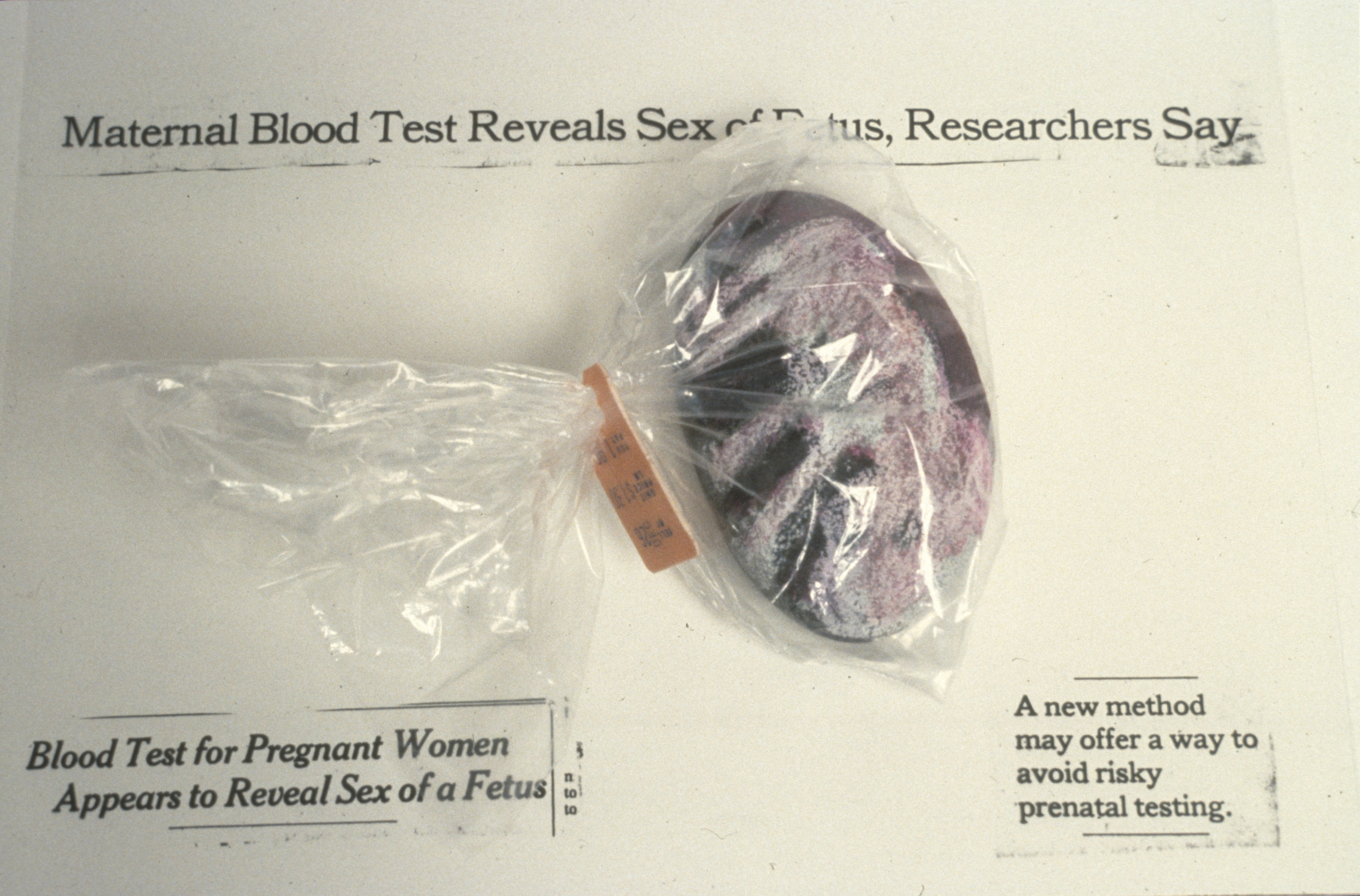
Blood Test for Sex
A large amethyst-toned fetal stone is sealed in a clear plastic bag with an orange pharmacy label. Behind it: "Maternal Blood Test Reveals Sex of Fetus, Researchers Say." Below: "Blood Test for Pregnant Women Appears to Reveal Sex of a Fetus." At right: "A new method may offer a way to avoid risky prenatal testing." The rock is tagged and bagged — already a patient, already a datum.
Painted river stone, plastic specimen bag, pharmacy label, newsprint · c. 1994
1.13
Choose the Sex
A second view of the blood-test stone, now cropped more tightly, the rock more frontal, its painted fetal form more legible. The same headlines surround it, the same pharmacy tag binds it. What shifts is perspective: this stone asks not what science reveals but what parents will do with that revelation. Choice and selection hover at the edge of the visible.
Painted river stone, plastic specimen bag, pharmacy label, newsprint · c. 1994
1.14
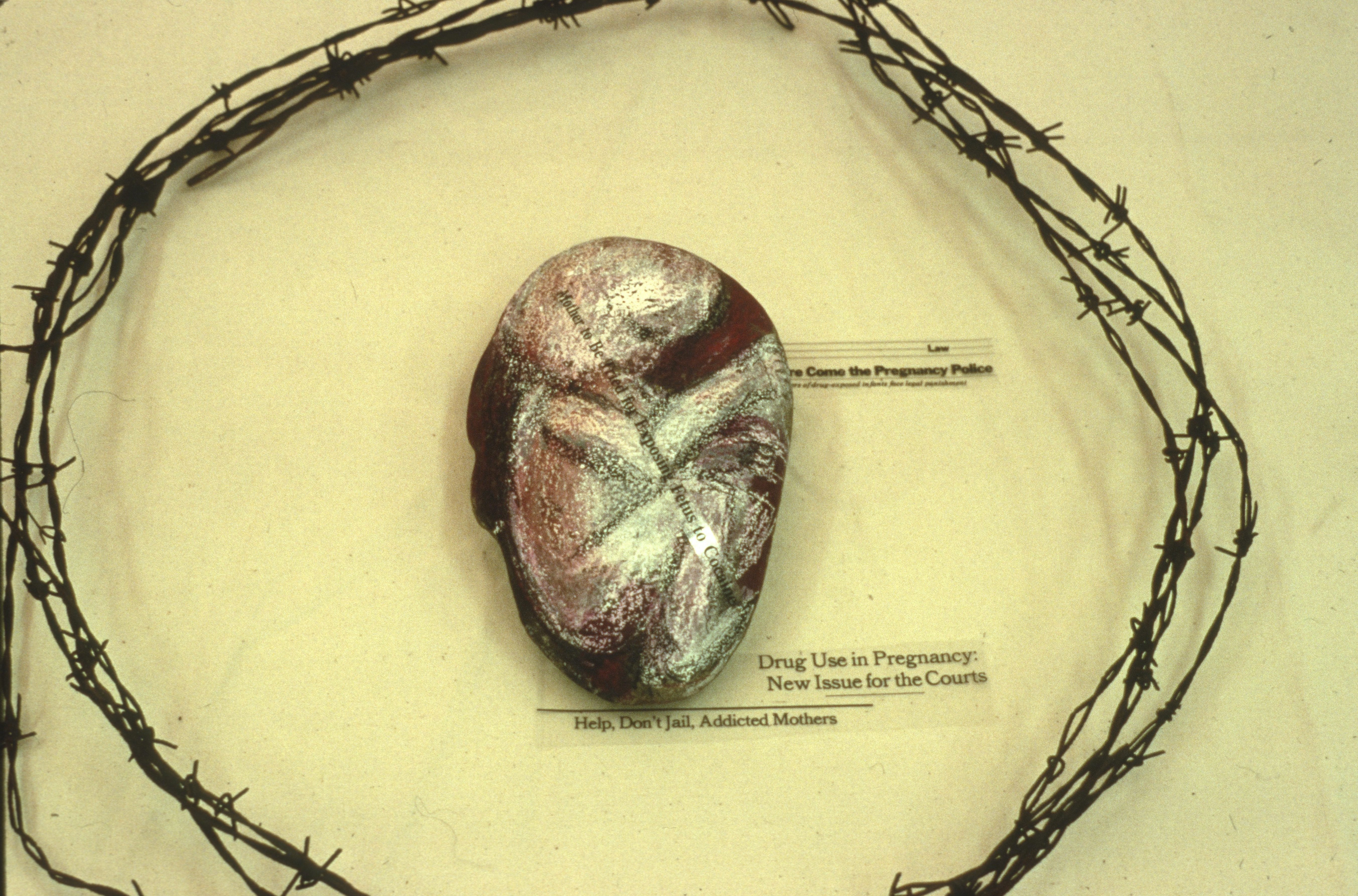
Encircled in Barb Wire
A rose-and-silver painted fetal stone rests at the center of a circle of barbed wire on a soft yellow ground. Headlines underneath speak to drug use in pregnancy, the "pregnancy police," legal punishment for addicted mothers. The barbed wire halo is simultaneously a crown, a border, a cage — the fetus surrounded by the apparatus of the carceral state.
Painted river stone, barbed wire, newsprint on paper ground · c. 1994
1.15
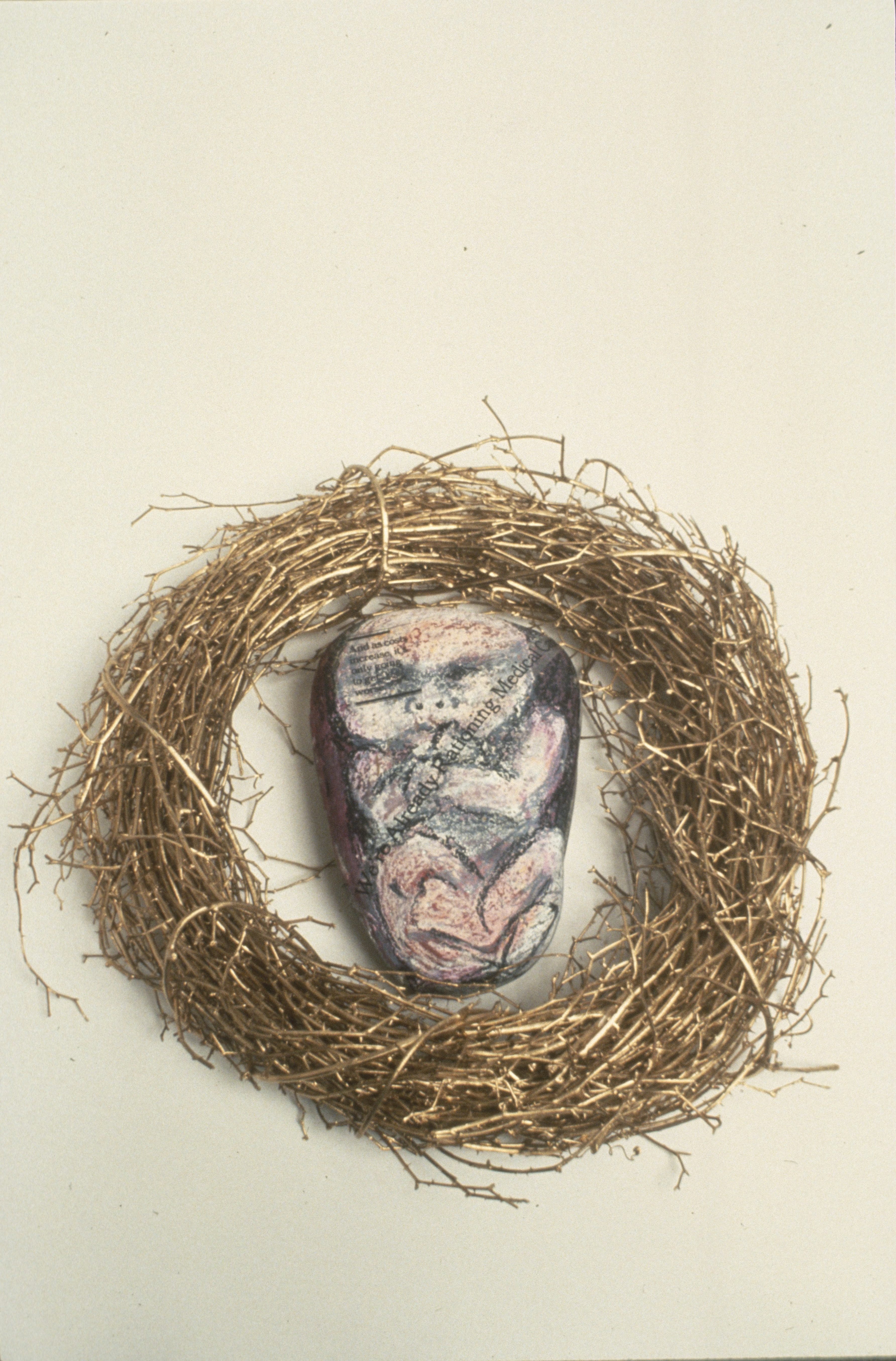
A Crown of Thorns
A painted fetal stone, tender pink and gray, rests within a woven nest of gilded twigs. Unlike the barbed wire of 1.14, this encirclement is protective — a nursery cradle, a Madonna's bower — yet the newsprint text embedded in the stone speaks of medical miracles and Medicaid. The nest is made of gold, but the problem is real. Warmth and abandonment in the same gesture.
Painted river stone, natural twig nest, newsprint · c. 1995
1.16
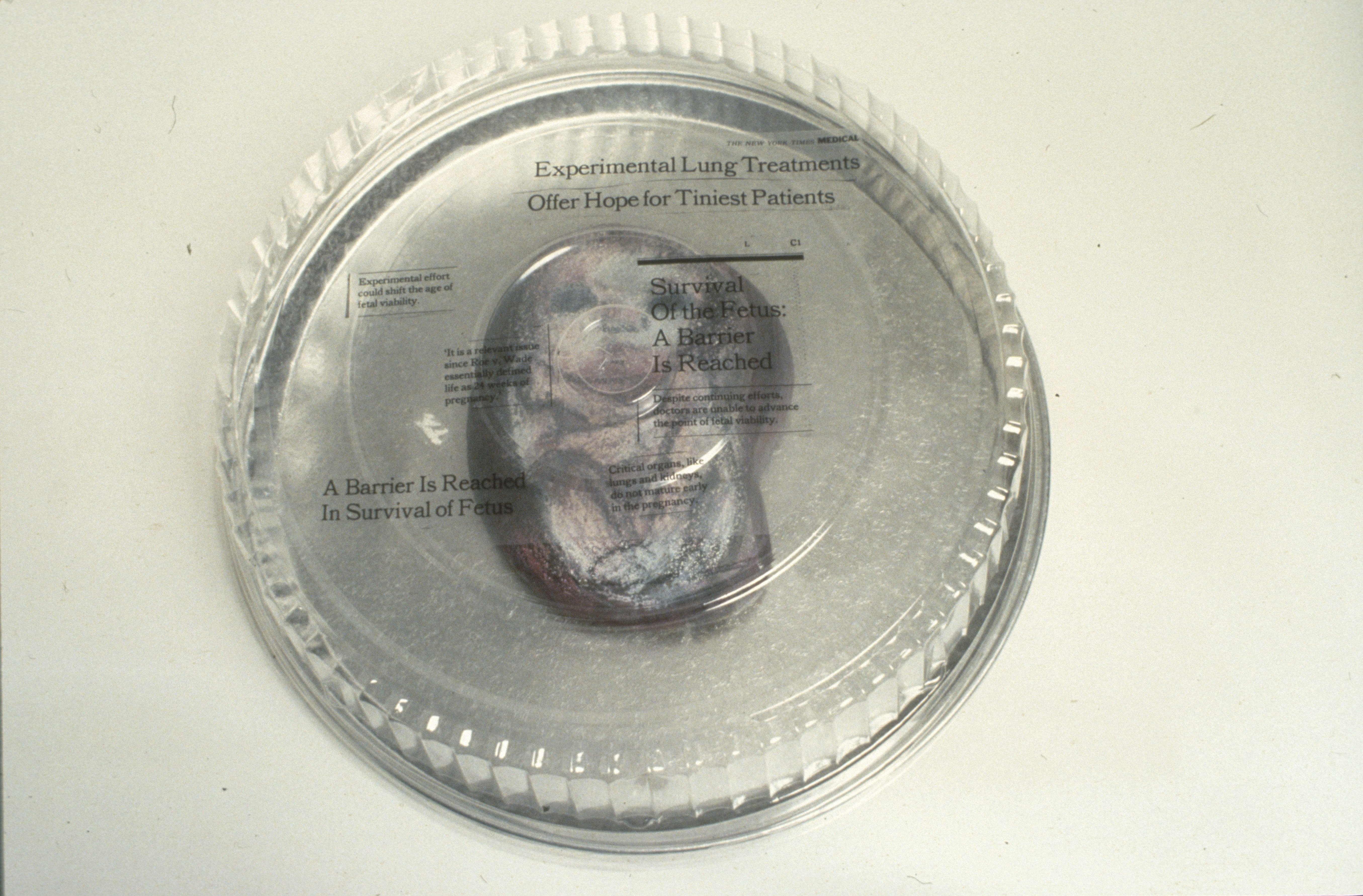
Survival of the Fetus: A Barrier Is Reached
A fetal stone — rendered in lavender and gray — is pressed beneath a circular plastic food-service lid, foil base below. Text fills the translucent dome: "Survival of the Fetus: A Barrier Is Reached." "Experimental Lung Treatments Offer Hope for Tiniest Patients." "It is a relevant issue since Roe v. Wade essentially defined life at 24 weeks of pregnancy." The stone is sealed, displayed, preserved — viability as spectacle.
Painted river stone, plastic dome lid, foil base, newsprint · c. 1996
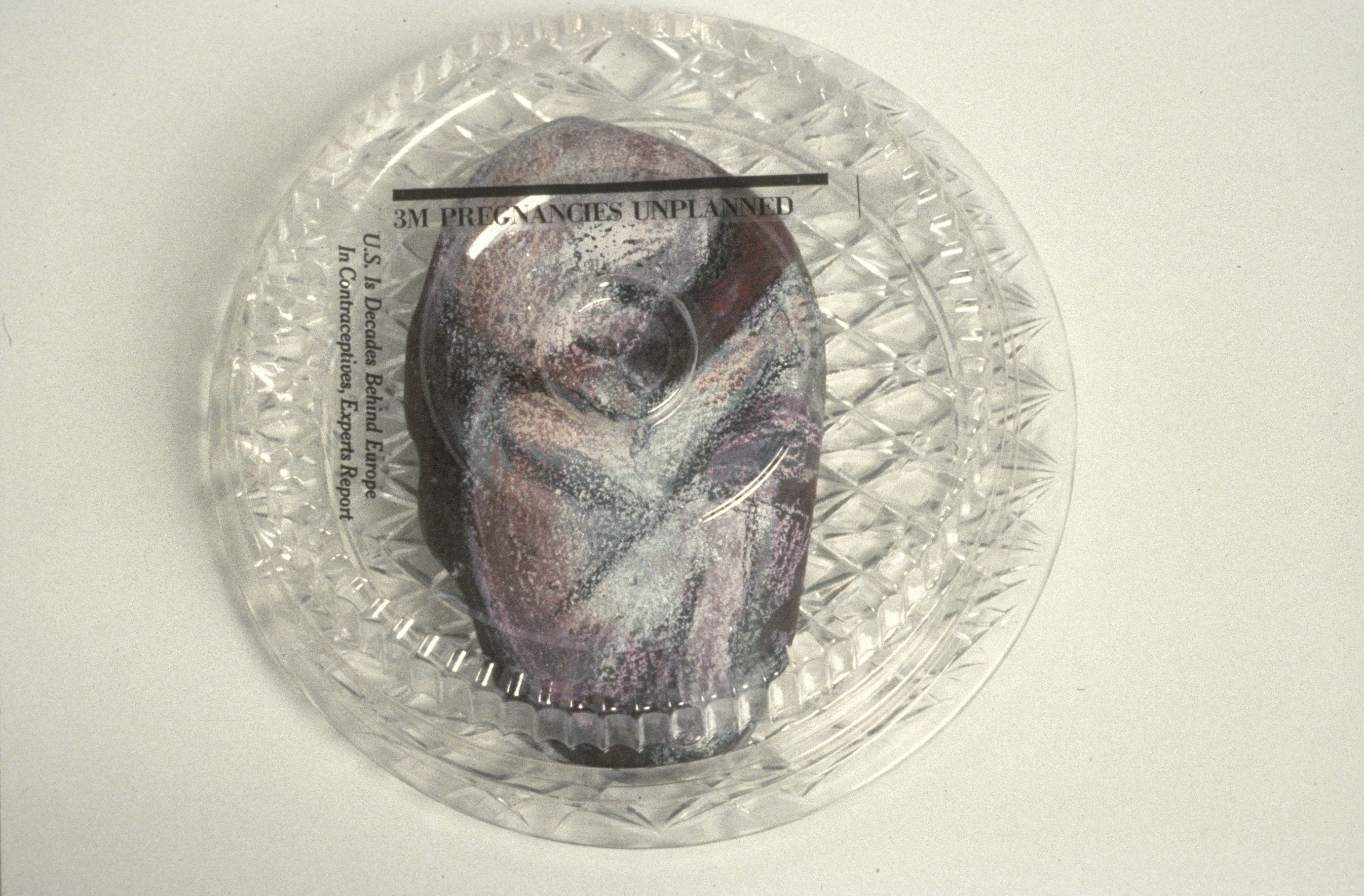
1.17
Three Million Pregnancies Unplanned
A richly painted mauve and silver fetal stone sits on a crystal-cut glass plate, the decorative domestic china of American households. A bold newspaper banner reads: "3M PREGNANCIES UNPLANNED." Alongside: "U.S. Is Decades Behind Europe in Contraceptives, Experts Report." The fine glass and the stark statistic are irreconcilable — the crisis set at the dining table, the problem too large for any table to hold.
Painted river stone, cut crystal plate, newsprint · c. 1997
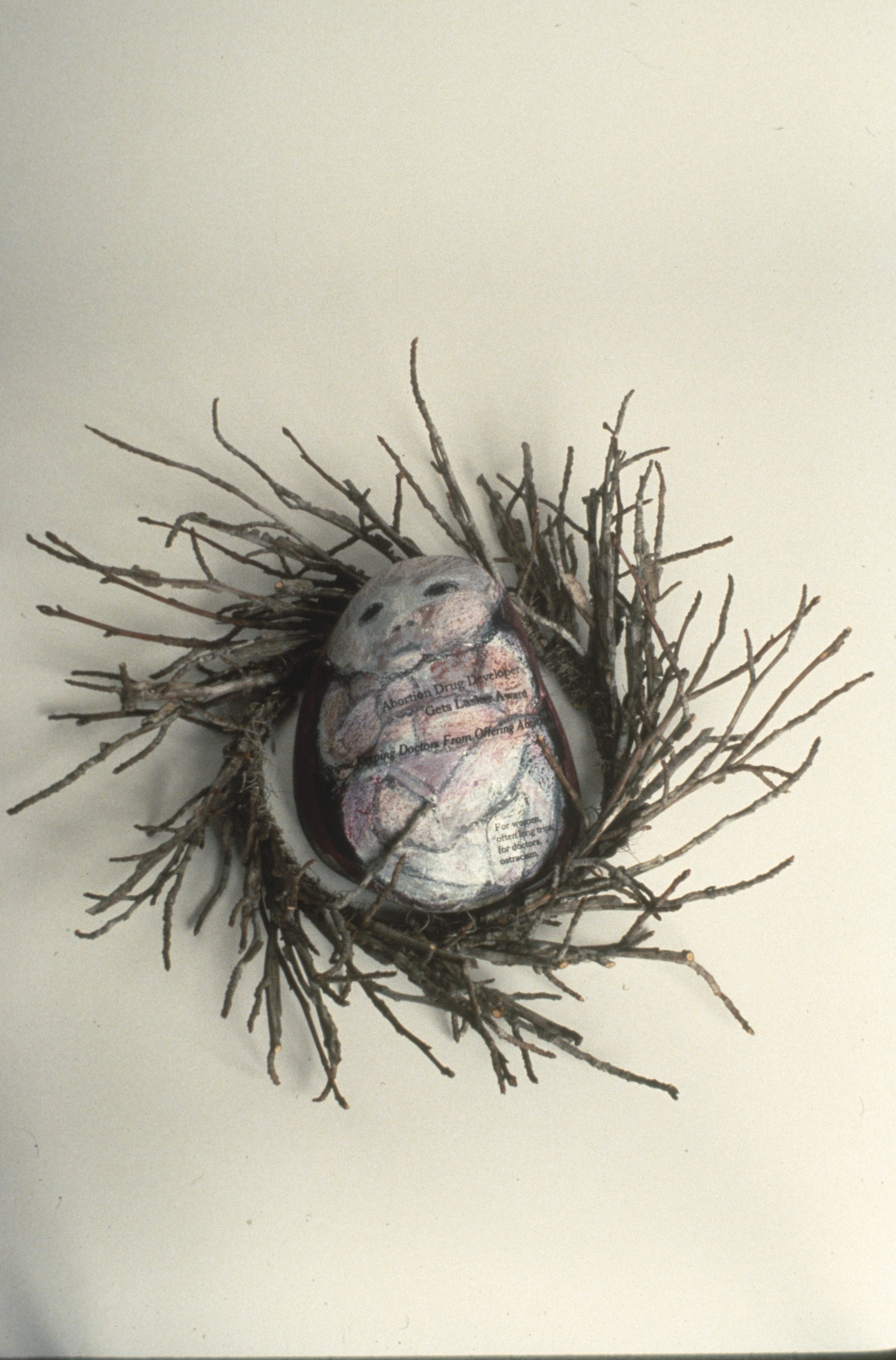
1.18
Nest
A pale, infant-faced fetal stone rests within a nest of dark, winter-bare twigs — organic and spare, unlike the gilded twig nest of 1.15. The stone carries text about an abortion drug developer receiving a Lasker Award, and about physicians facing ostracism for providing abortions: "For women, often long trials; for doctors, ostracism." Two forms of abandonment, one natural vessel.
Painted river stone, natural twig nest, newsprint · c. 1998
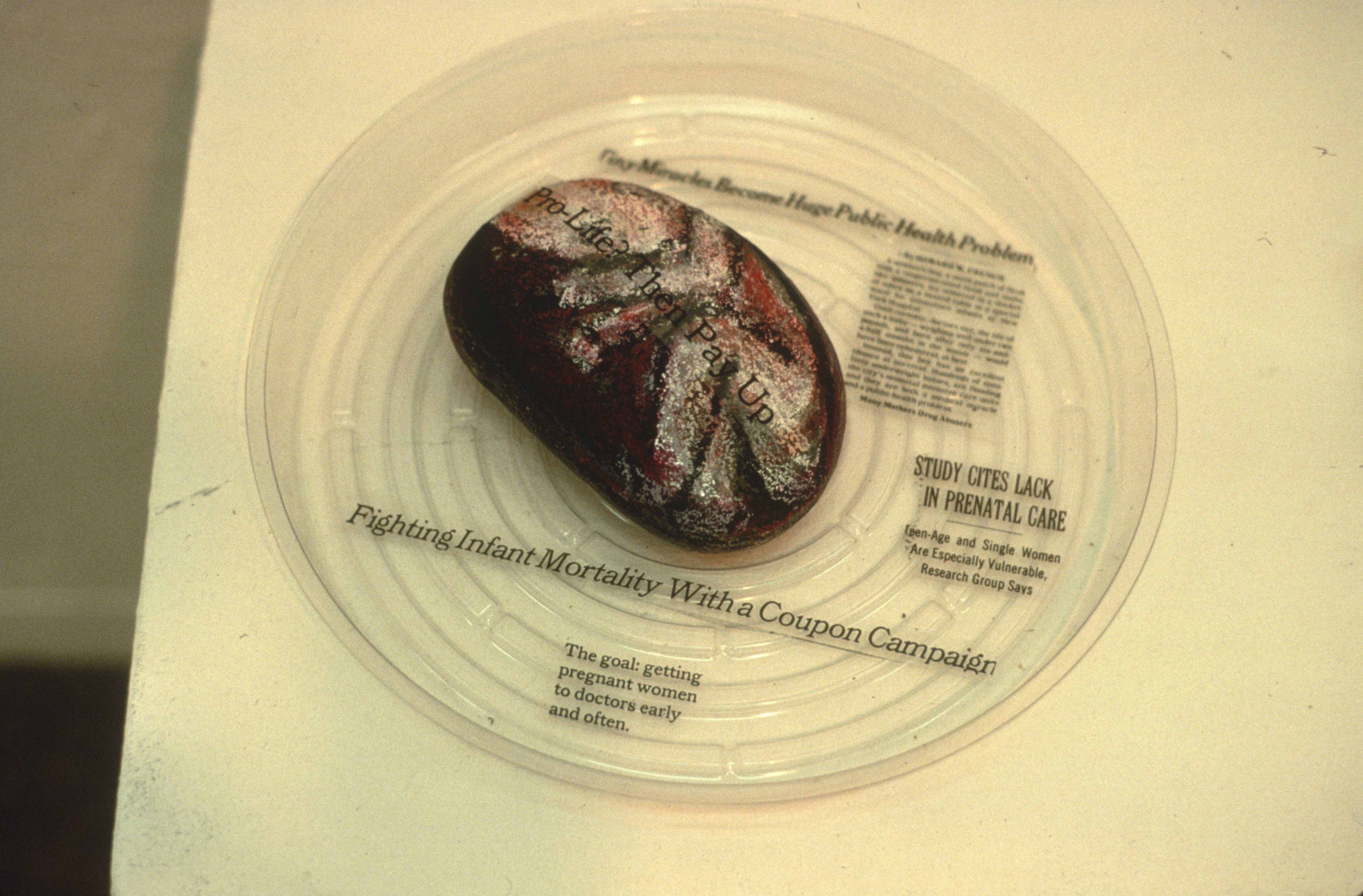
1.19
Economics of Reproductive Technology
The same plastic disc tray from 1.7 reappears, with a second view of its loaded surface — the coupon campaign, the infant mortality study — but here the angle has shifted to reveal more of the stone's painted surface. The economics of the body: public health campaigns that rely on coupons, studies that indict single mothers and teenagers. "The goal: getting pregnant women to doctors early and often." Access framed as marketing.
Painted river stone, plastic display tray, newsprint · c. 1999
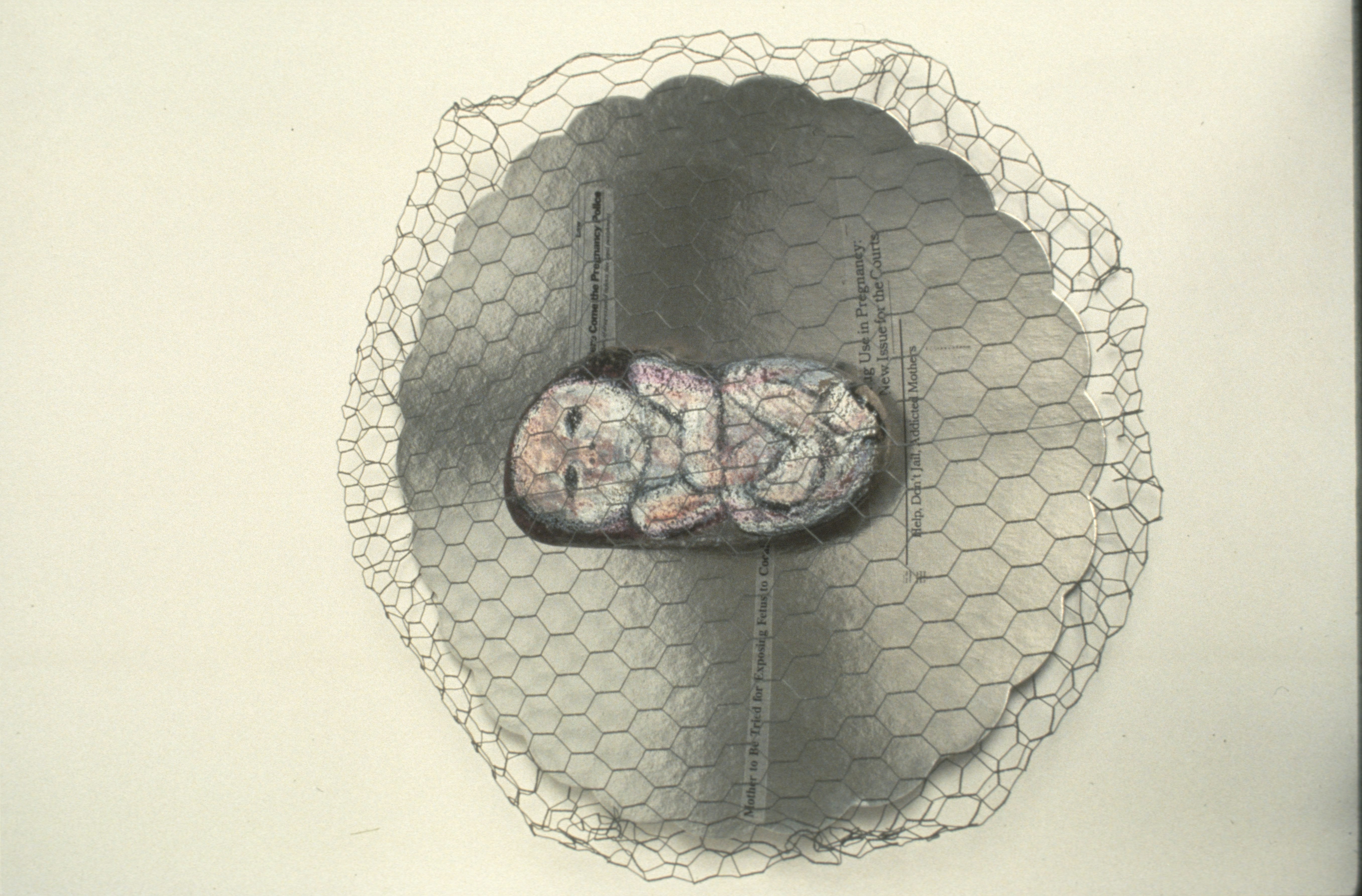
1.20
Pregnancy Police
A pale infant-stone rests atop a circular foil base, covered by a dome of plastic hexagonal netting — visually distinct from the more industrial materials used elsewhere. Headlines below: "Here Come the Pregnancy Police," "Mother to Be Tried for Exposing Fetus to Cocaine," "Drug Use in Pregnancy: New Issue for the Courts," "Help, Don't Jail, Addicted Mothers." The plastic dome turns the figure of the fetus into a specimen under surveillance — protected and imprisoned simultaneously.
Painted river stone, foil base, plastic netting dome, newsprint · c. 2000
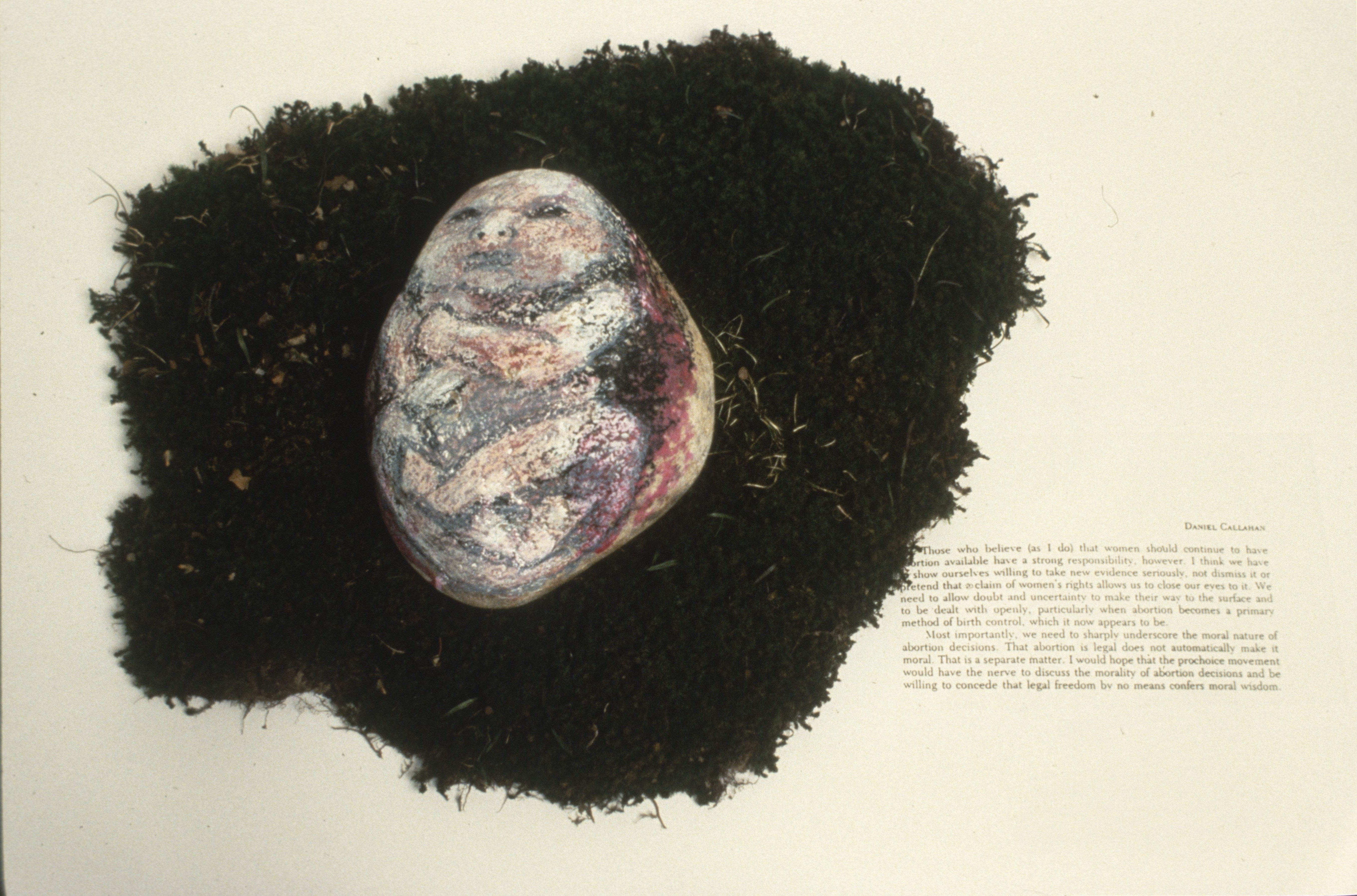
1.21
Back to Nature
A painted stone rests on a mound of dark earth and moss — the most elemental setting in the series. Around it, a text by Daniel Callahan argues that legal freedom does not confer moral wisdom, and that the pro-choice movement must engage honestly with the morality of abortion decisions. The stone returned to the ground, to the organic, as if Darmstadt is asking: before law, before medicine, what does the earth say?
Painted river stone, earth, moss, printed text · c. 2001
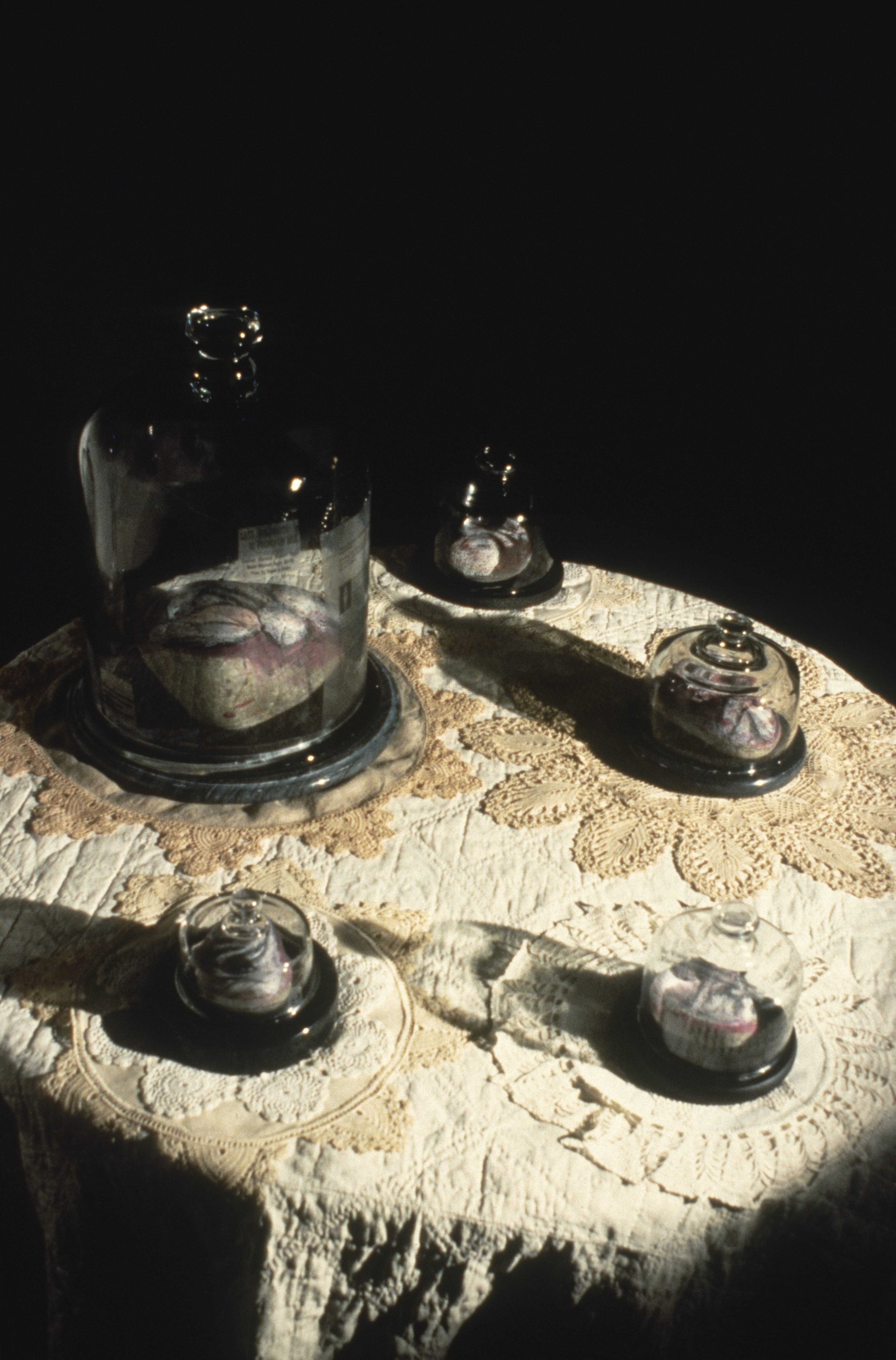
1.22
Glass Bells
Five fetal stones are displayed under glass bell jars of varying sizes on a round table draped in an antique lace cloth — the domestic reliquary, the Victorian parlor transformed into a cabinet of curiosities about the body. Each jar a display case, each stone a specimen preserved and hallowed simultaneously. The lace suggests inheritance, tradition, the fragile domestic order within which reproductive life has always been contested.
Painted river stones, glass bell jars, antique lace tablecloth · c. 2002
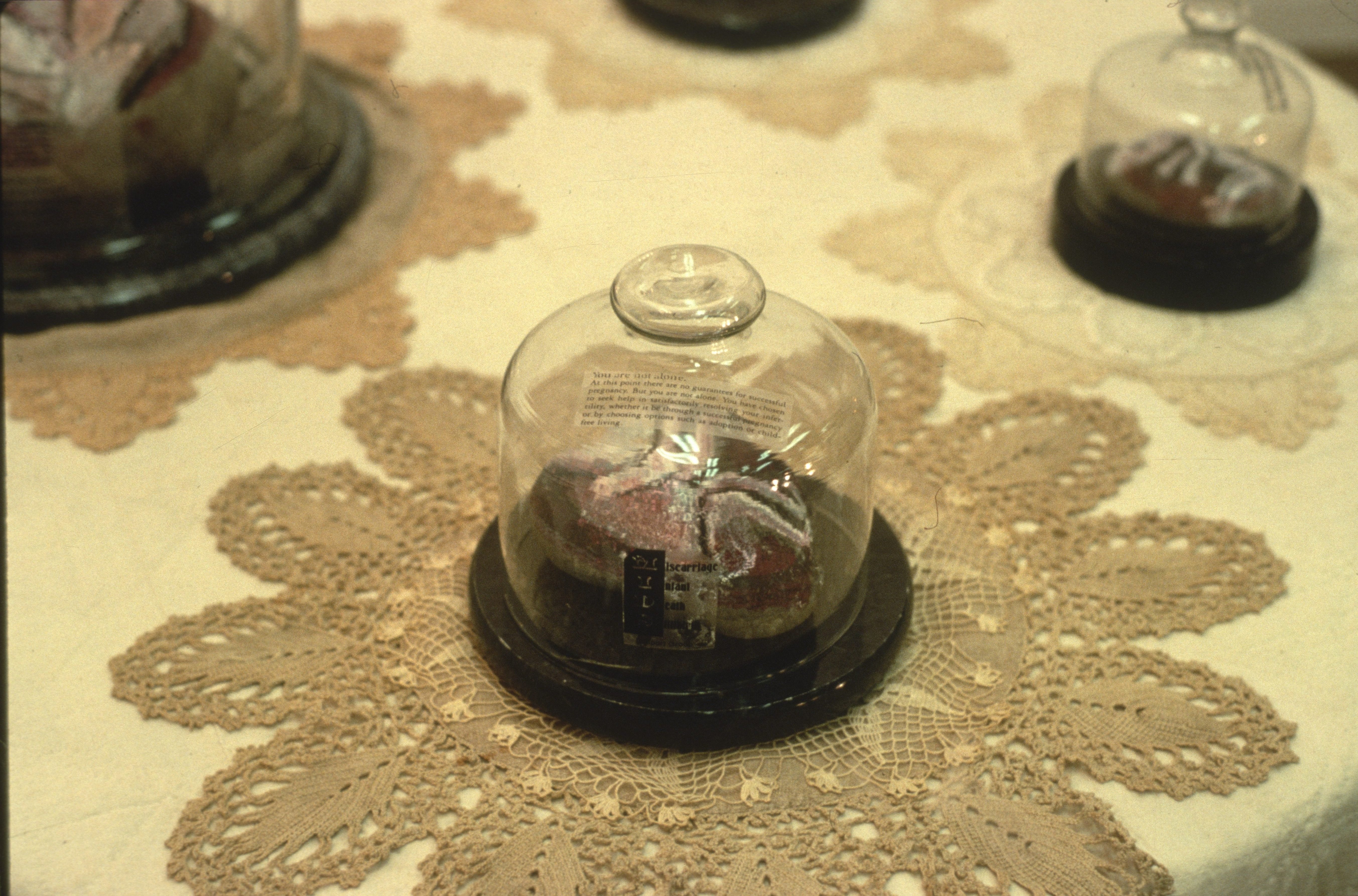
1.23
Bell Jar Detail
A close view of one bell jar from the installation: a single painted stone under a glass dome on a black lacquered base, set on crocheted lace. Text visible through the glass reads: "You are not alone... At this point there are no guarantees for a successful pregnancy." A small label near the base reads "Miscarriage." The intimacy of scale makes the work almost unbearable — this private grief placed under glass for display.
Painted river stone, glass bell jar, lacquered base, lace, text · c. 2002
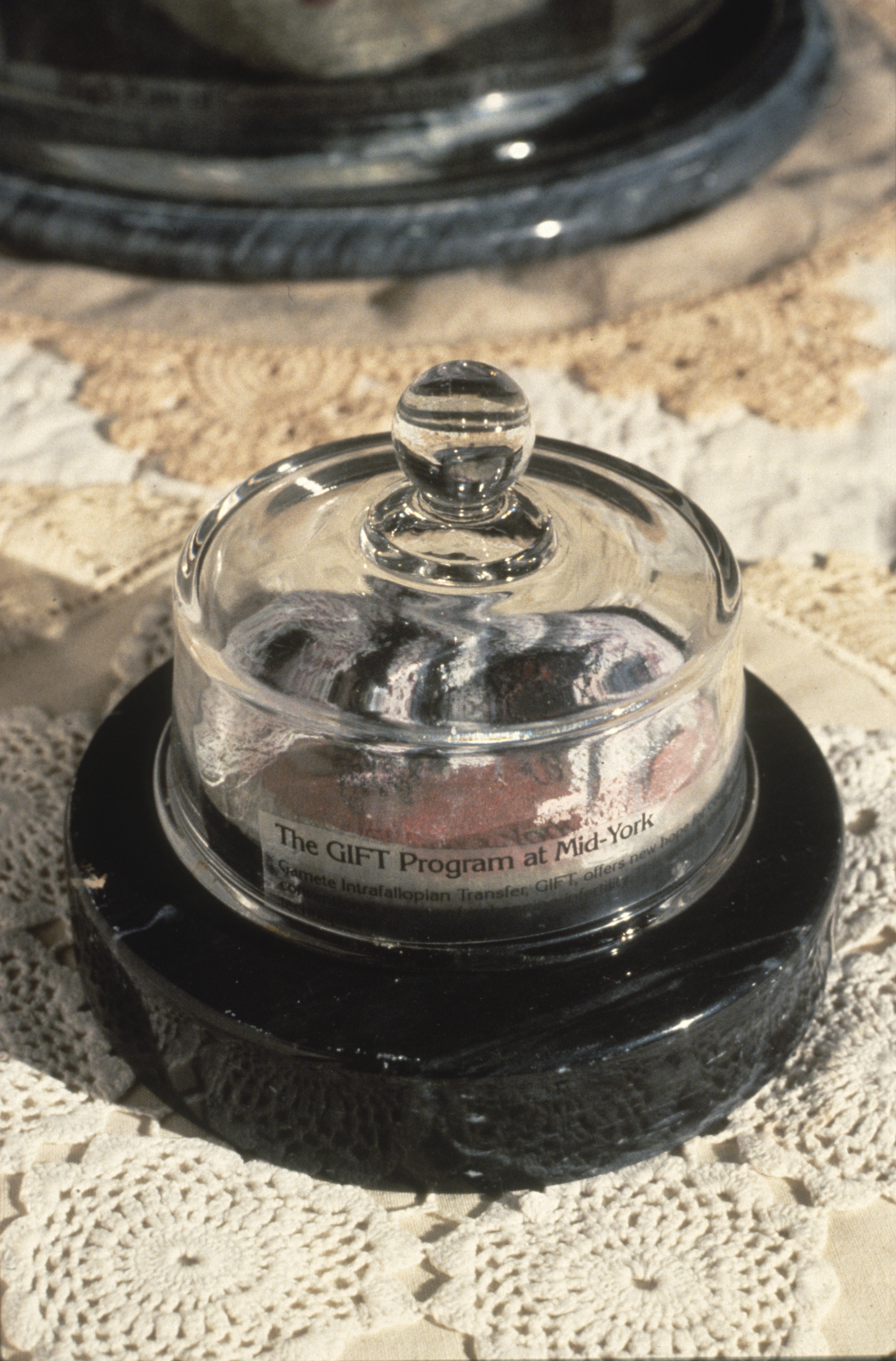
1.24
The GIFT Program
The final rock: a stone pressed beneath a shallow glass cloche with a large decorative ball finial, set on a thick black lacquered disc, on the same lace. Visible through the glass: "The GIFT Program at Mid-York — Gamete Intrafallopian Transfer." Technology and the body's desire refracted through Victorian glass and modern fertility branding. The word "gift" carries its full double weight.
Painted river stone, glass cloche, lacquered base, lace, text · c. 2003
Section Two
Gourds:
Voices of the Body
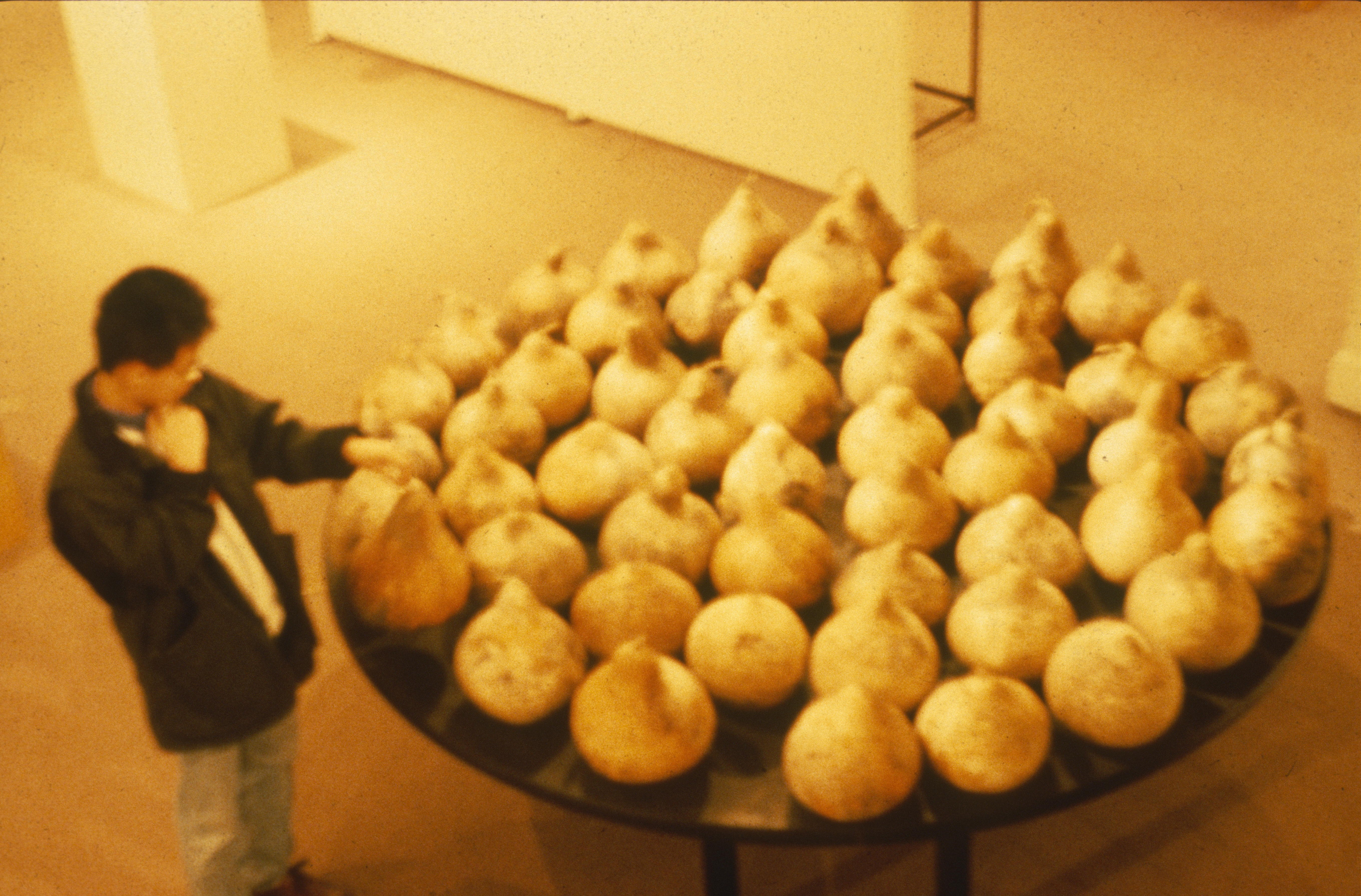
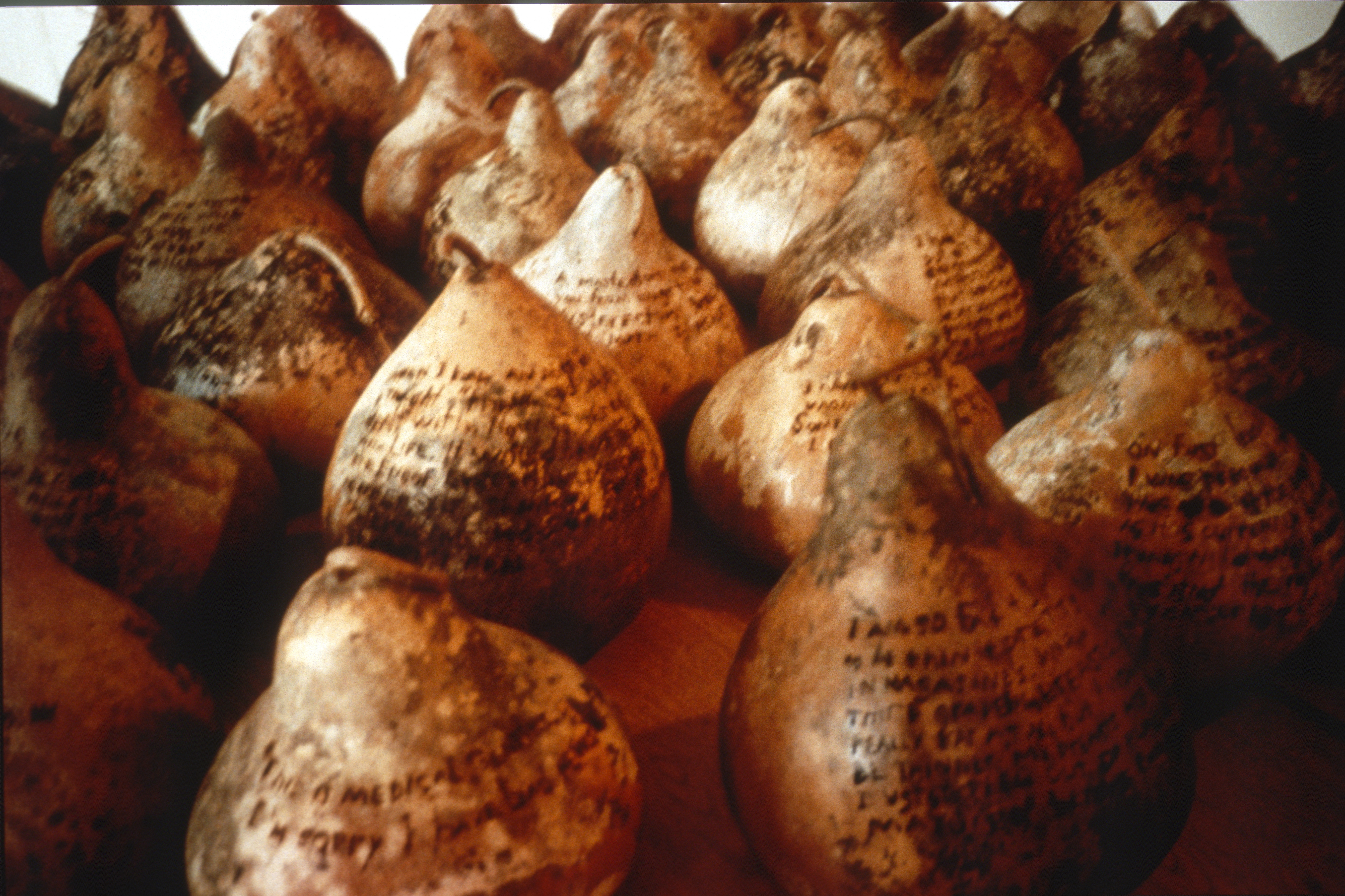
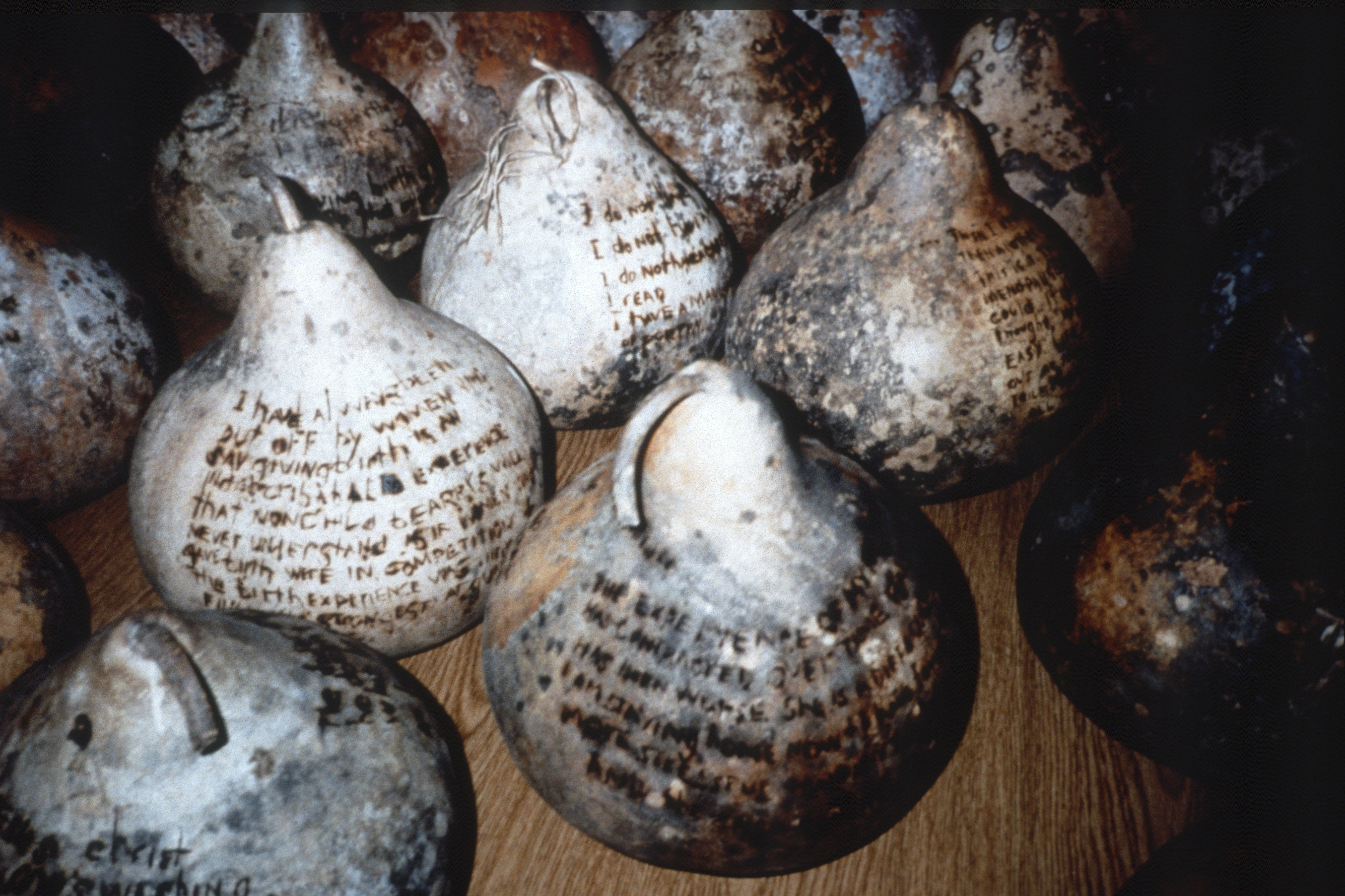
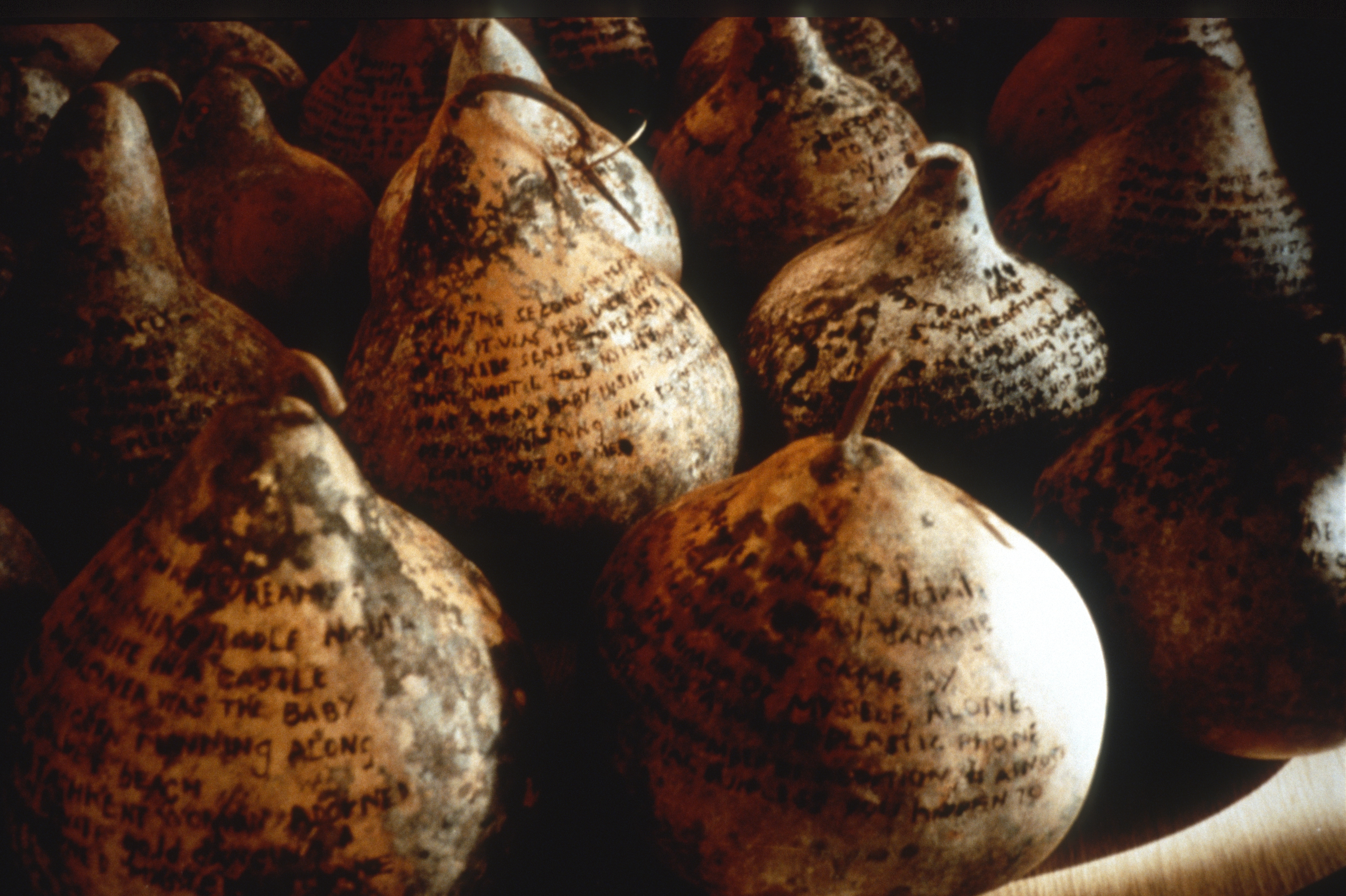
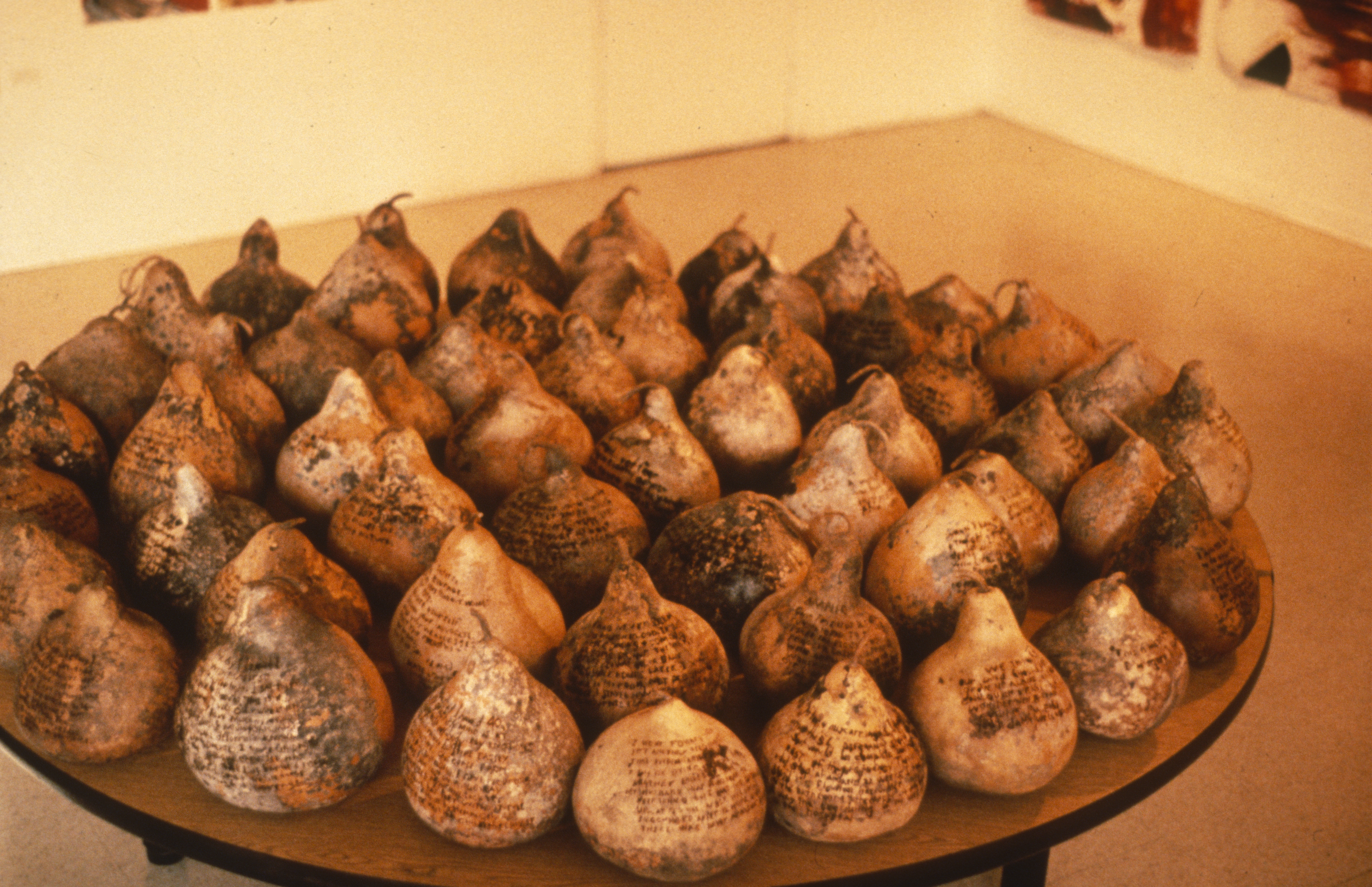
Darmstadt collected the personal testimonies of sixty-nine women about their experiences with breast cancer and wrote them, in her own hand, on the surfaces of dried gourds. The gourd — pregnant in form, hollow within, organic — became the vessel for stories the culture had declared inappropriate, embarrassing, too intimate for public discourse. In a table installation of dozens of gourds, the weight of testimony becomes architectural.
c. 1990–1998 / Gourd, handwritten text
2.1
The Table Installation
Seen from above: dozens of pale, smooth gourds crowd a round black table. A figure stands at the edge, reaching in — the viewer entering a field of bodies, each one sealed and particular. At this scale the gourds overwhelm individuality; they become a population, a statistic made flesh and gourd.
Installation view — dried gourds, round table · c. 1993
2.2
Testimony
Close-up: the gourds are darkened with age and handling, their surfaces dense with handwritten text. "When I have no more life / I might as well not be here at all — I'm a human being." Another reads: "I need to be sexy / I need to feel good about myself / I need to be here." Darmstadt's handwriting — urgent, leaning, personal — turns each gourd into a confessional object.
Dried gourds, handwritten text · c. 1993
2.3
I Do Not Want
In a cluster of weathered gray-white gourds, one reads: "I have always been put off by women / an day giving that is an / inescapable experience / that nonchild bearers / never understand, as if having / children rates in competition / the birth experience as the strongest." Another says simply: "I do not want / I do not want / I do not want / I read / I have a mammogram." Refusal as self-knowledge.
Dried gourds, handwritten text · c. 1993
2.4
In the Second Trimester
A warmer group of gourds catches oblique light; the handwriting is more legible here. "In the second trimester / it was beginning to make sense to me / until I was told my dead baby inside / the baby thing was coming out of me." Another tells of waking at 2am, "alone / except for my plastic phone / can I happen to talk to someone." The night terrors of illness and loss inscribed in a curved pastoral form.
Dried gourds, handwritten text · c. 1993
2.5
Dear Sisters
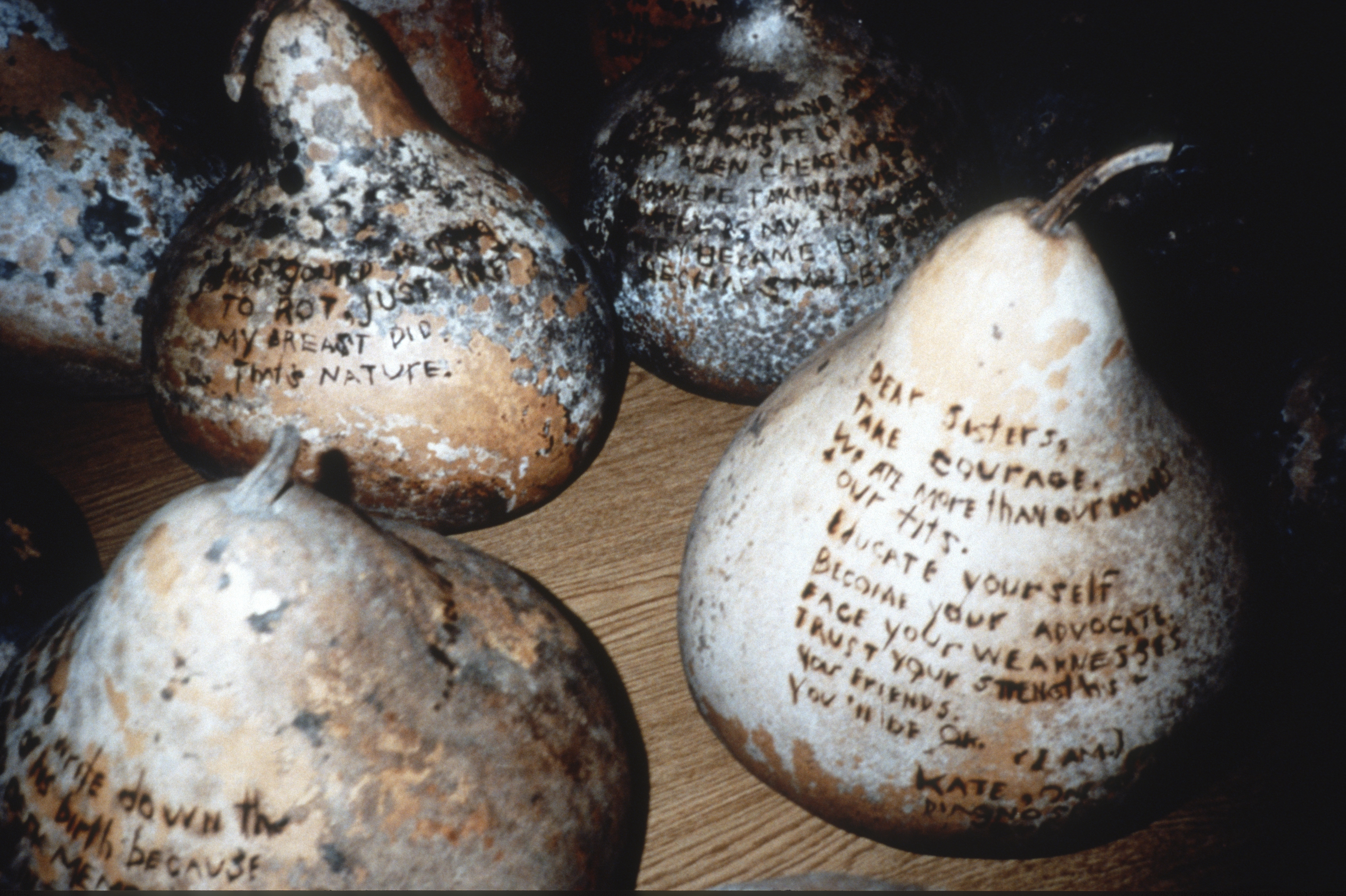
A large smooth gourd carries a message of solidarity: "Dear Sisters, Take courage. / We are more than our bodies. / Educate yourself. / Become your advocate. / Face your weaknesses. / Trust your strengths. / Your friends. / You will be ok. (I am.)" — signed Kate. Alongside it, a darker gourd reads: "I'm going to rot, just like / my breast did. / That's nature." Two registers of survival.
Dried gourds, handwritten text · c. 1994
2.6
The Full Installation
A wide gallery view: the gourds now cover the entire table in a dense field, the writing visible on every surface. On the wall behind, additional works from the rock and fence series are visible. The gourds — now aged darker than in 2.1 — form a community of voices in the room, a collective testimony impossible to silence.
Installation view — dried gourds with handwritten text, round table · c. 1998
Section Three
Fence:
The Gender Line
Fence is Darmstadt's most spatially ambitious work — an immersive installation in which the gallery itself becomes a gendered space. Years of New York Times pages, laminated and suspended from floor to ceiling, form walls through which viewers must navigate. An electric fence runs the perimeter. Birch trees, ladders, and warning signs complete a landscape of simultaneous access and exclusion. The work asks: what does it cost to cross?
c. 1992–2000 / Installation: laminated newspaper pages, electric fence wire, birch trees, ladders, mixed media
3.1
Women Only / Men Only
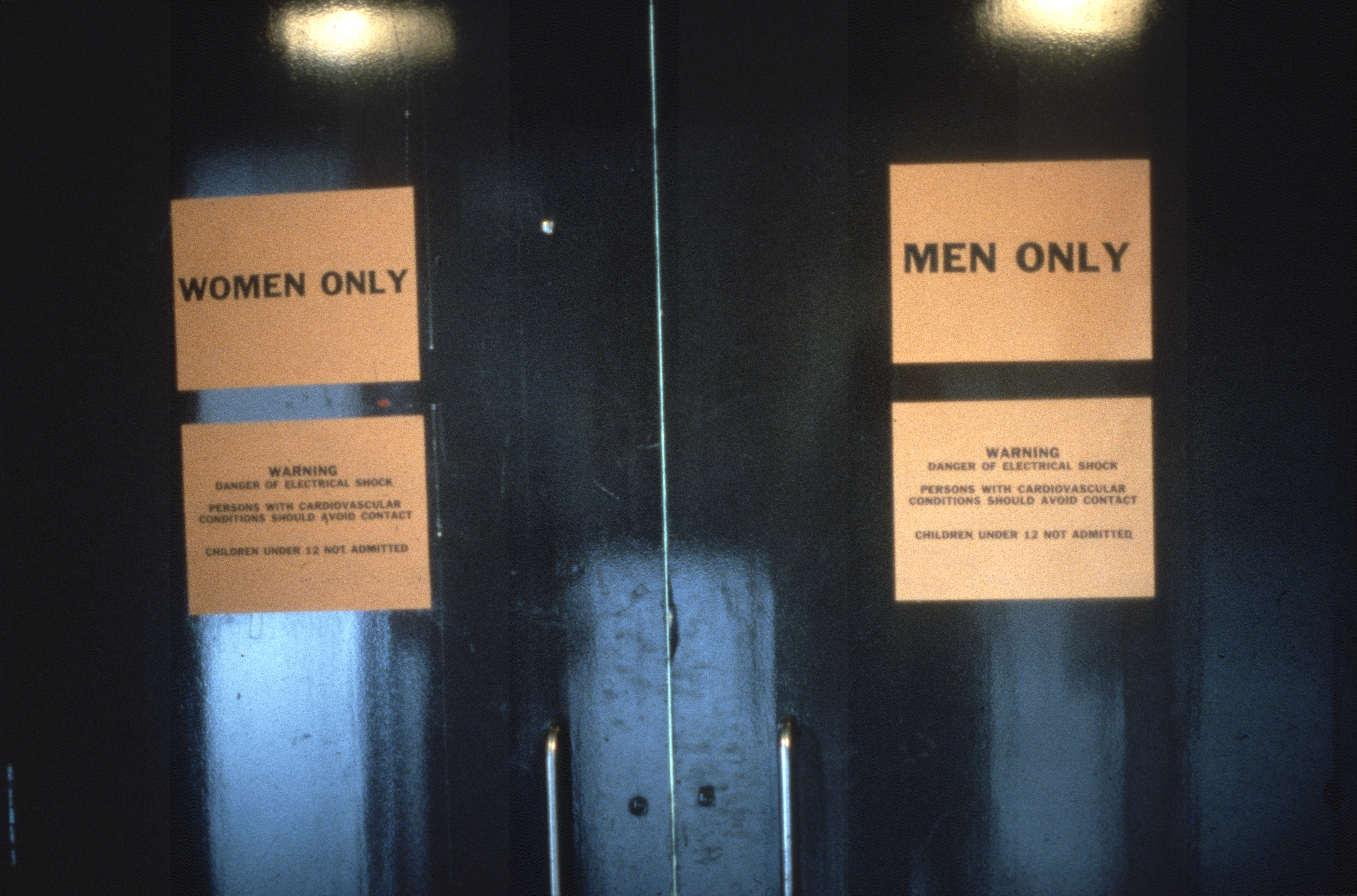
Two black metal doors, each bearing an amber warning placard: "Women Only" and "Men Only" respectively, with an electric shock warning below each. The binary is enforced by architecture itself, by law, by the jolt of current. The doors are closed. The artist refuses to open them.
Metal doors, printed placards · c. 1992
3.2
Survey Cards
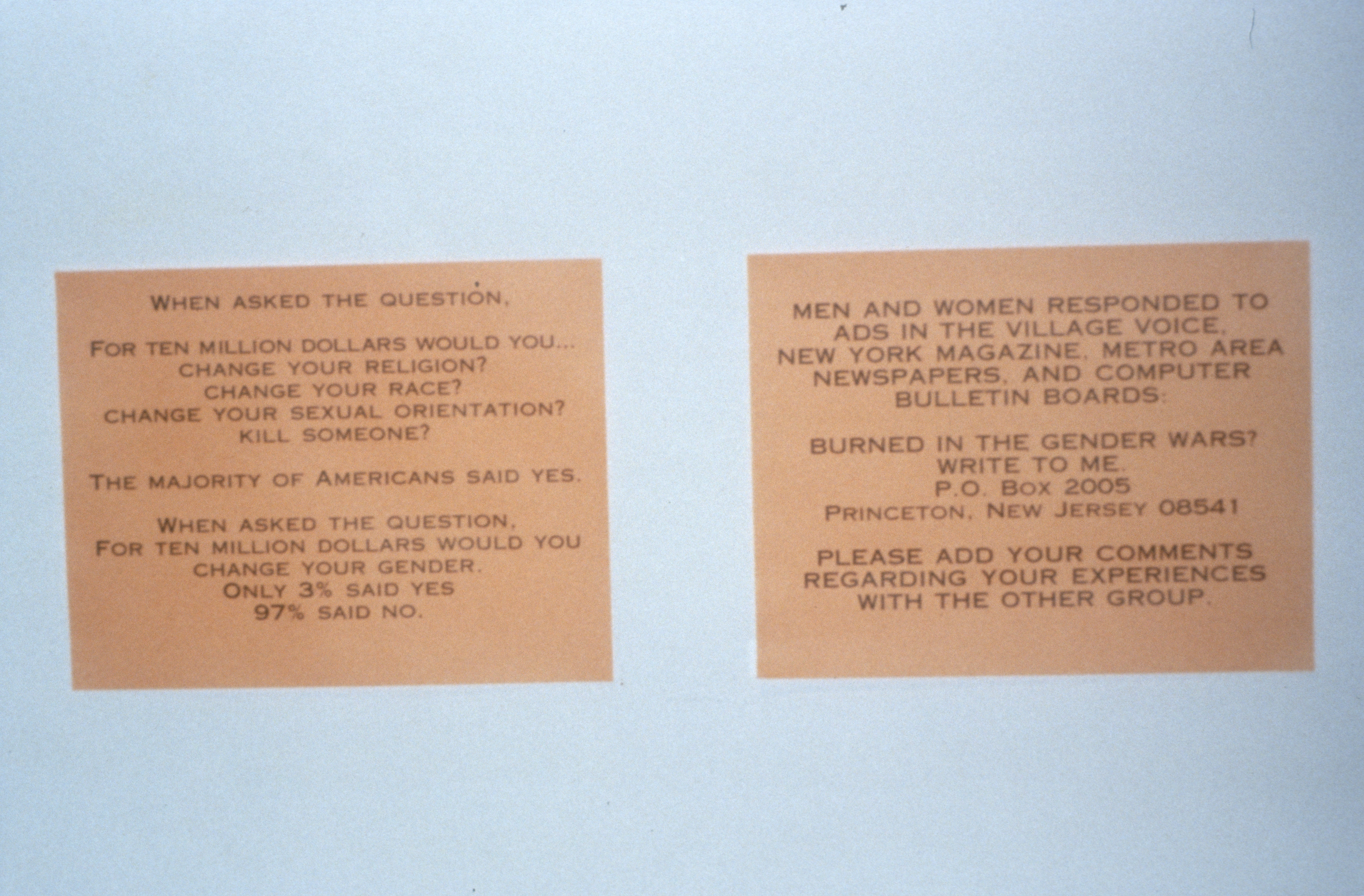
Two amber cards displayed side by side, their text reversed as if seen in a mirror. One poses a survey: "When asked the question — For ten million dollars would you change your sexual orientation? Change your race? Change your religion? Change your gender? — the majority of Americans said yes. Only 3% said no." The second invites readers to write in their own gender-war experiences and mail them to Darmstadt in Princeton, NJ. Art as social research.
Printed cards, mixed media · c. 1992

3.3
The Archive
Stacked bales of bundled newspapers — years of newsprint, tied with twine — lean against a white wall. This is the raw material of the installation: every story about gender, reproduction, law, and the body that Darmstadt collected over years of reading. The stacks suggest abundance and weight, the impossibility of keeping up with the accumulation of public discourse about private bodies.
Newsprint, twine · c. 1993
3.4
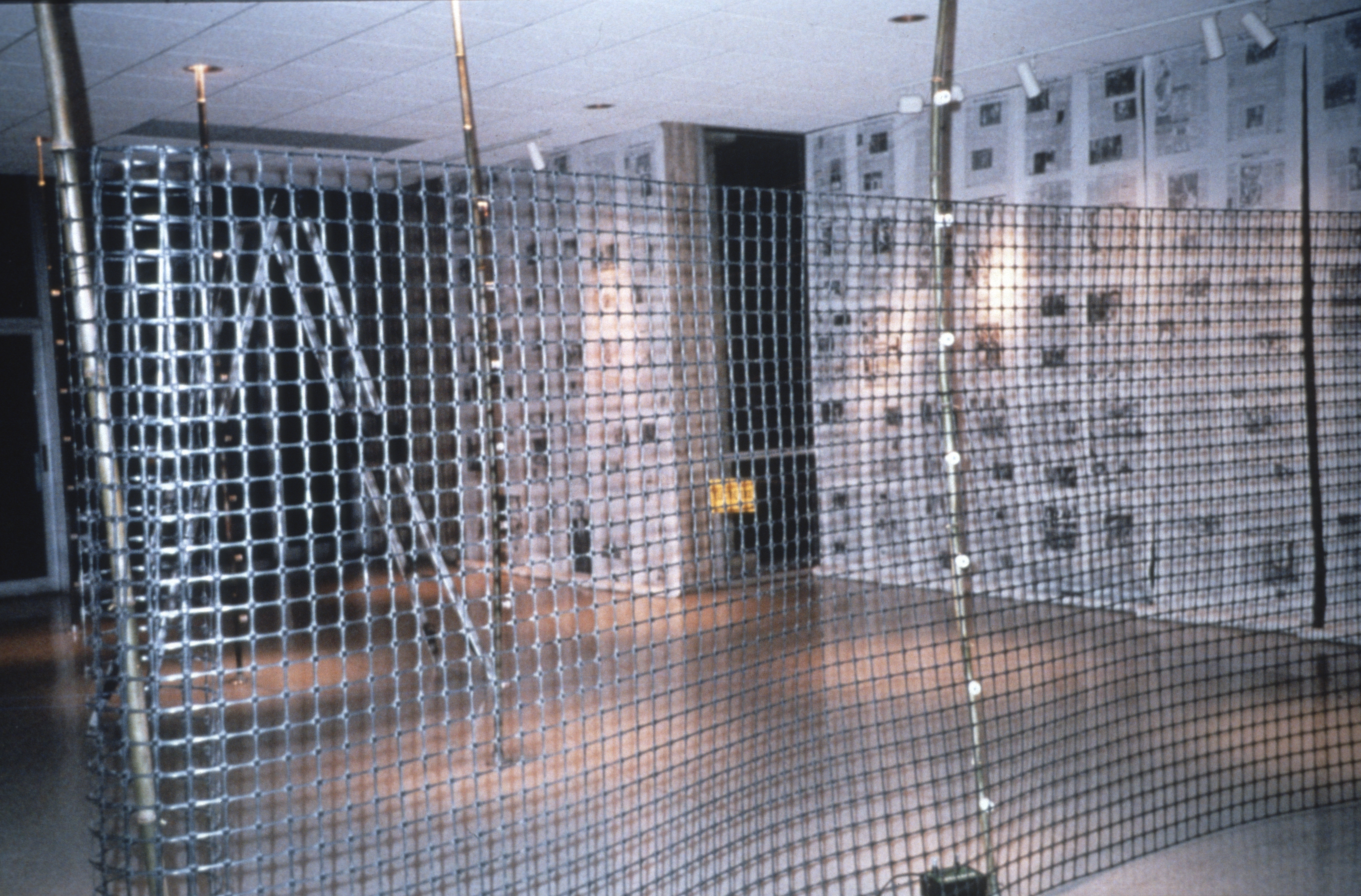
The Walls
The newspaper pages, laminated and suspended in sheets from floor to ceiling, form the interior walls of the installation. Two different fence materials — dark plastic netting and bright chain link — create layers of translucent barrier, overlapping and shifting perspective as the viewer moves. The gallery becomes an obstacle course of information and obstruction.
Laminated newspaper pages, plastic netting, chain-link fence sections · c. 1994
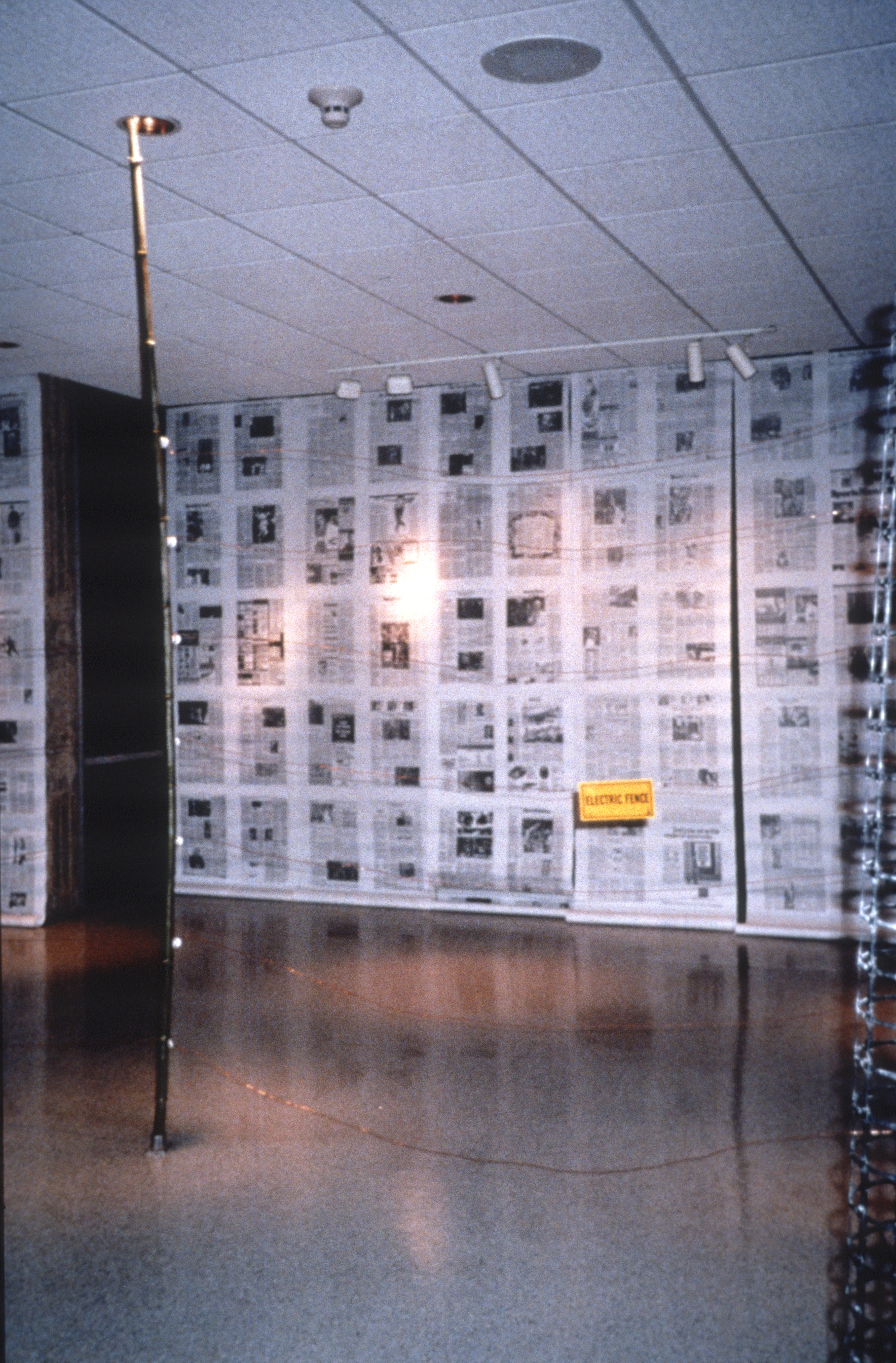
3.5
Electric Fence
A wide gallery view: the laminated newspaper wall fills the background in a grid of stories. A brass pole rises from the floor to the ceiling. At lower right, a yellow industrial warning sign: "Electric Fence." A single wire runs the length of the room at waist height. The sign warns; the wire enforces. Whether the current is live is never quite clear, and that ambiguity is the work.
Laminated newspaper pages, brass pole, electric fence wire, warning sign · c. 1994
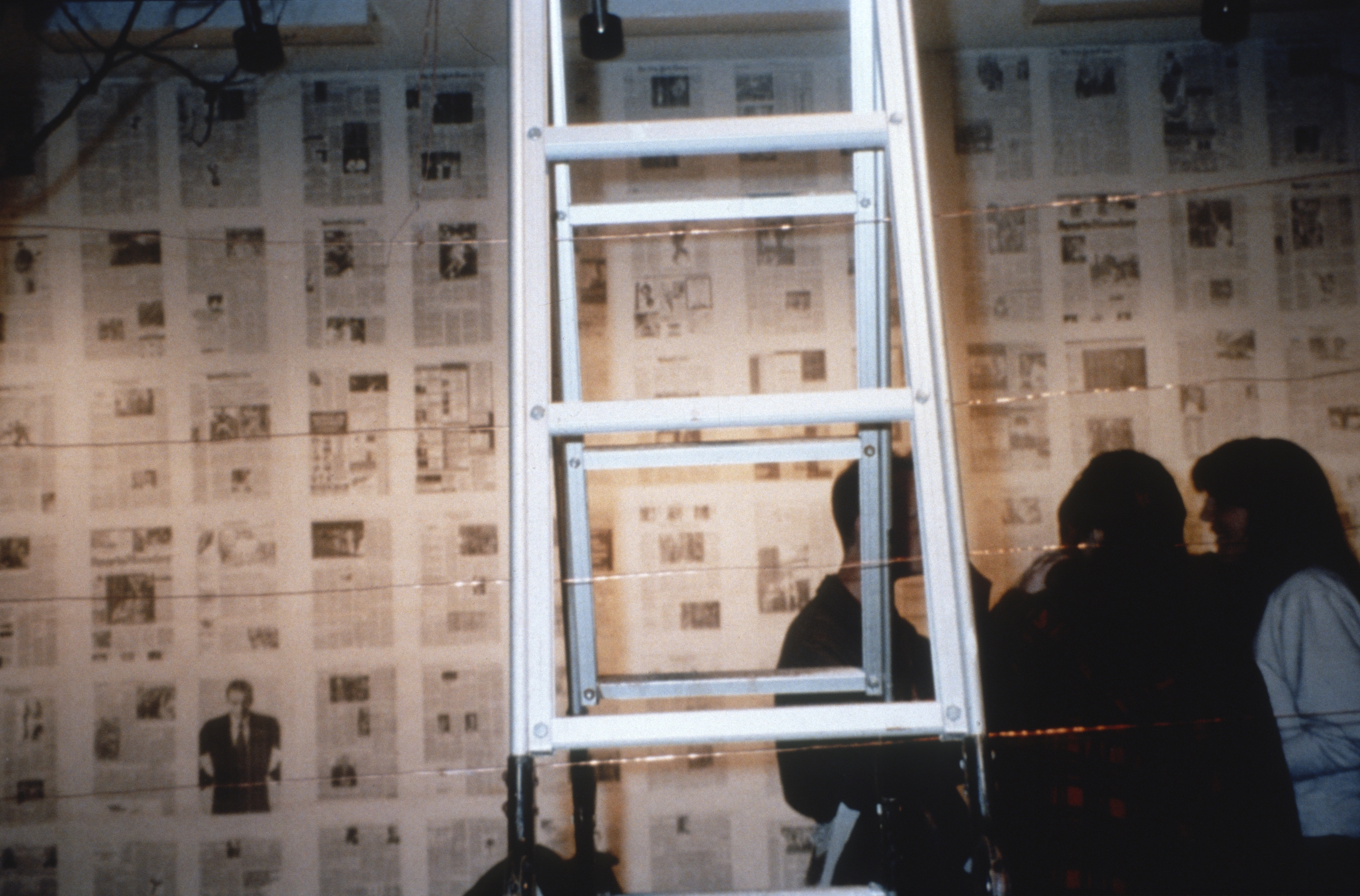
3.6
The Ladder
An aluminum extension ladder leans against the newspaper wall, seen through a layer of translucent fence. Two visitors are silhouetted, their shadows projected back against the laminated pages. The ladder offers a way over; the fence says not yet. The body of the visitor becomes part of the work.
Aluminum ladder, laminated newspaper pages, fence material · c. 1994
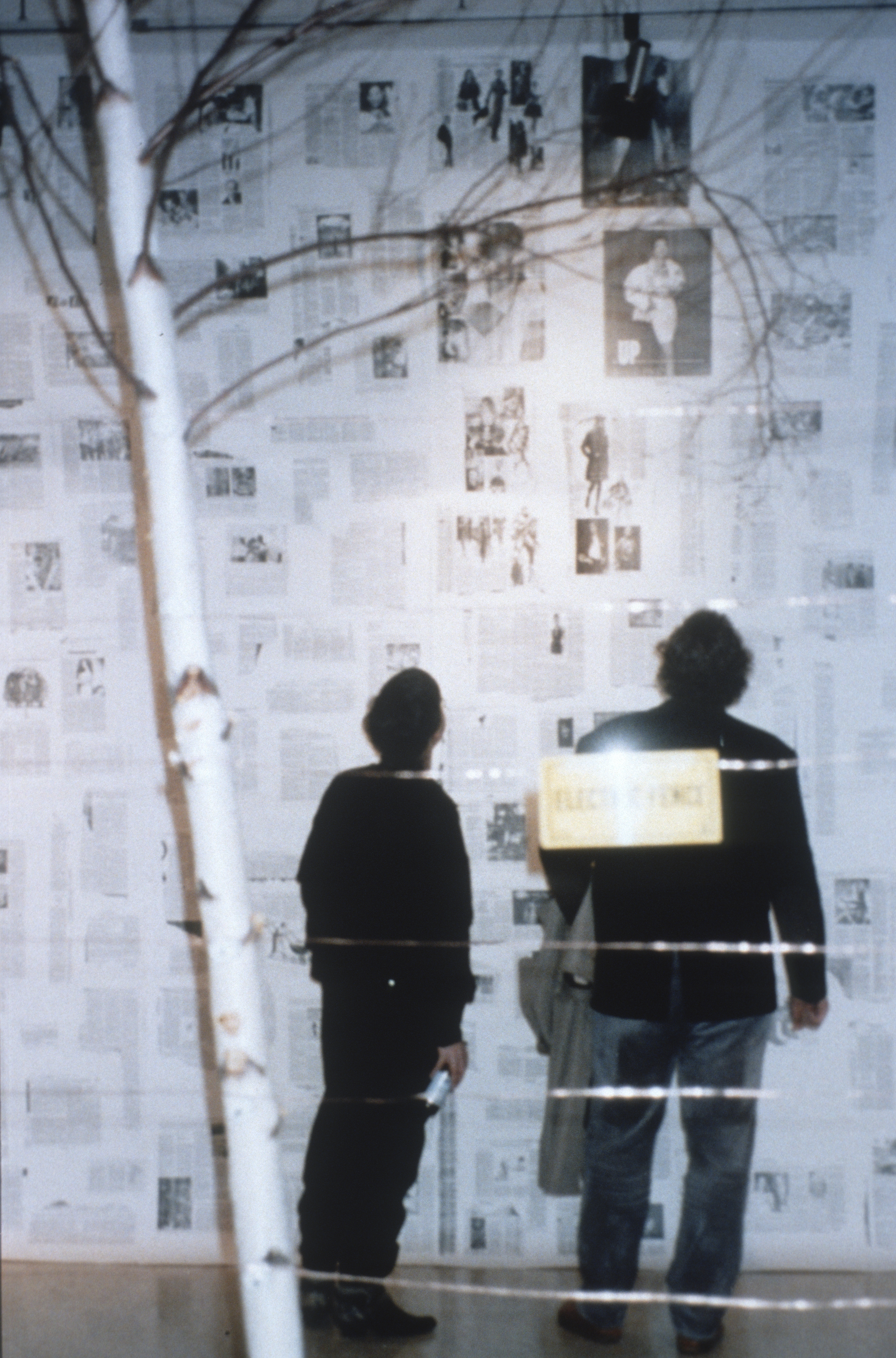
3.7
Birch Tree
A white birch tree — bare of leaves — stands beside the electric fence wire within the installation. The tree's organic verticality contrasts the industrial materials surrounding it. Two visitors study the newspaper wall behind the fence, their backs to us. An "Electric Fence" placard is visible. The birch suggests nature as witness, or as the original boundary.
Birch tree, electric fence wire, laminated newspaper pages · c. 1994
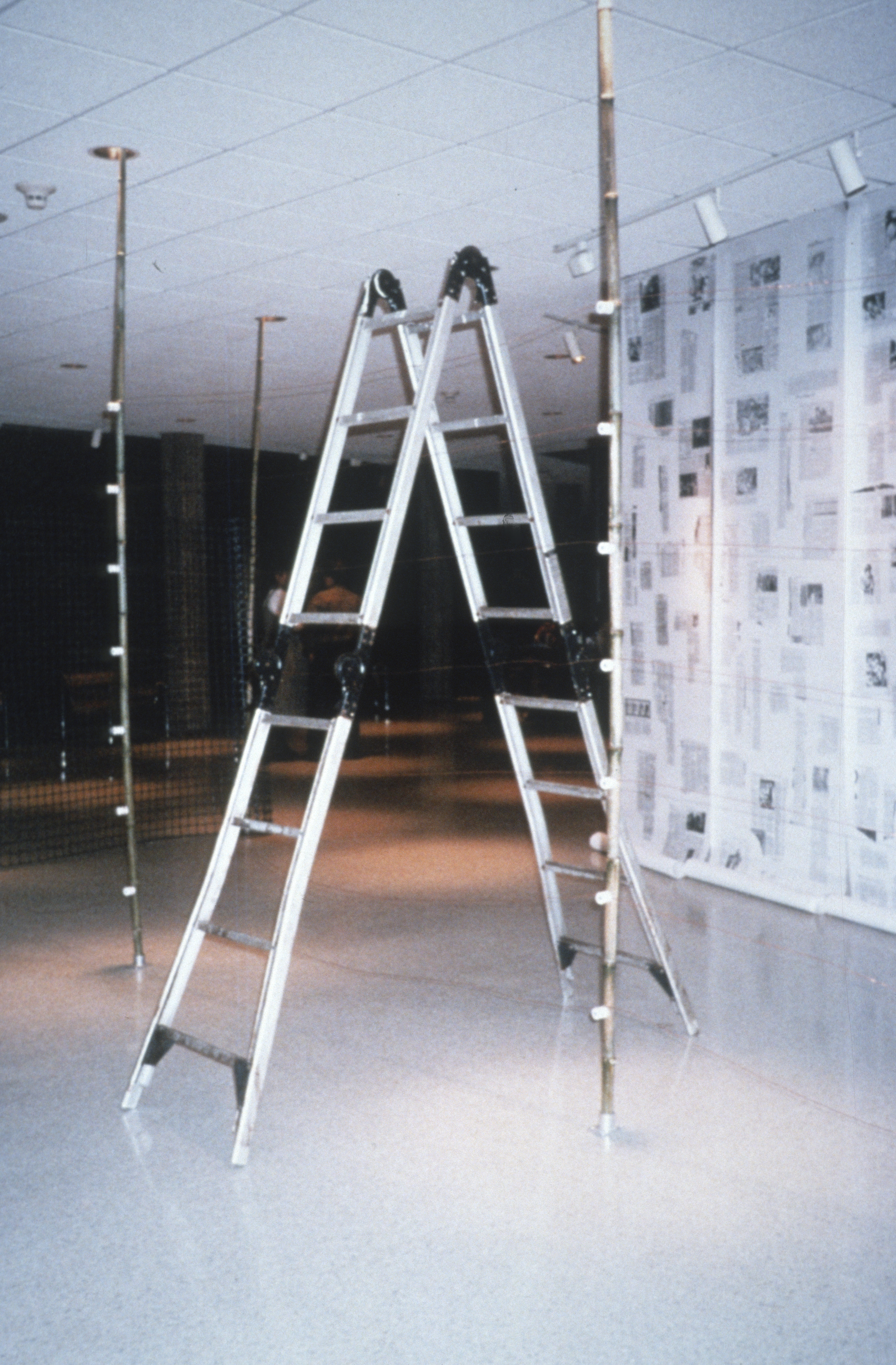
3.8
A-Frame
A large aluminum A-frame stepladder stands open and unoccupied at the center of the installation, flanked by a brass pole on the left and a hanging fence section on the right. The newspaper wall extends behind. The ladder stands ready but unused — the offer of ascent without anyone yet willing or able to climb.
Aluminum A-frame ladder, laminated newspaper pages, brass pole, fence material · c. 1995
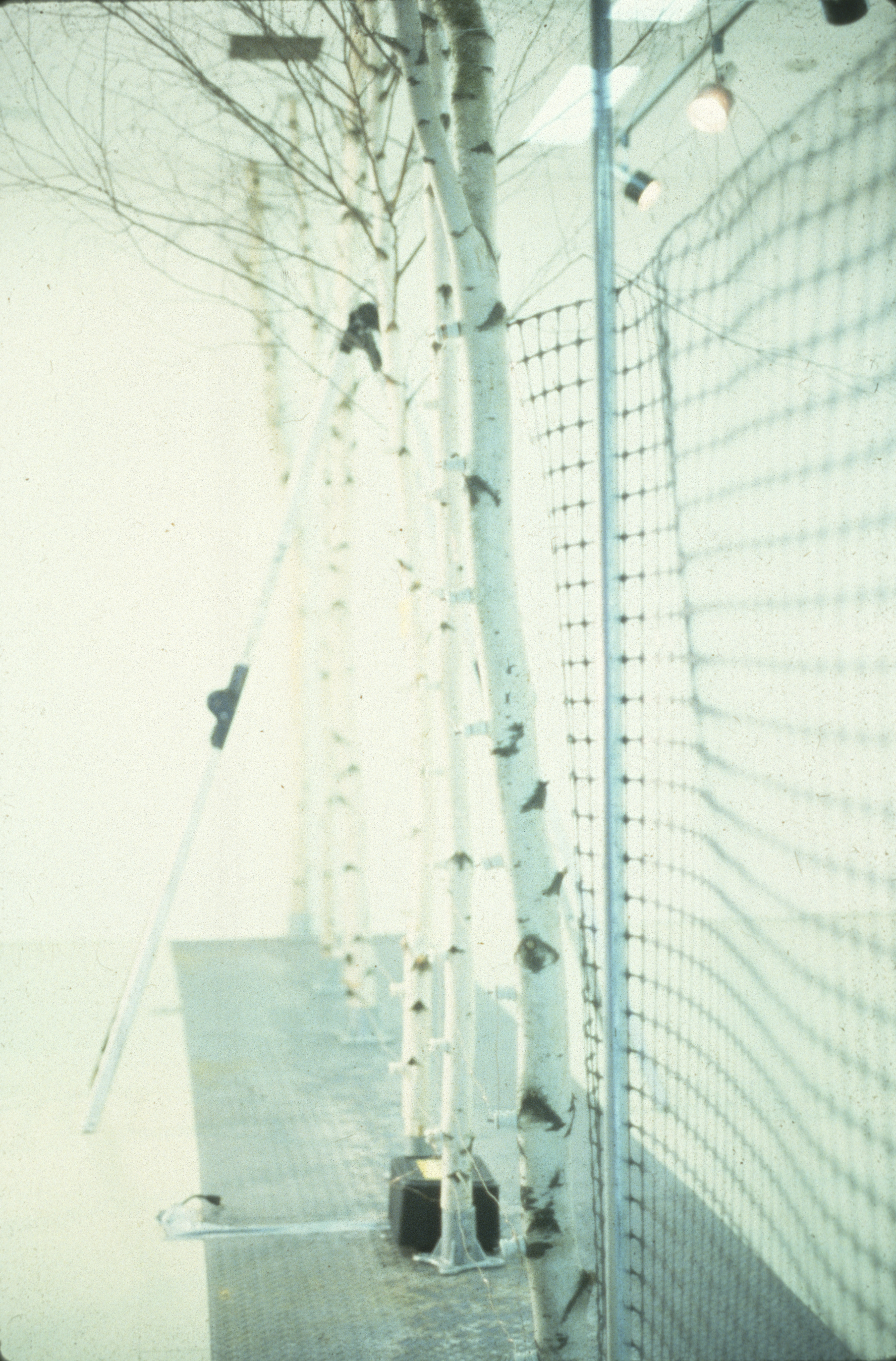
3.9
Birch and Fence
A corridor view down the inside edge of the installation: white birch trunks recede along the left, small black forms — birds? shoes? — are attached along their length. To the right, a plastic net fence stretches flat. The view is almost pastoral, almost peaceful — until you register the fence's rigid geometry and notice that the attached figures are rubber shoes, evidence of bodies that have tried to pass through.
Birch trees, plastic net fence, rubber shoes, mixed media · c. 1995
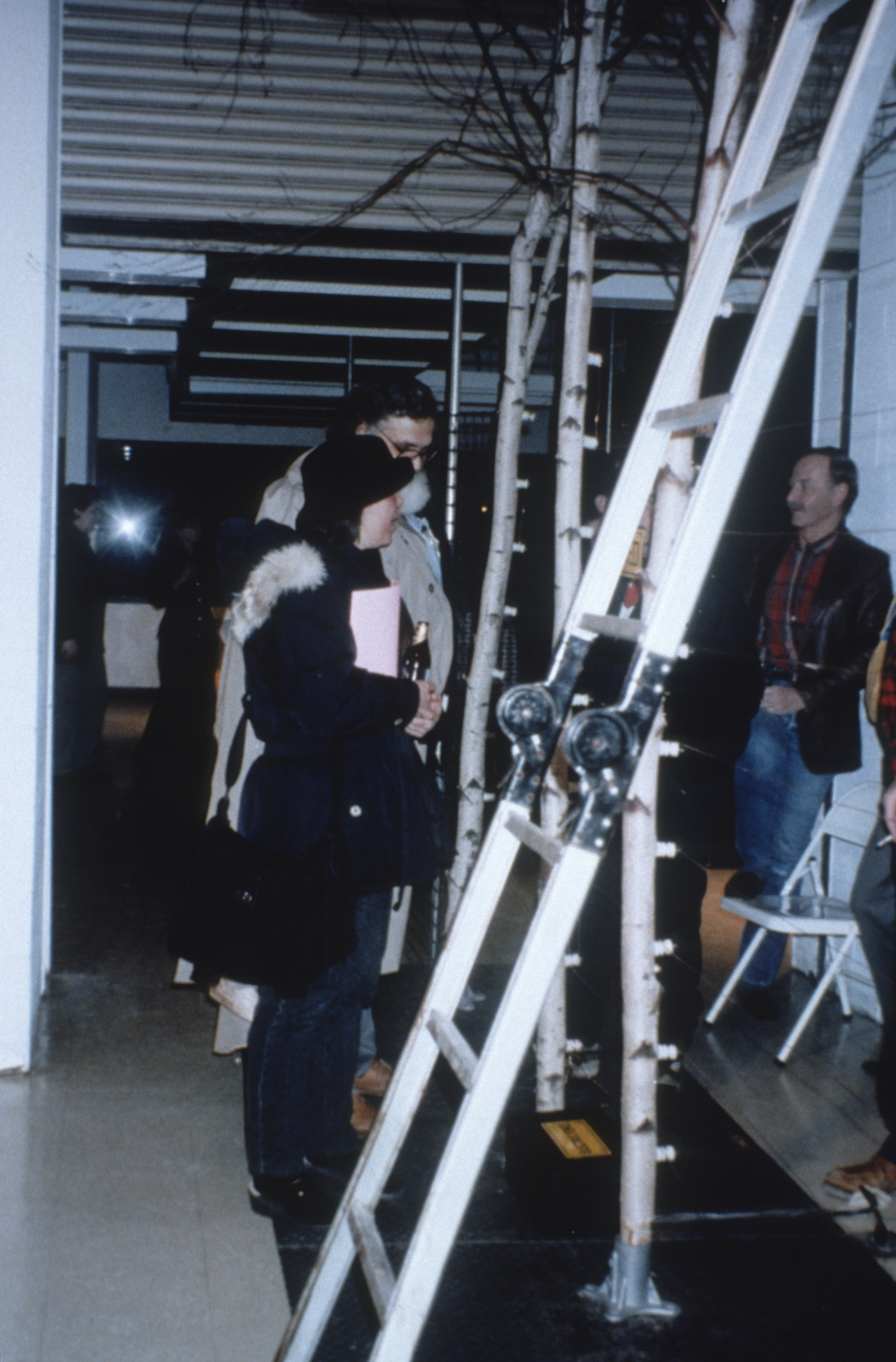
3.10
Opening Night
Visitors navigate the installation at an opening: a couple examines the ladder mechanism, a man sits at its base. Camera flash illuminates the far entrance. The bodies of the audience complete the installation — their presence and discomfort, their negotiations with the electric fence, their choices about where to stand, become part of the work itself.
Installation view with visitors · c. 1995
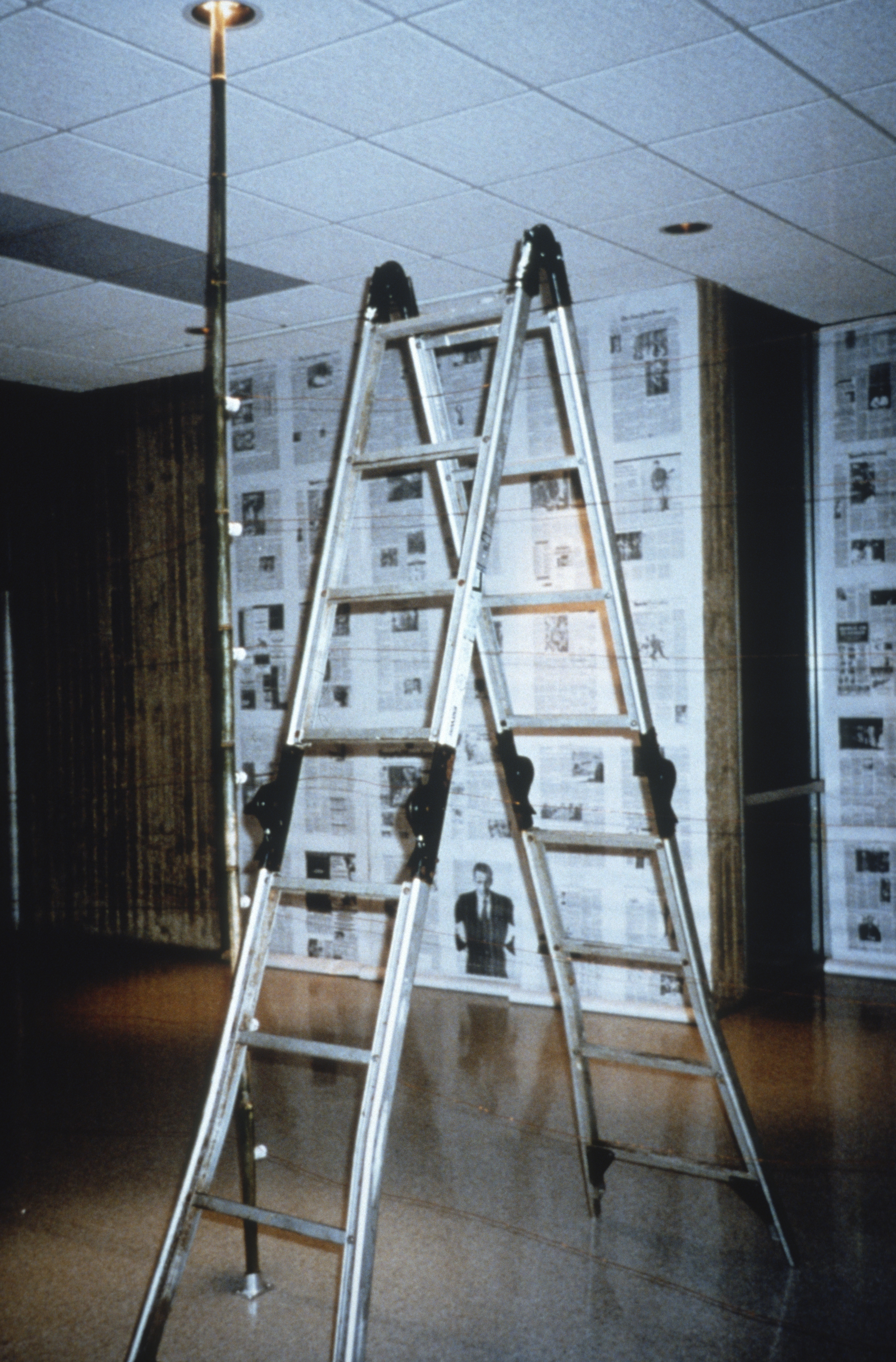
3.11
Ladder and Column
The A-frame ladder and the brass pole stand together — parallel structures, one for climbing, one for electrification. The newspaper wall wraps the gallery behind them. A politician's image — a figure in a suit — is visible through the fence near the ladder base. Power: official, architectural, and latent. The room does not tell you which is more dangerous.
Aluminum ladder, brass pole, laminated newspaper pages · c. 1996
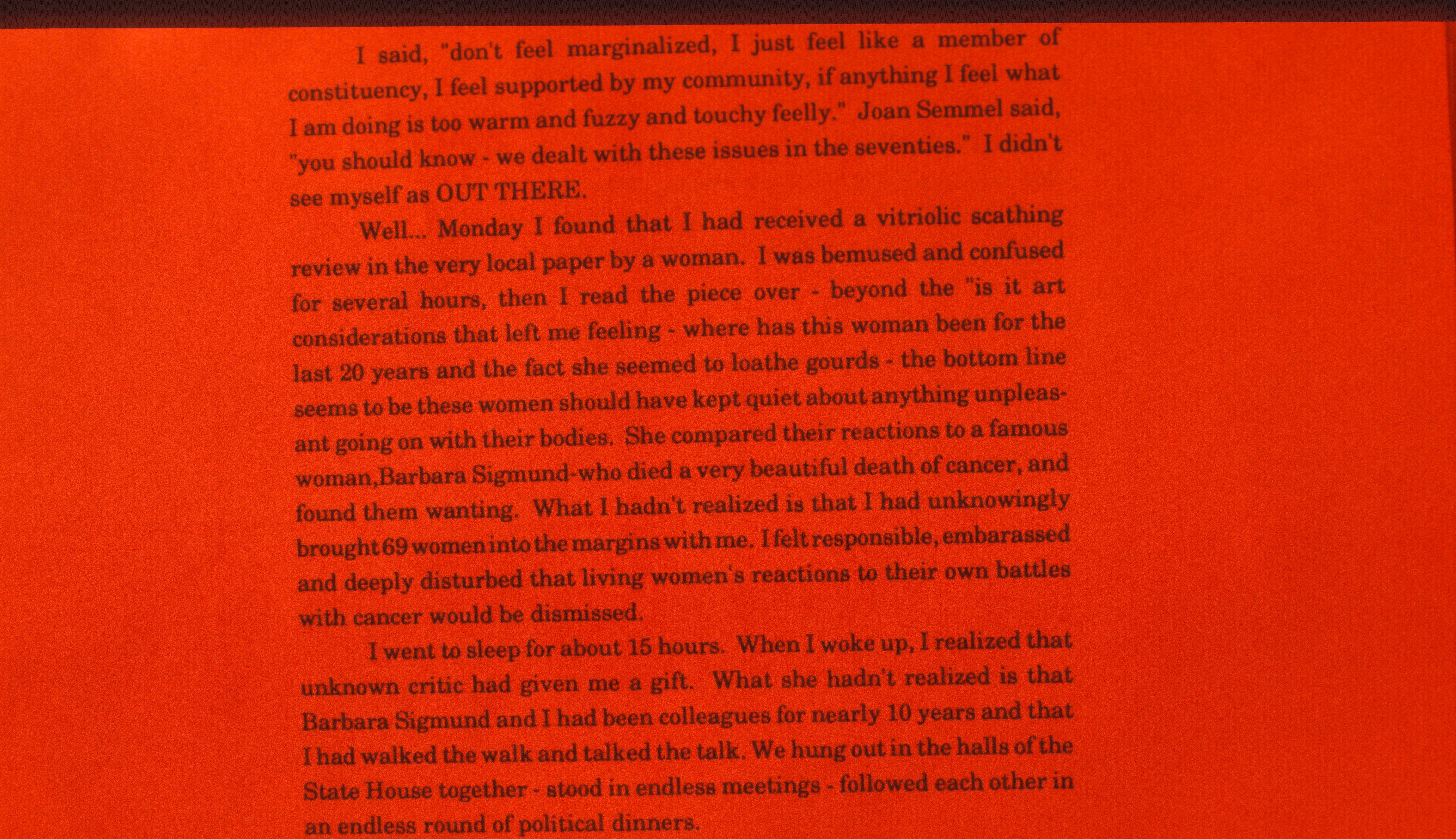
3.12
The Artist's Statement
Red-lit text on amber paper — a typescript of Darmstadt's own account of the work's genesis. She describes the vitriolic local review that told her the 69 women whose cancer stories filled the gourds "should have kept quiet about anything unpleasant going on with their bodies." The red light turns the document into urgency, into warning, into evidence.
Typescript on paper, red light · c. 1997
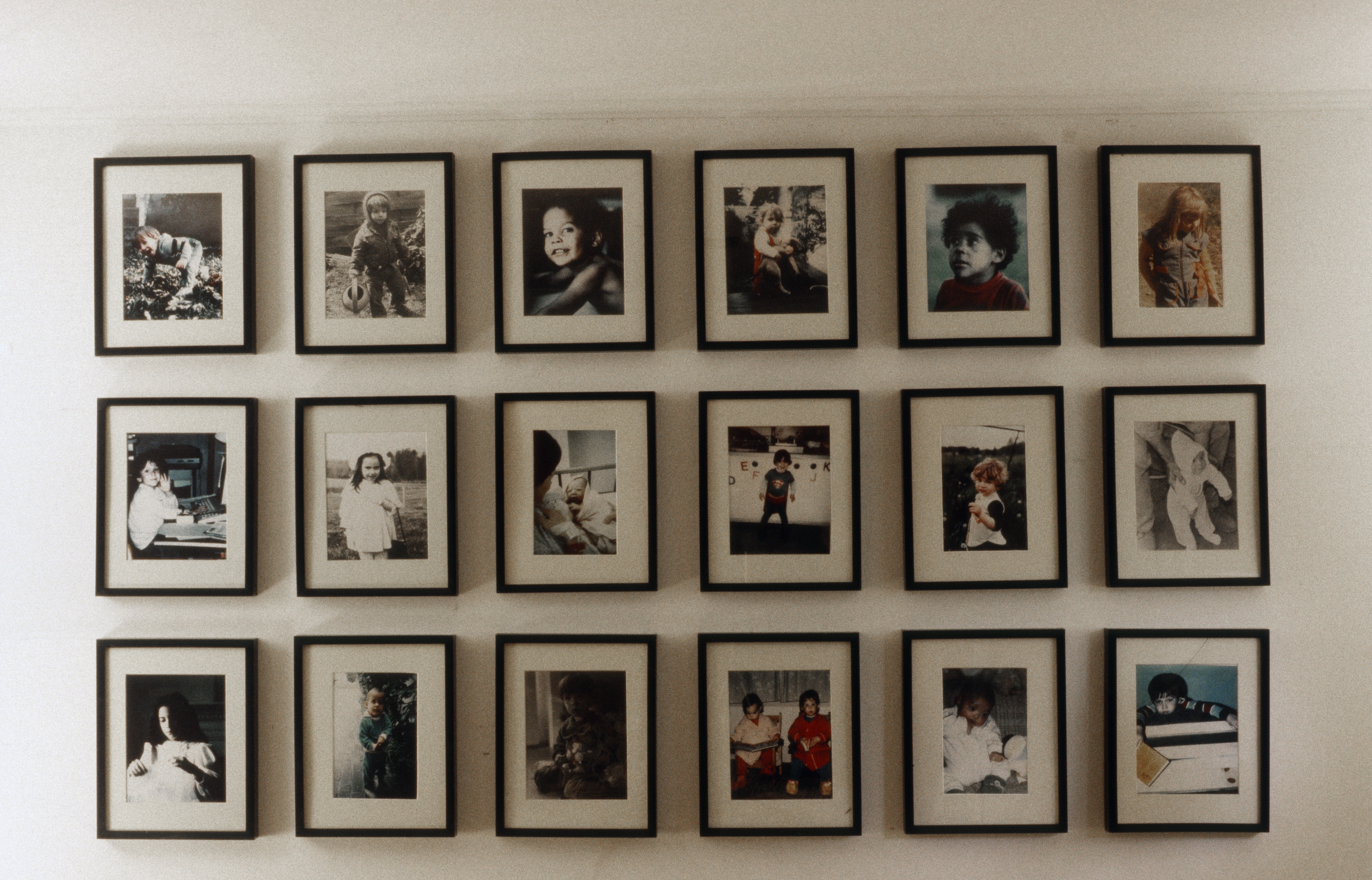
3.13
The Children
Eighteen photographs of children — diverse in age, race, and era — are framed identically in black and mounted in a three-by-six grid on the gallery wall. Black and white and color intermixed; some are snapshots, some formal. These are the children born, the children who lived. After the rocks and gourds and fences — after all the contested bodies — Darmstadt ends this section with faces.
Photographs, black frames, gallery wall · c. 1998
Section Four
Male Figure:
The Other Body
Running parallel to her investigation of the female reproductive body, Darmstadt's paintings of the male nude engage the tradition of academic figure study and subject it to the same scrutiny she turns on other bodies. These are not trophies or ideals; they are bodies under observation, caught in the act of being looked at by a woman who is also looking at power.
c. 1985–2005 / Oil on canvas
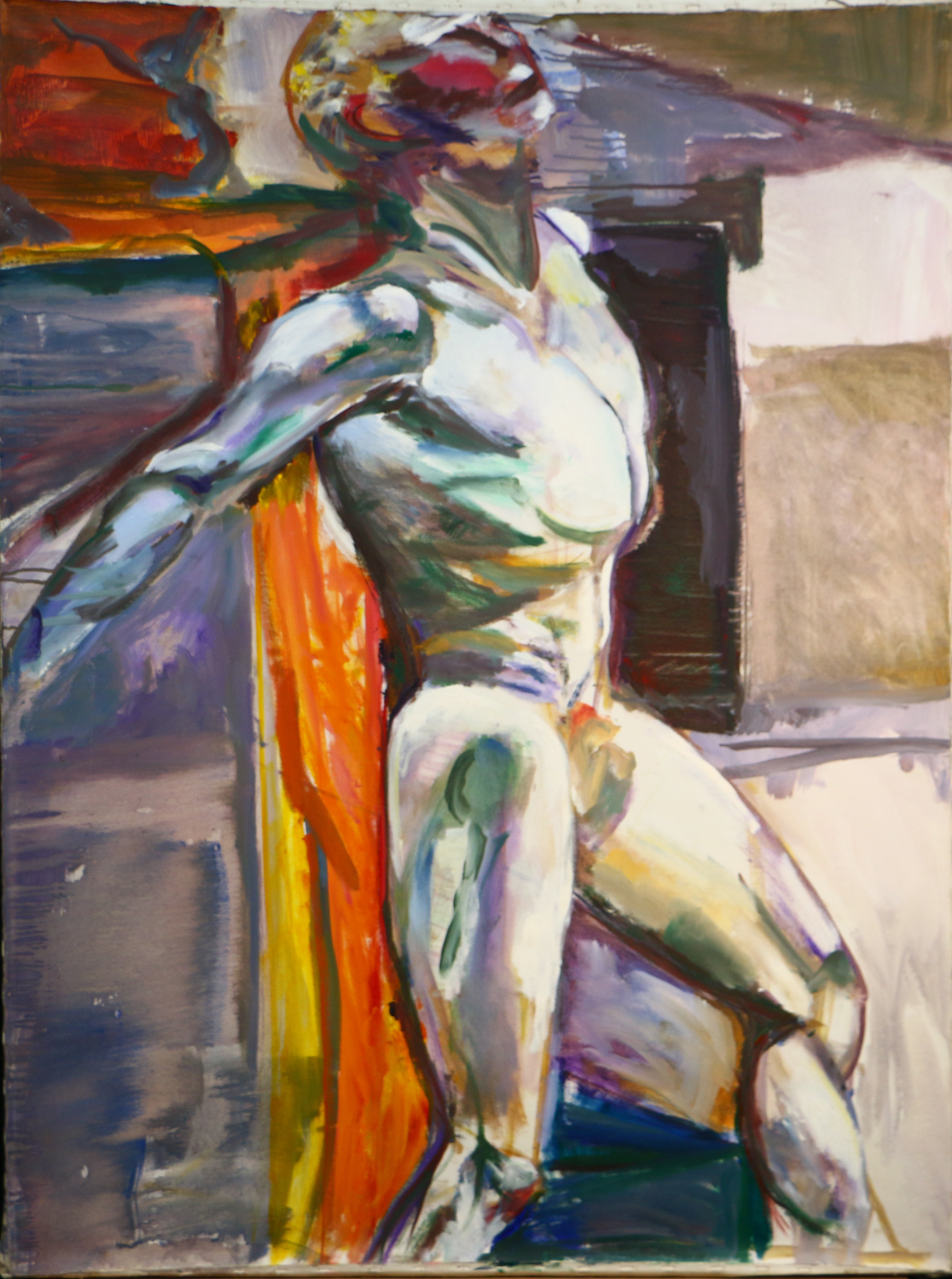
4.1
Turning
A male figure twists away from the viewer — the classic contrapposto, reversed. Darmstadt's palette is volcanic: orange, deep crimson, cerulean, cream. The body is not presented for admiration but caught mid-motion, mid-thought, the head turned toward a dark interior. The architecture behind — a door, a wall — grounds a figure that seems about to leave the canvas altogether.
Oil on canvas · c. 1988
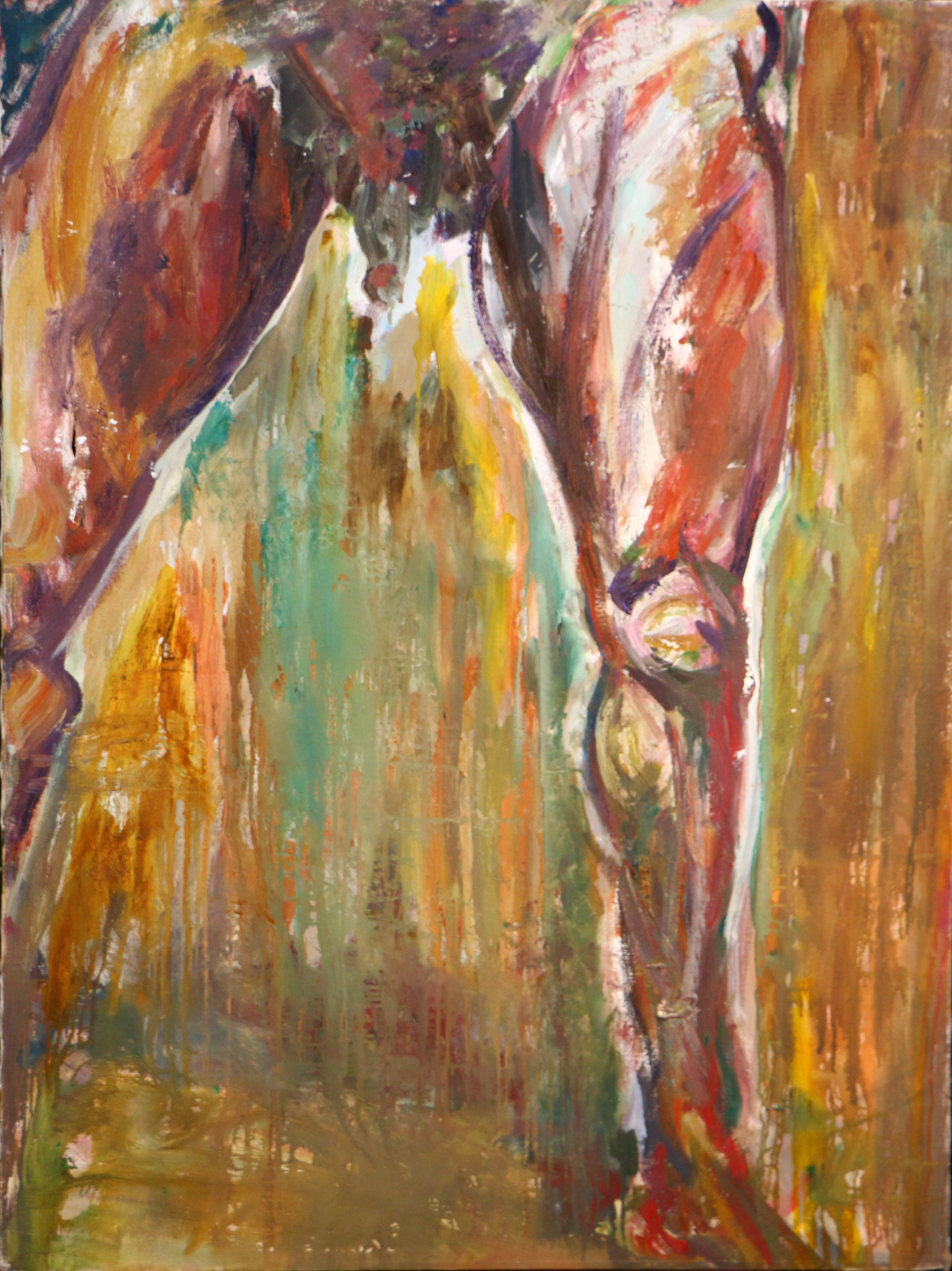
4.2
Torso Fragment
A radical close-up eliminates head, hands, and feet: only the male torso from mid-chest to mid-thigh. Darmstadt's paint is applied in streaming vertical passages — amber, teal, red-brown — that dissolve anatomical certainty. This is not a nude; it is a study in how the body becomes paint, how paint becomes body, how looking always involves a partial erasure.
Oil on canvas · c. 1990
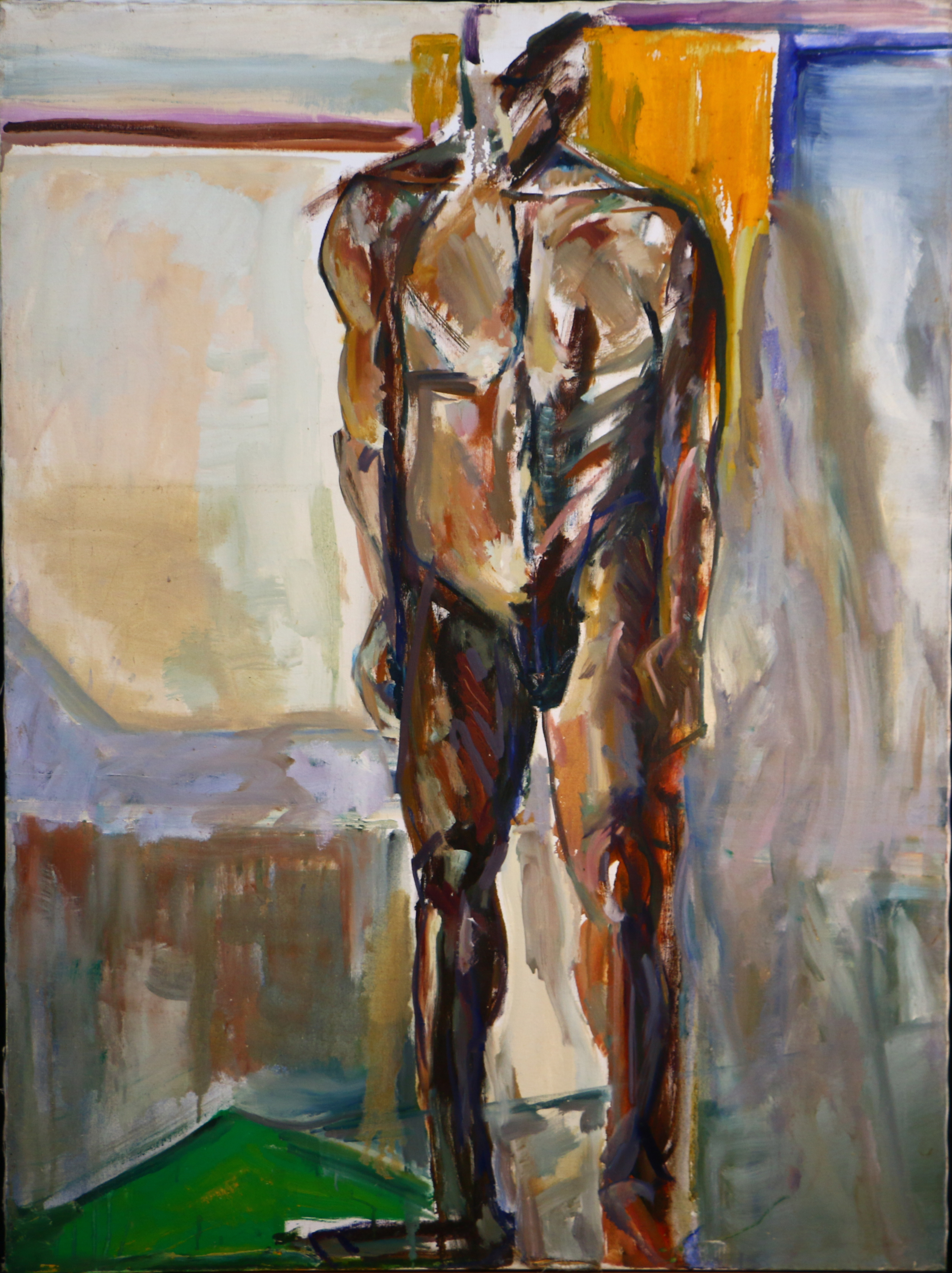
4.3
Standing
A full standing male figure — frontal, hands at sides, head slightly bowed — is placed against a vivid yellow-ochre and blue-gray background that reads as both interior and abstract field. The body is built from warm sienna and cool shadow, the brushwork rapid and declarative. The figure holds its ground without theatrics: a body in a room, being seen.
Oil on canvas · c. 1993
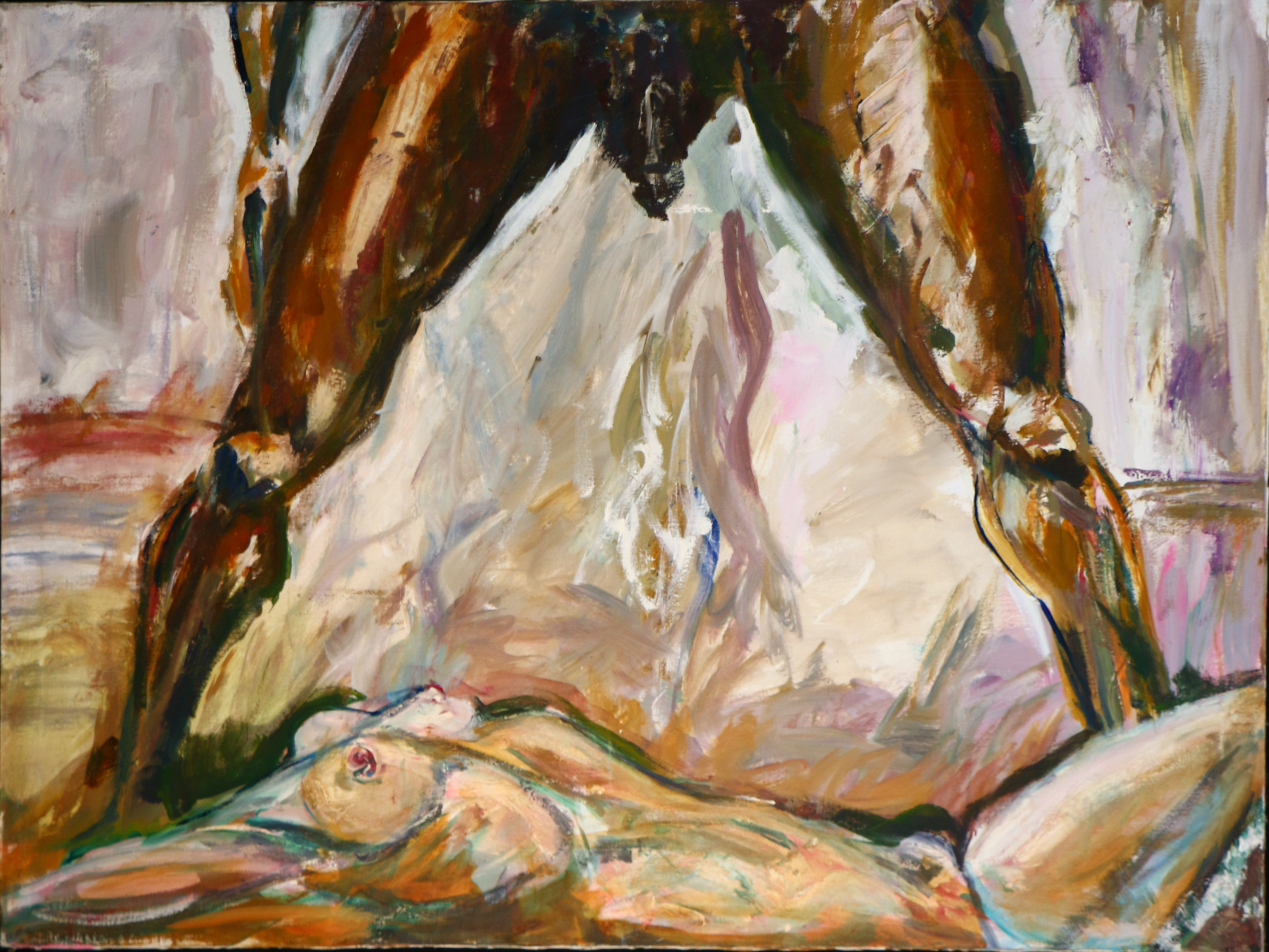
4.4
Reclining Beneath
The composition shifts dramatically: a female figure reclines in the lower third of the canvas while male legs — columnar, monumental, painted in chestnut and deep brown — tower above. The woman is not subordinated so much as differently positioned — her body horizontal, the male body vertical, as though two different orientations of being in the world are placed in simultaneous view. The painting refuses to resolve the tension.
Oil on canvas · c. 1995
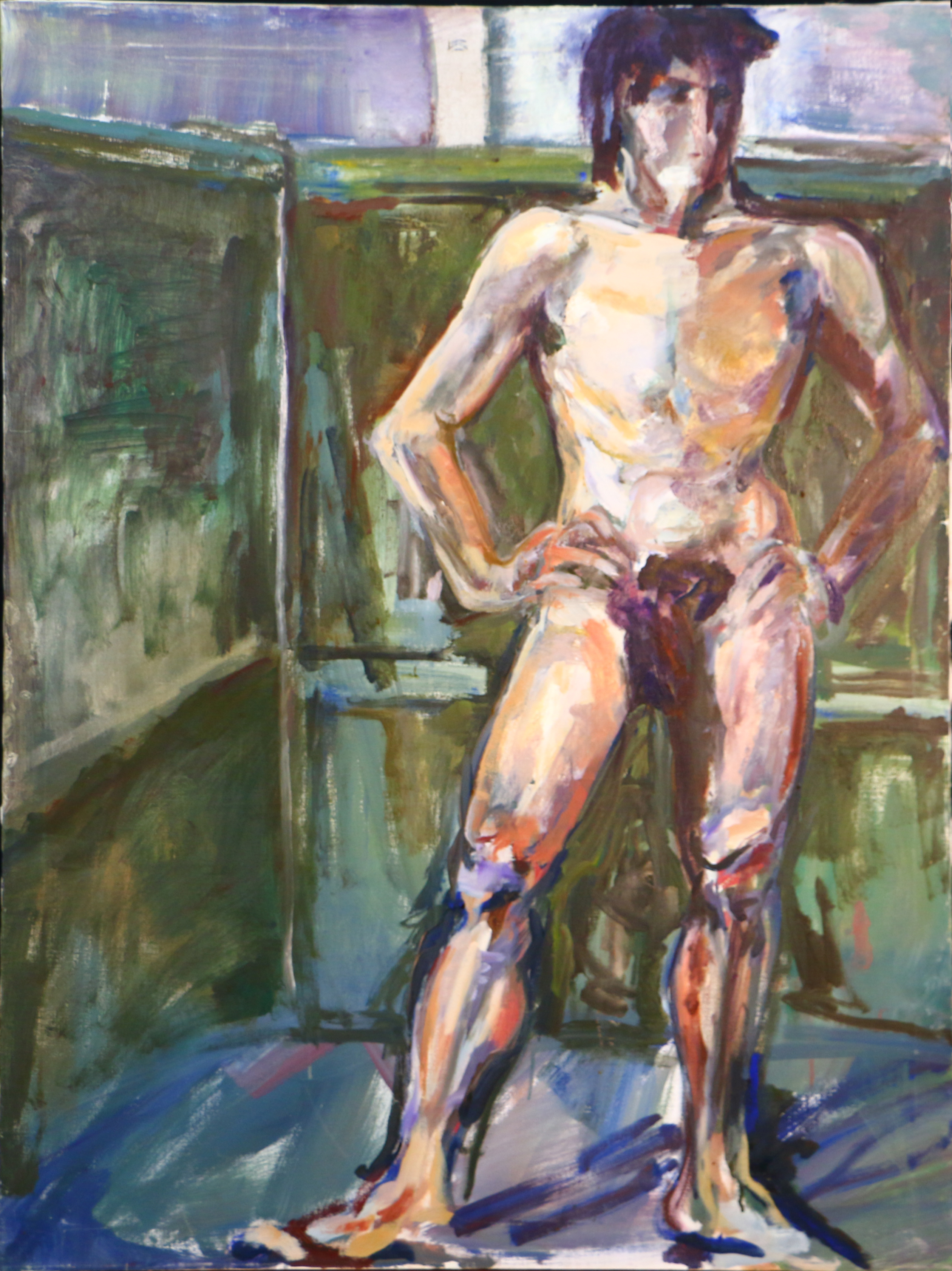
4.5
Green Room
A dark-haired male figure stands confidently, hands on hips, in a cool green interior. The pose has the ease of authority; the cool palette undercuts it. This is the male nude aware of being painted, aware of the gaze — performing relaxation while under study.
Oil on canvas · c. 1997
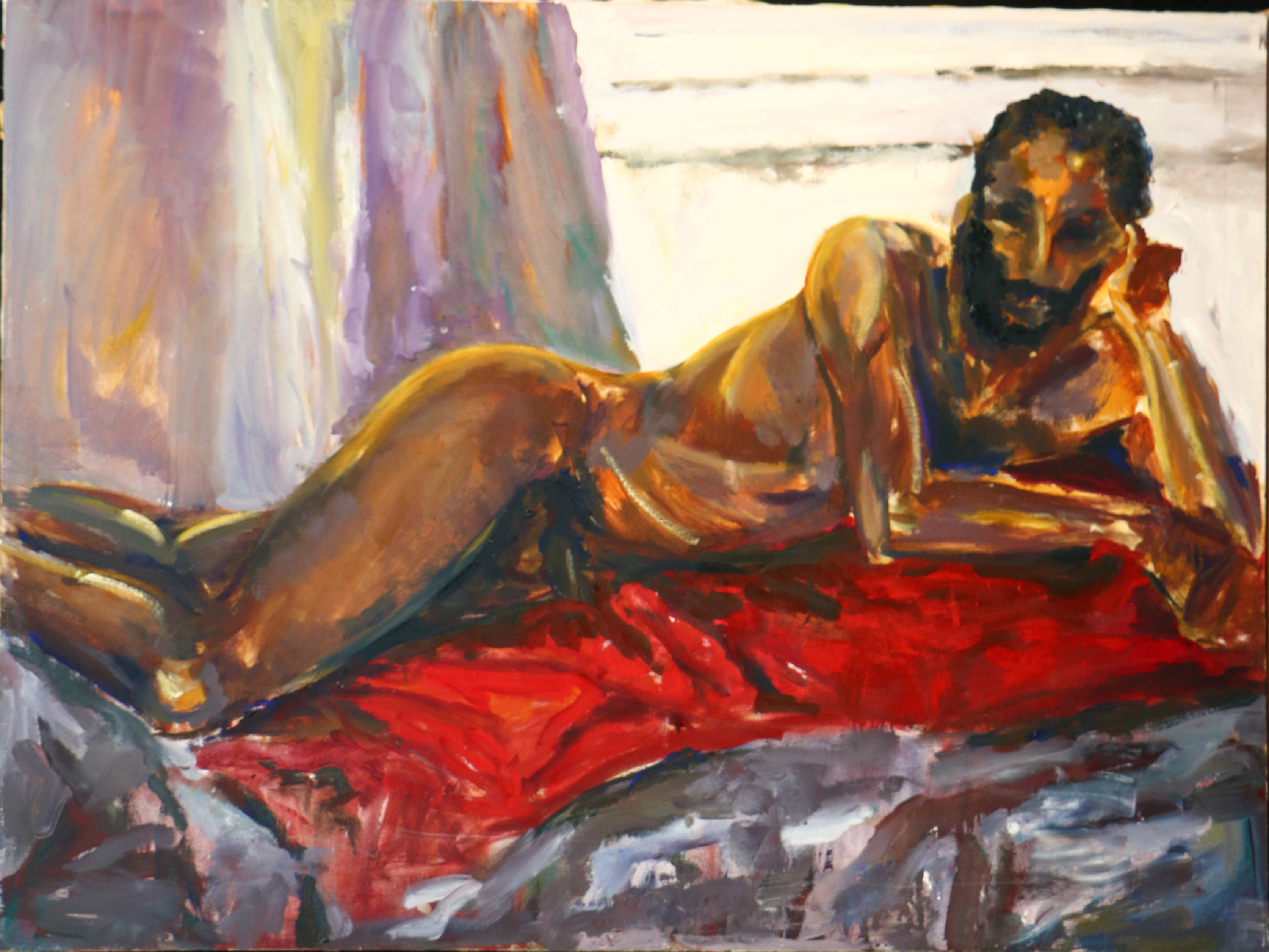
4.6
Red Ground
A bearded male figure reclines on a crimson cloth — the odalisque pose traditionally reserved for women, here claimed by a man of dark complexion painted in rich golden ochre. The reversal is complete and painterly, executed without irony. Darmstadt's brushwork is particularly assured here: long, luxuriant strokes that honor the body's weight.
Oil on canvas · c. 2000
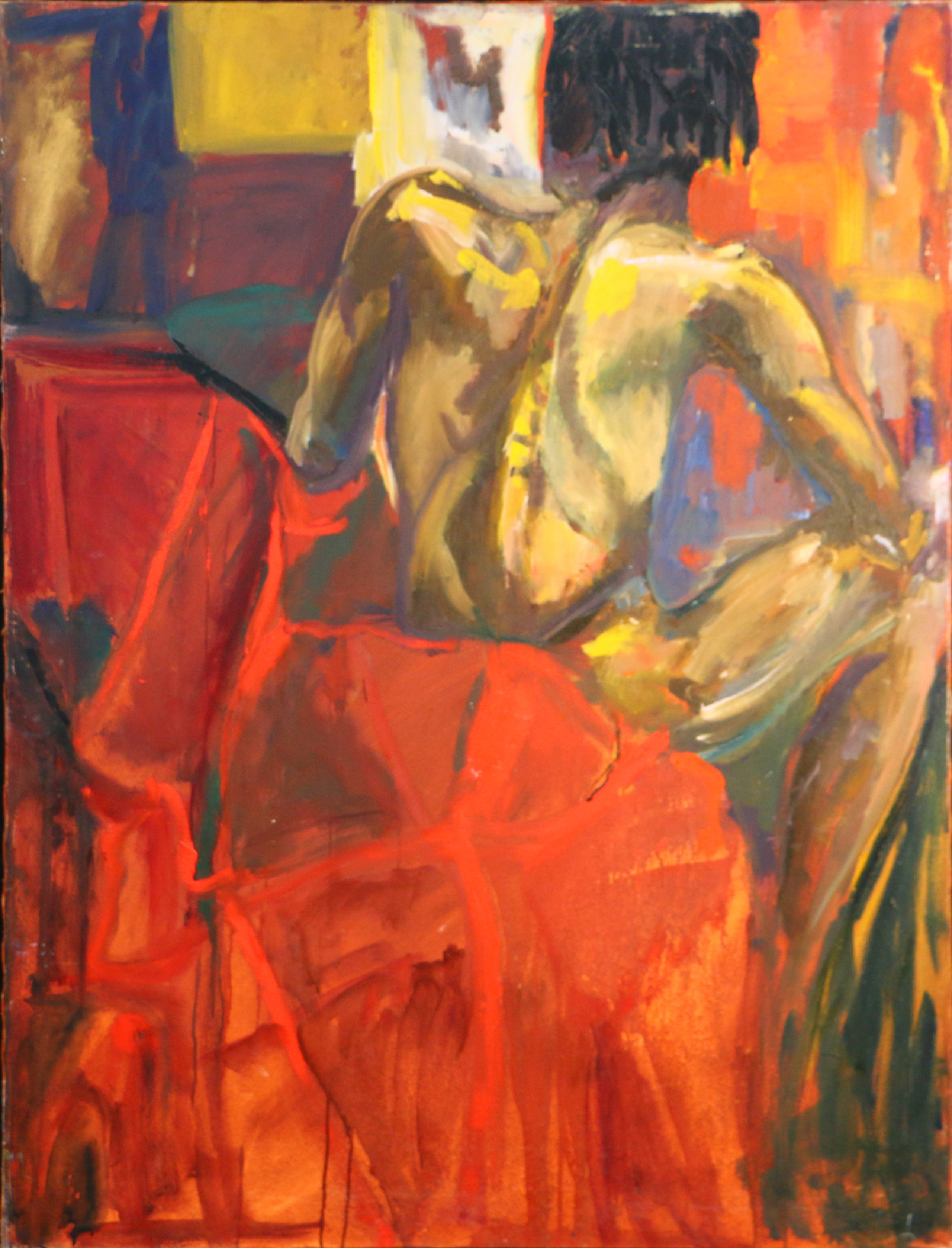
4.7
Back / Red
The final male figure: a back view, the figure turned entirely away, surrounded by red and orange on all sides — a conflagration of color. The identity of the figure is withheld; only the muscular architecture of the back and the warmth of skin against all that red remain. Anonymity as dignity.
Oil on canvas · c. 2003
Section Five
Early Works:
Landscape Preludes
Before the rocks, before the gourds, Darmstadt worked in the tradition of decorative landscape — flat-painted tropical scenes executed with a jeweler's precision of outline and a painter's freedom in color. These works anticipate her later concerns: the body of the earth, containment and openness, the gap between the idyllic image and the complex reality it represents.
c. 1985–1990 / Paint on board
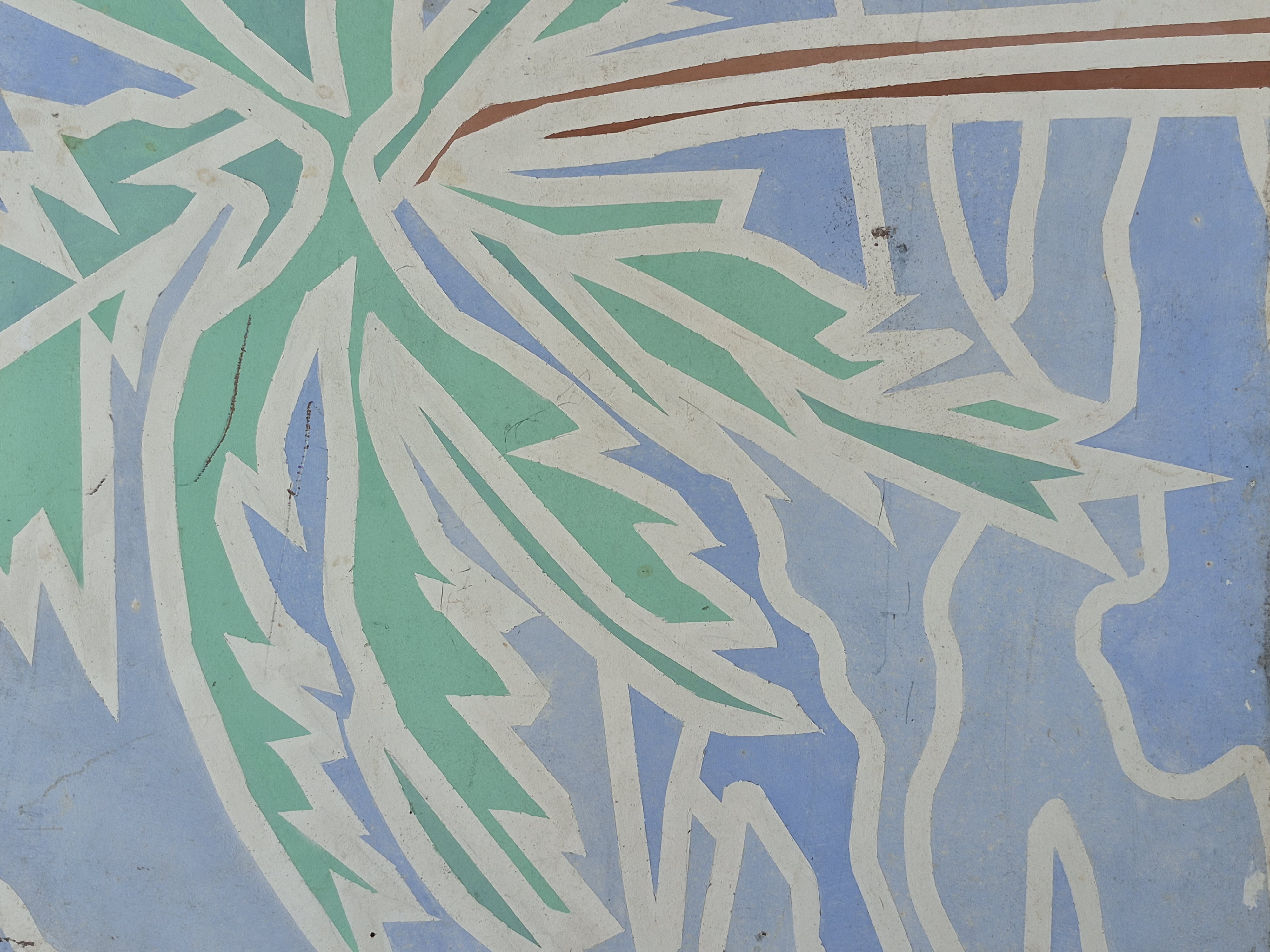
5.1
Palm, Close
A palm tree in close-up: the fronds fill the frame with a bold graphic language of green on blue, every leaf edge outlined in cream-white. The style is at once Art Deco and folk — flat planes of color separated by crisp outlines. The painting has the confidence of a sign, the precision of a diagram, and the warmth of a memory of somewhere south.
Paint on board · c. 1985
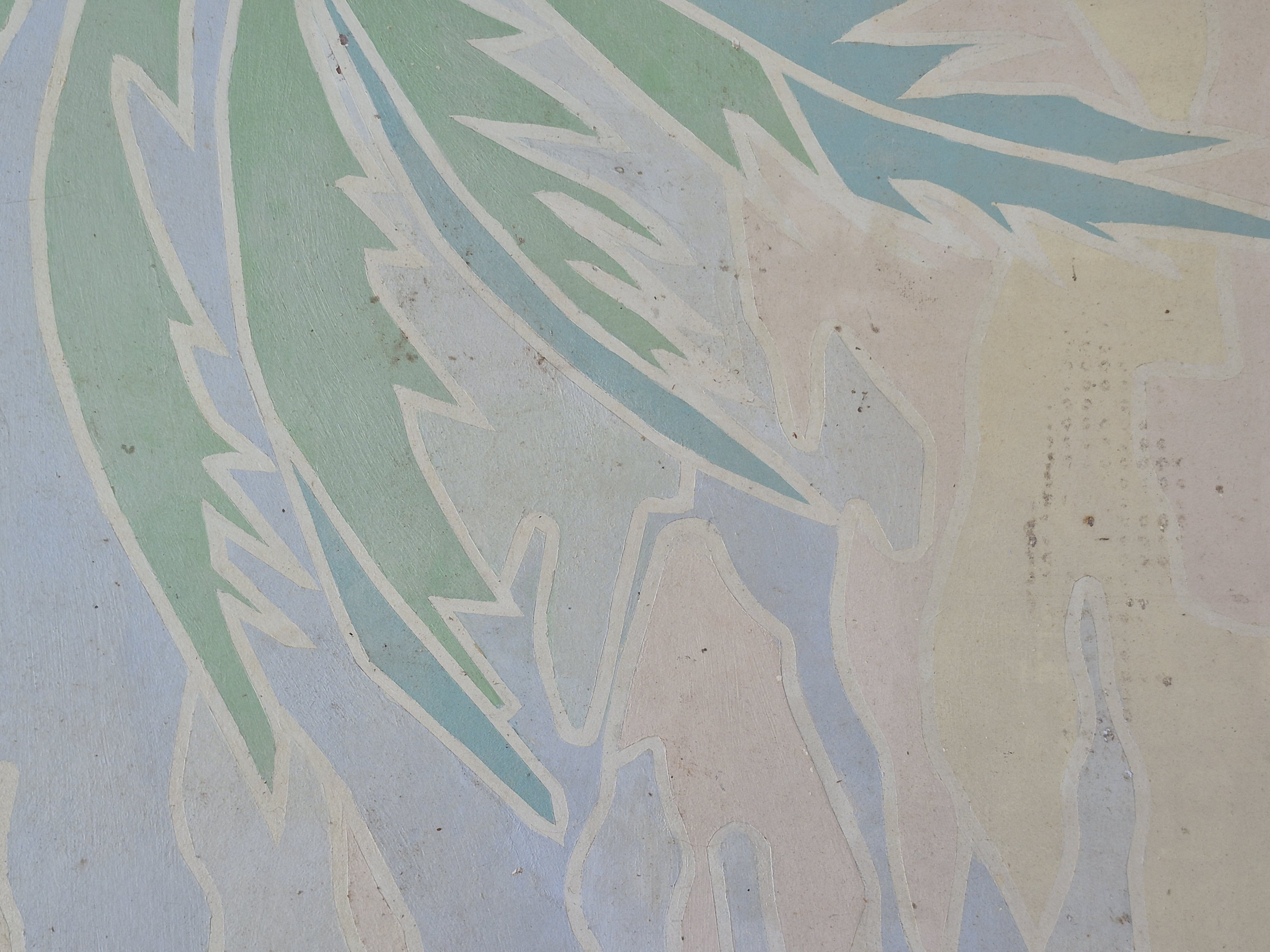
5.2
Wind and Shore
The same graphic vocabulary opens outward: wind-bent fronds, a horizon of pale sand, the pale blue of shore and sky nearly indistinguishable. Darmstadt's outlines are perfectly controlled, but the color beneath them breathes — cream shading to sand, blue shading to gray. It is a landscape about what cannot be held still.
Paint on board · c. 1986
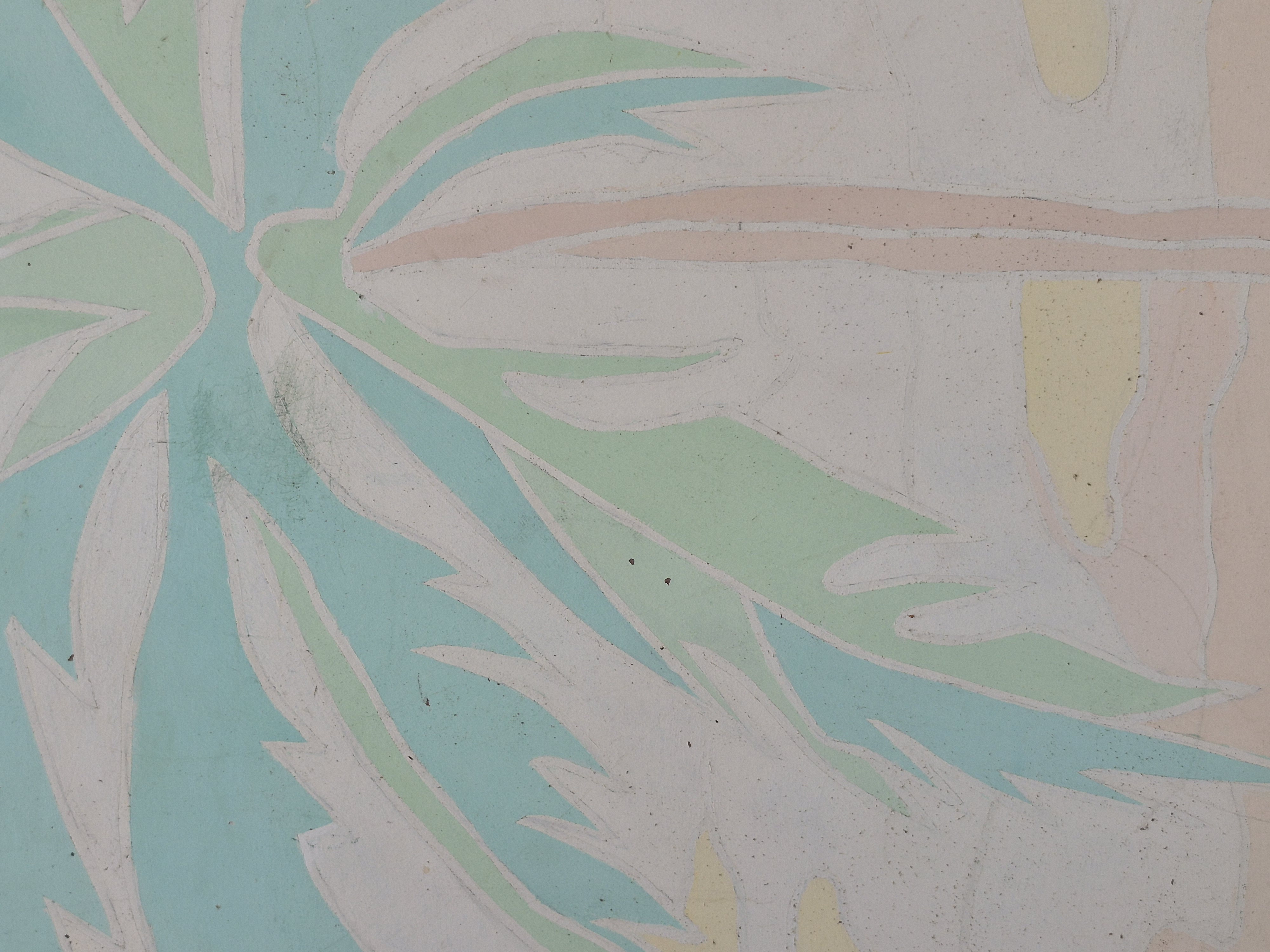
5.3
Aqua Ground
On a field of aqua blue, a palm — lighter in palette, the fronds fading toward white — stands against a sky barely differentiated from the sea below. The ground shifts from aqua to cream at the bottom edge, flecked with pale yellow forms. More abstract than the earlier works, this painting anticipates the colorfield concerns that will animate the later abstract series.
Paint on board · c. 1987
5.4
Land and Sky
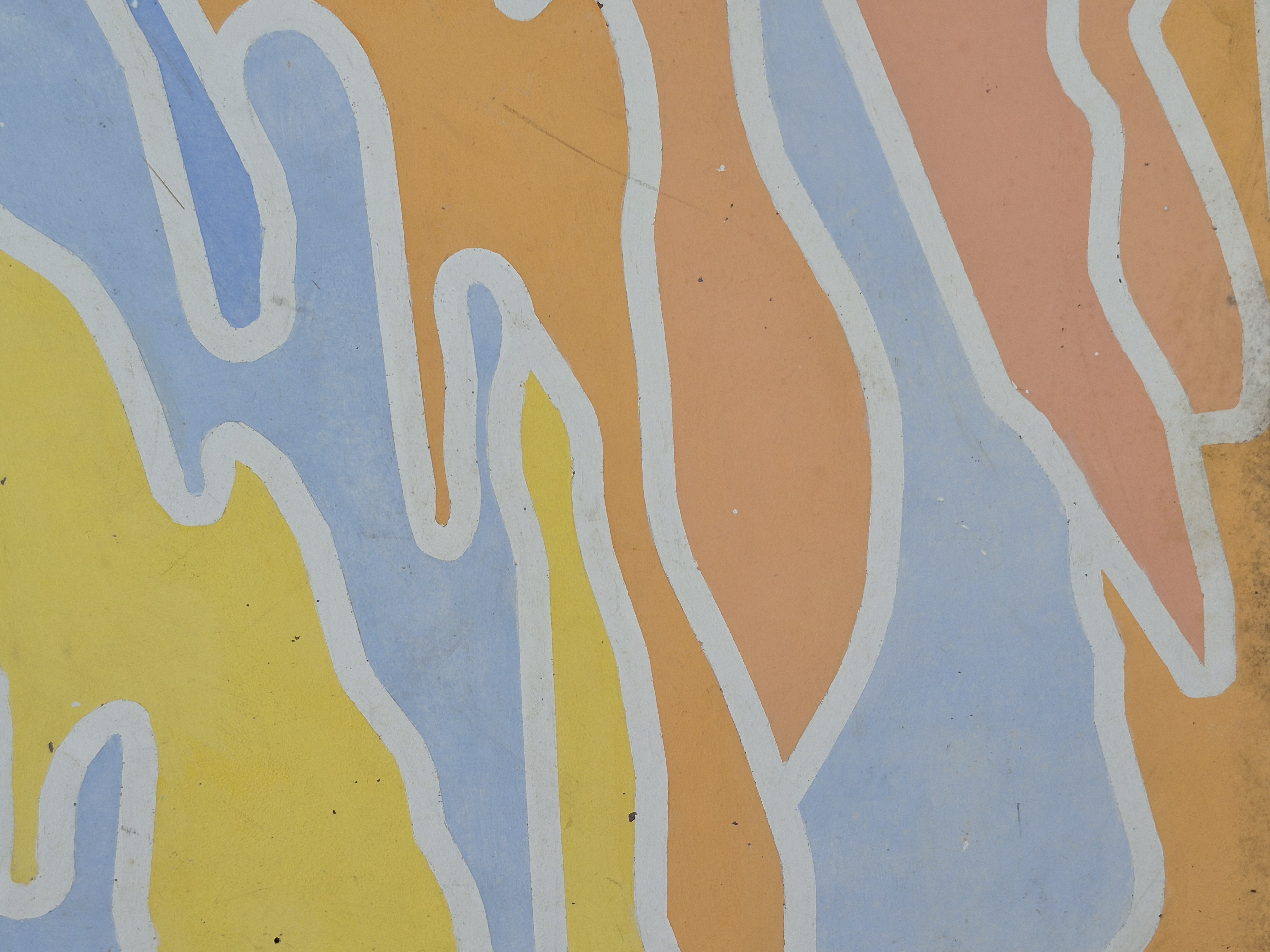
Here the palm disappears entirely and what remains is the landscape itself: undulating bands of yellow, blue, and orange-peach, their edges sinuous and curved. The white outlines that separate each zone are the same marks used elsewhere for fronds — now they describe terrain, atmosphere, the abstract language of place. A painting almost entirely of transitions.
Paint on board · c. 1988
5.5
Paint by Number
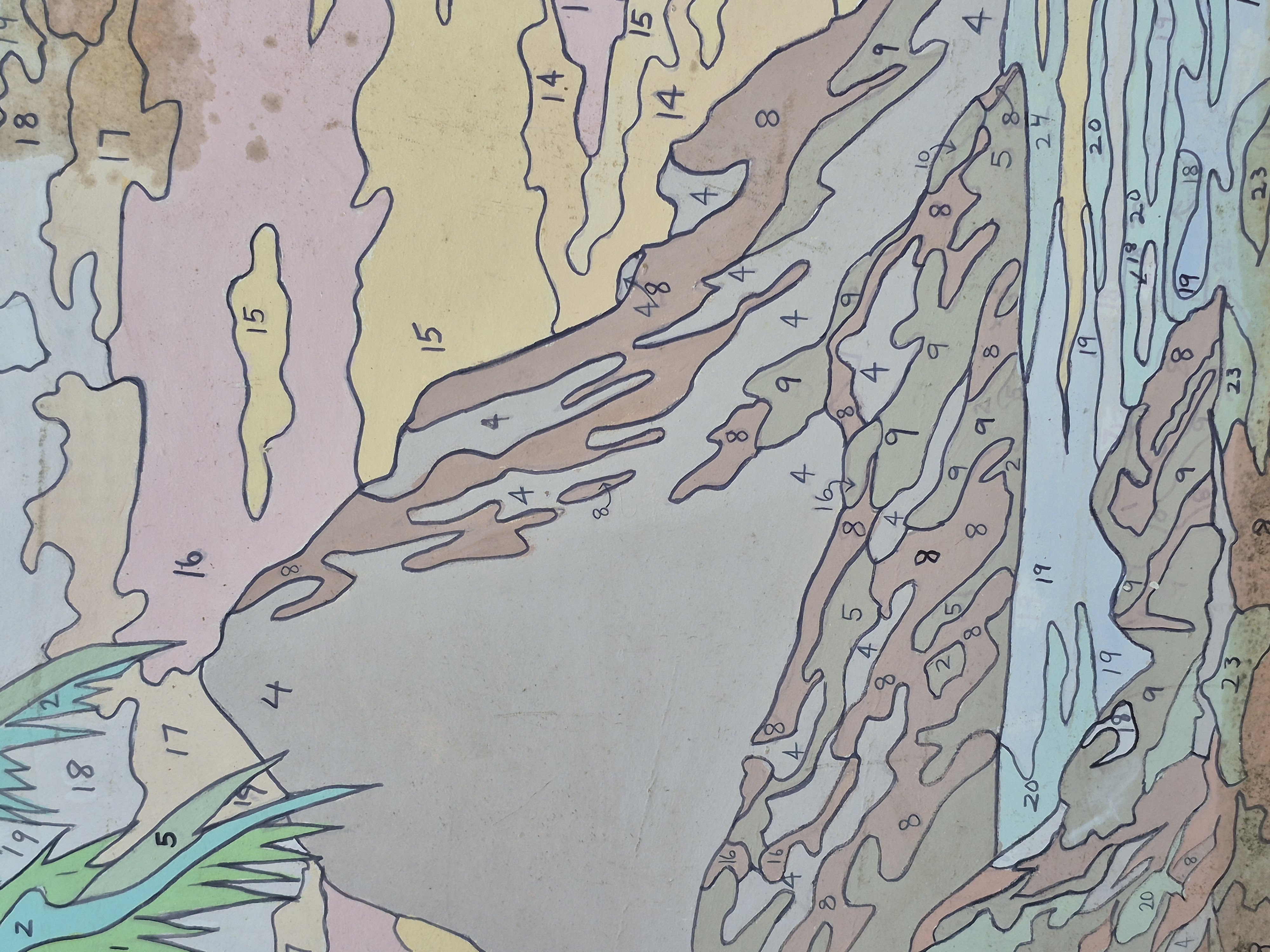
The most remarkable early work: a paint-by-number mountain landscape, the numbered zones carefully filled in but the overall project left in the territory between diagram and painting. Numbers from 2 to 24 fill the zones of mountain, cloud, and water. A fragment of palm tree enters from the upper left — connecting this work to the others in the series. It is a meditation on instruction, on the difference between following a system and making art, and on the landscape as something that can be — and perhaps cannot be — numbered.
Paint on board, paint-by-number system · c. 1989
Section Six
Abstractions:
Anatomies of Form
In her most sustained painterly investigation, Darmstadt develops a visual language organized around four recurring themes: Portals — openings, thresholds, arches through which something passes or is glimpsed; Voids — absences given form, the darkness that defines what surrounds it; Vortexes — spinning energy, the pull of a center, motion that consumes or generates; and Body — the anatomical, cellular, and aggregate forms of physical life rendered at every scale from the molecular to the monumental. These four forces move through the work not as fixed categories but as recurring intensities, sometimes isolated, sometimes intertwined.
1985–2020 / Oil and acrylic on canvas
6.1
Vortex with Figure
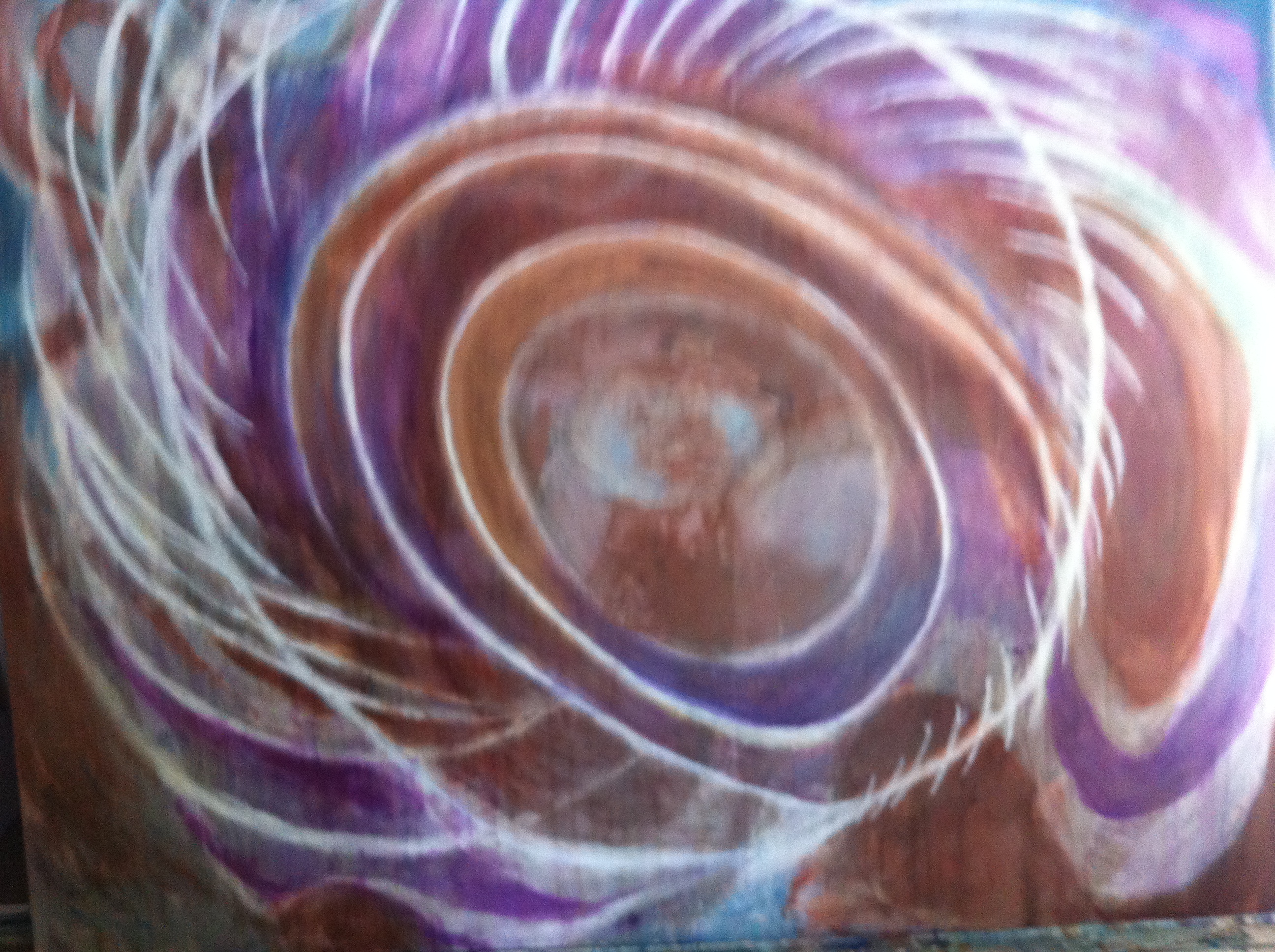
The first vortex: concentric ovals of rust and deep purple spin inward, compressing toward a still, dark center. White filaments streak outward from the eye of the vortex like energy released, or like the first traces of something gathering force. There is no figure here — only the pull itself, the pure rotational energy of a form that exists entirely to turn. The painting does not allow rest.
Oil on canvas · c. 1988
6.2
Portal: Cathedral
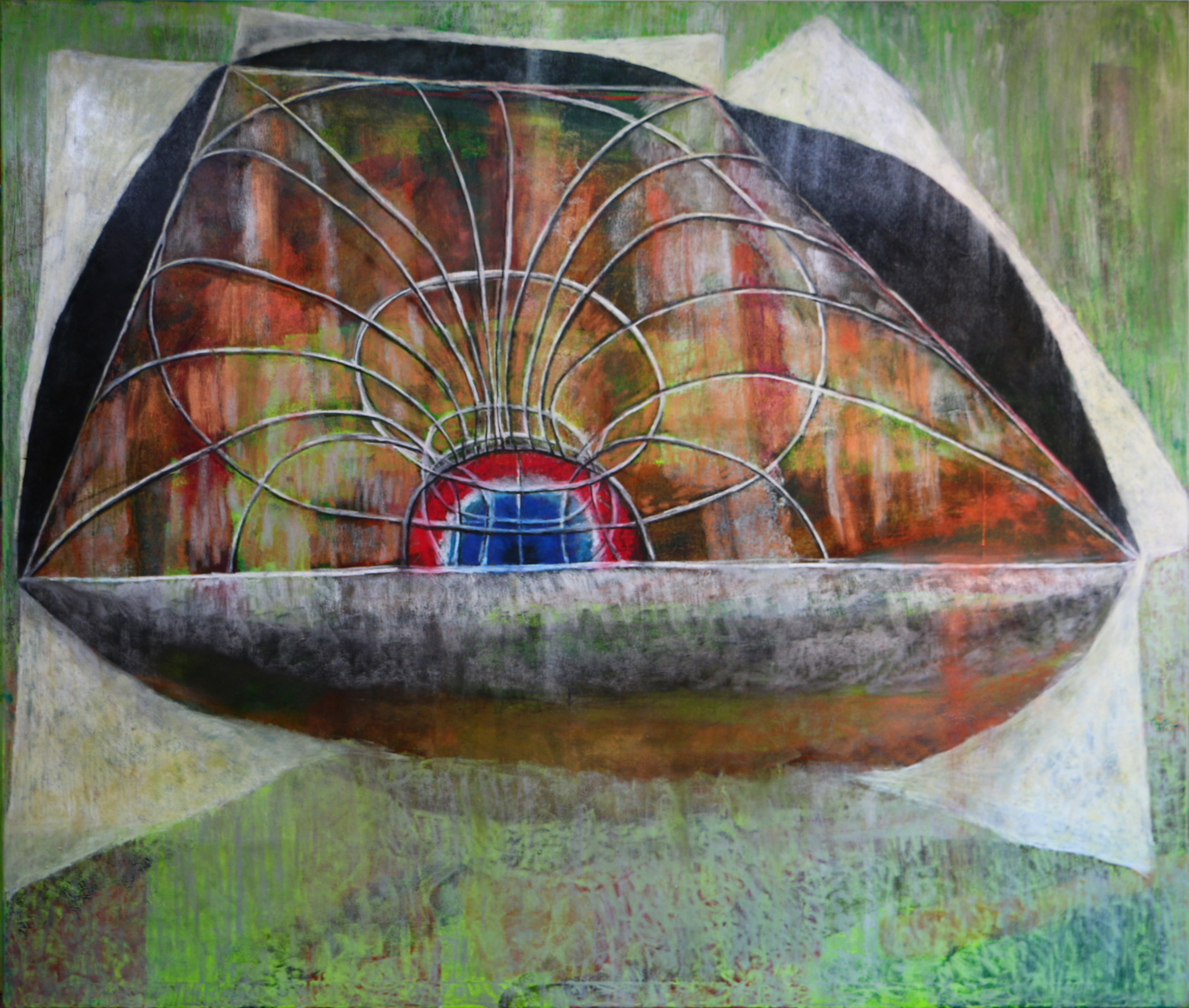
An ovoid opening frames a field of red and blue within — a portal shaped like a Romanesque arch, like a ribcage seen from within, like the aperture of a great instrument. Curved ribs radiate inward from its rim toward the luminous center. What is on the other side is not described; the portal is the subject. To stand before it is to consider the act of passing through.
Oil and acrylic on canvas · c. 1992
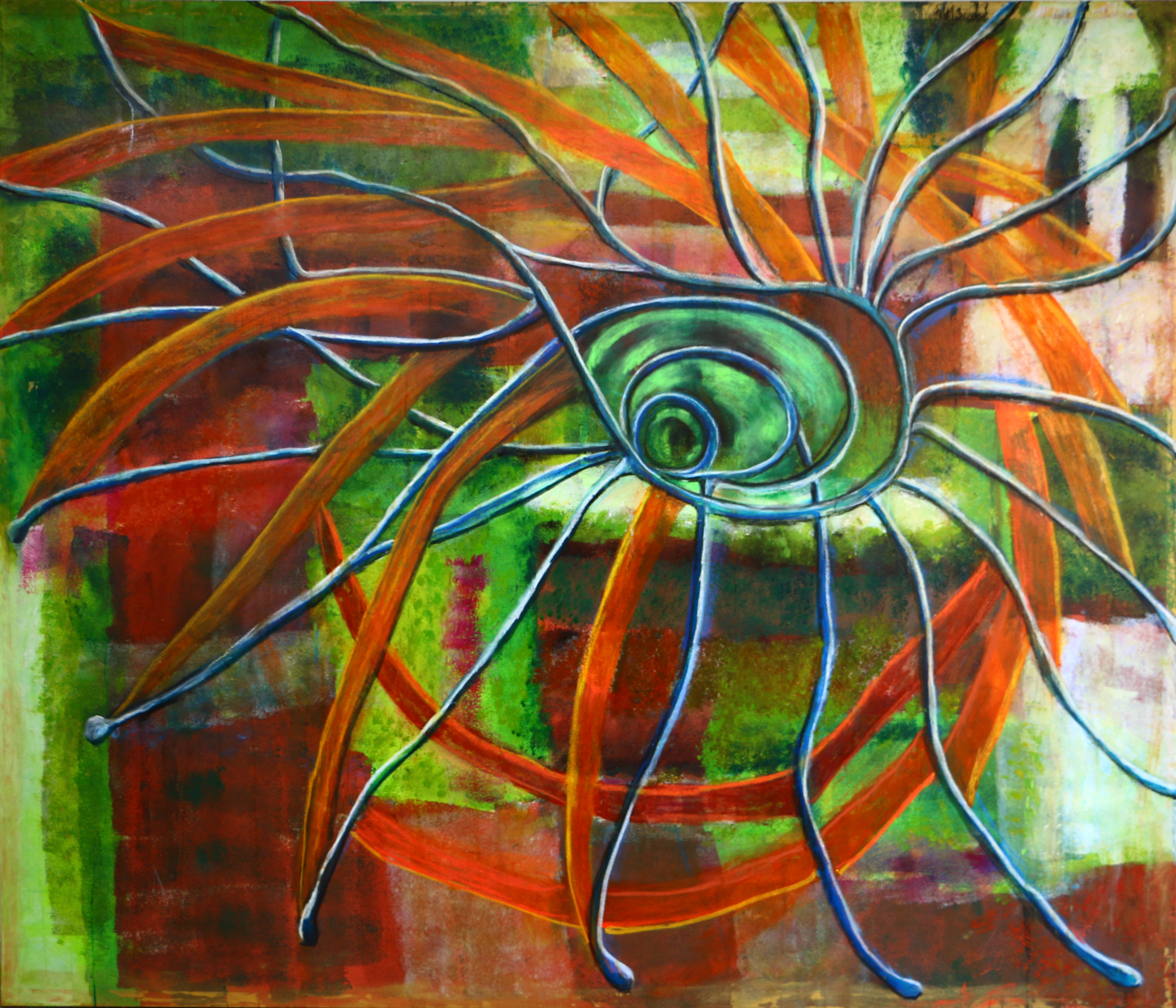
6.3
Vortex: Solar Wheel
A vortex of a different order — centrifugal rather than centripetal. Orange-red petals burst outward from a tightly coiled green center, silver-blue lines tracing the force lines of rotation. The painting vibrates with stored kinetic energy; it seems to spin as you look at it, the eye flung from center to edge and back again. A vortex that generates rather than consumes.
Oil and acrylic on canvas · c. 1993
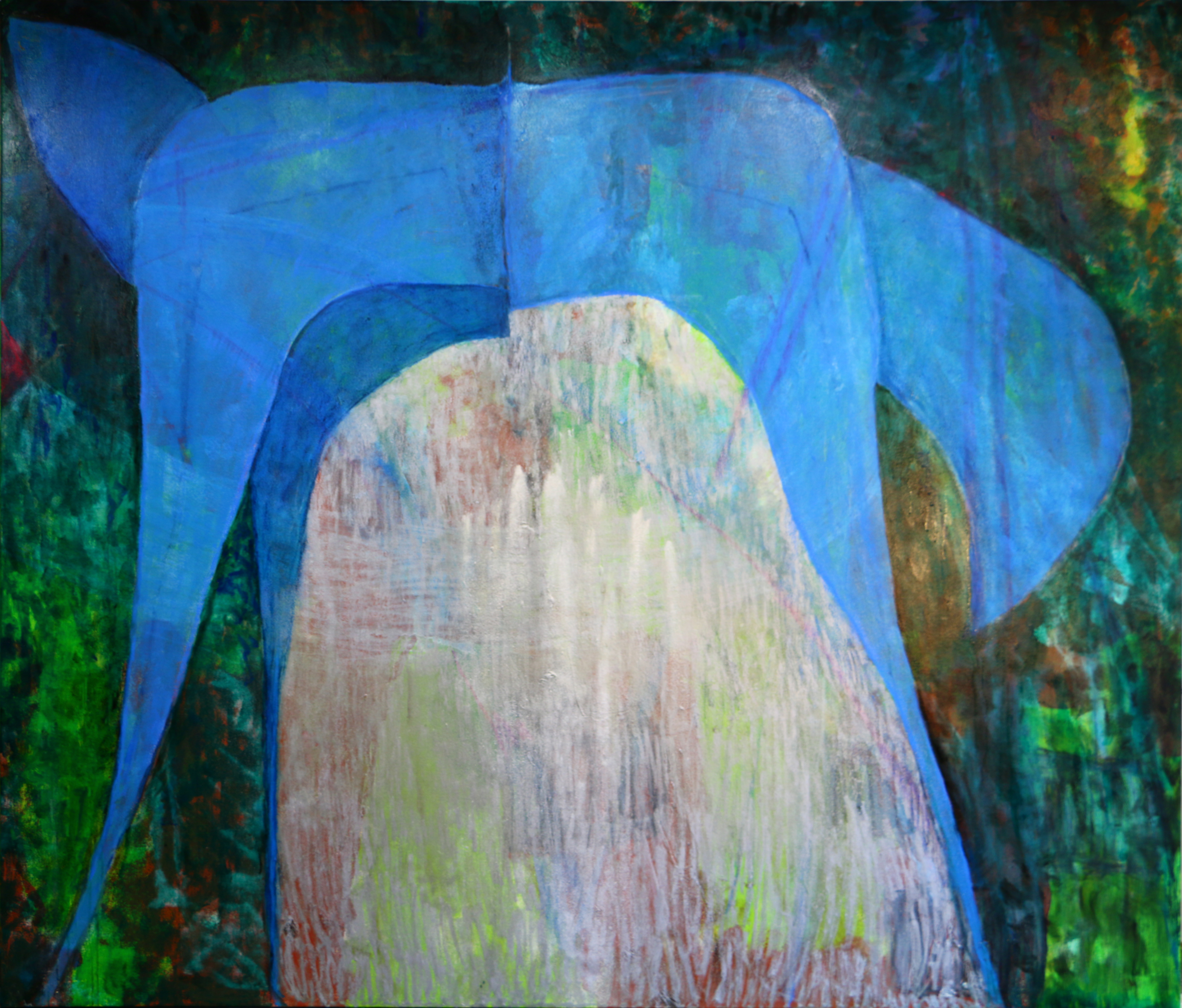
6.4
Body: Blue Arch
Two great blue forms curve inward — hips, or shoulders, or the walls of a pelvis — to frame a central expanse of cream and pink that reads unmistakably as flesh, as torso, as the warm interior of the body made visible. The green ground is cellular, alive. This is the body rendered at architectural scale: not a study of anatomy but an immersion in it.
Oil and acrylic on canvas · c. 1995
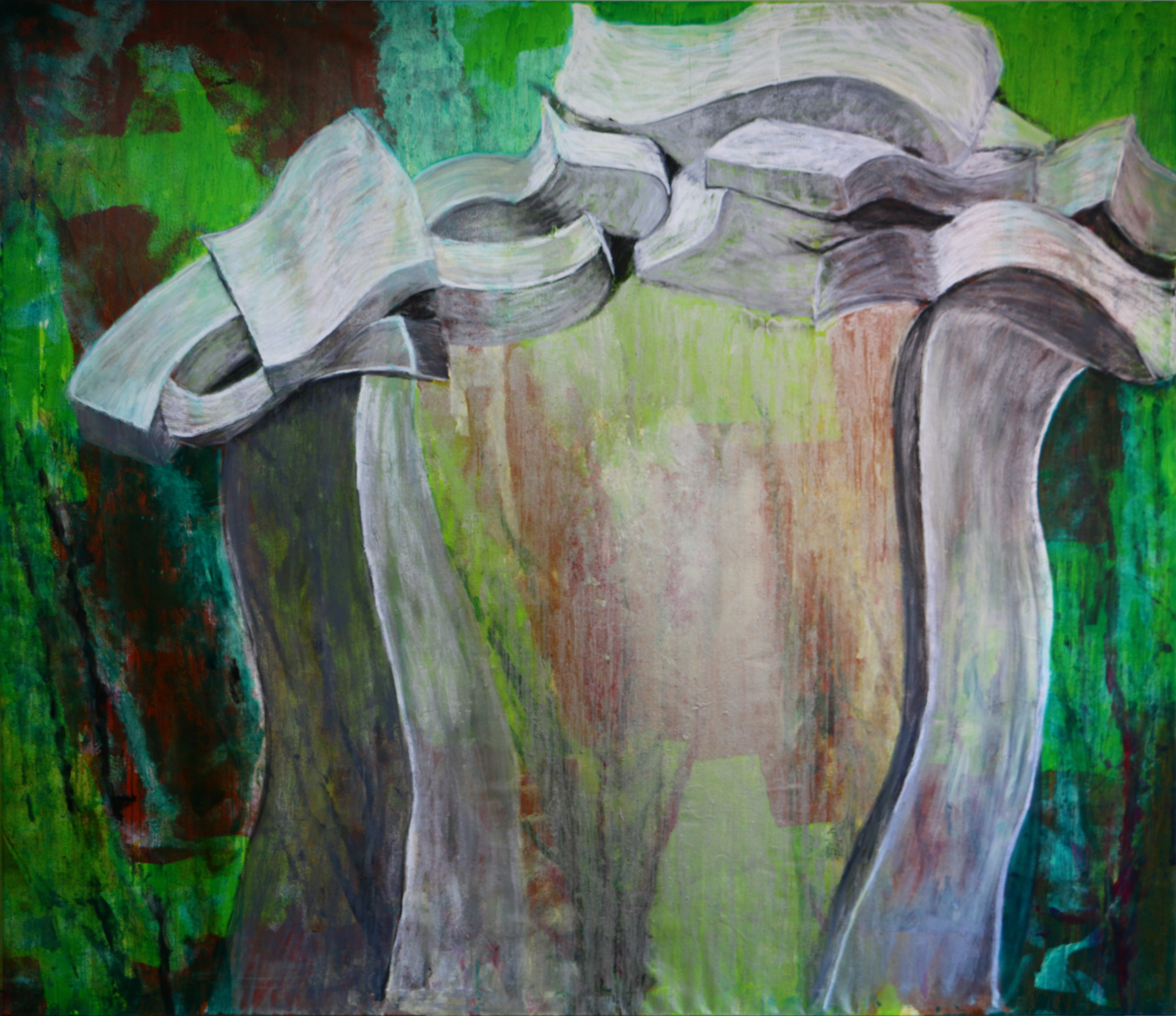
6.5
Body: Three Forms
Three upright figures — or torsos, or organs — rise side by side, their capped heads folded and compressed as if bearing weight. Built from dense gray and cream paint over a living green ground, the forms press against each other with the solidarity of bodies in close quarters. The painting evokes the body in multitude: not one anatomy but several, sharing the same space, the same surface.
Oil and acrylic on canvas · c. 1996
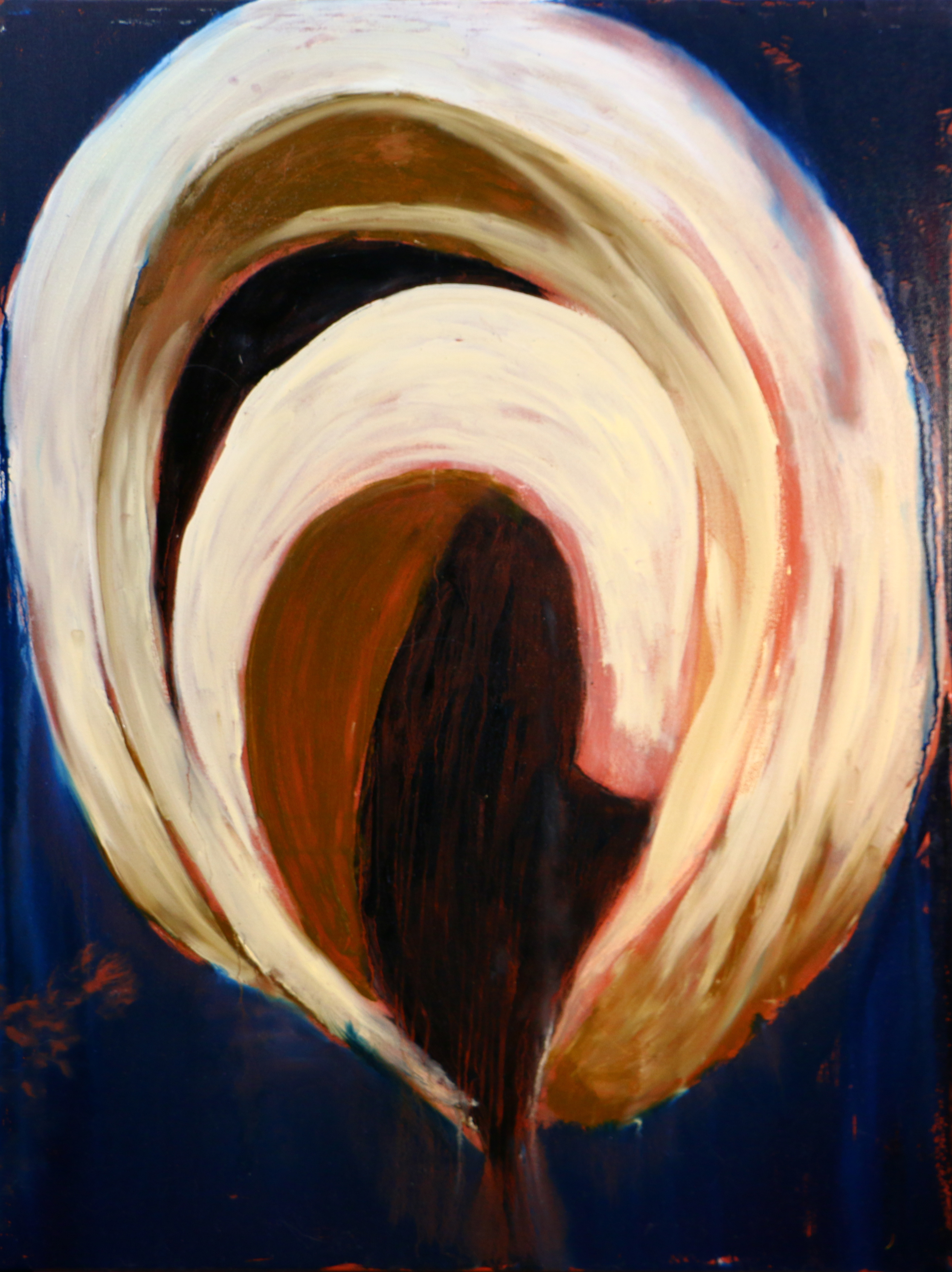
6.6
Void: Halo
A ring of cream and rose surrounds a central dark — not a presence but an absence, a void given form by what encircles it. The dark vertical at the center is not a figure but a gap, an unlit interior that the luminous brushstrokes of the halo both frame and refuse to fill. Darmstadt paints the void not as emptiness but as the thing that light orbits, endlessly, without touching.
Oil on canvas · c. 1997
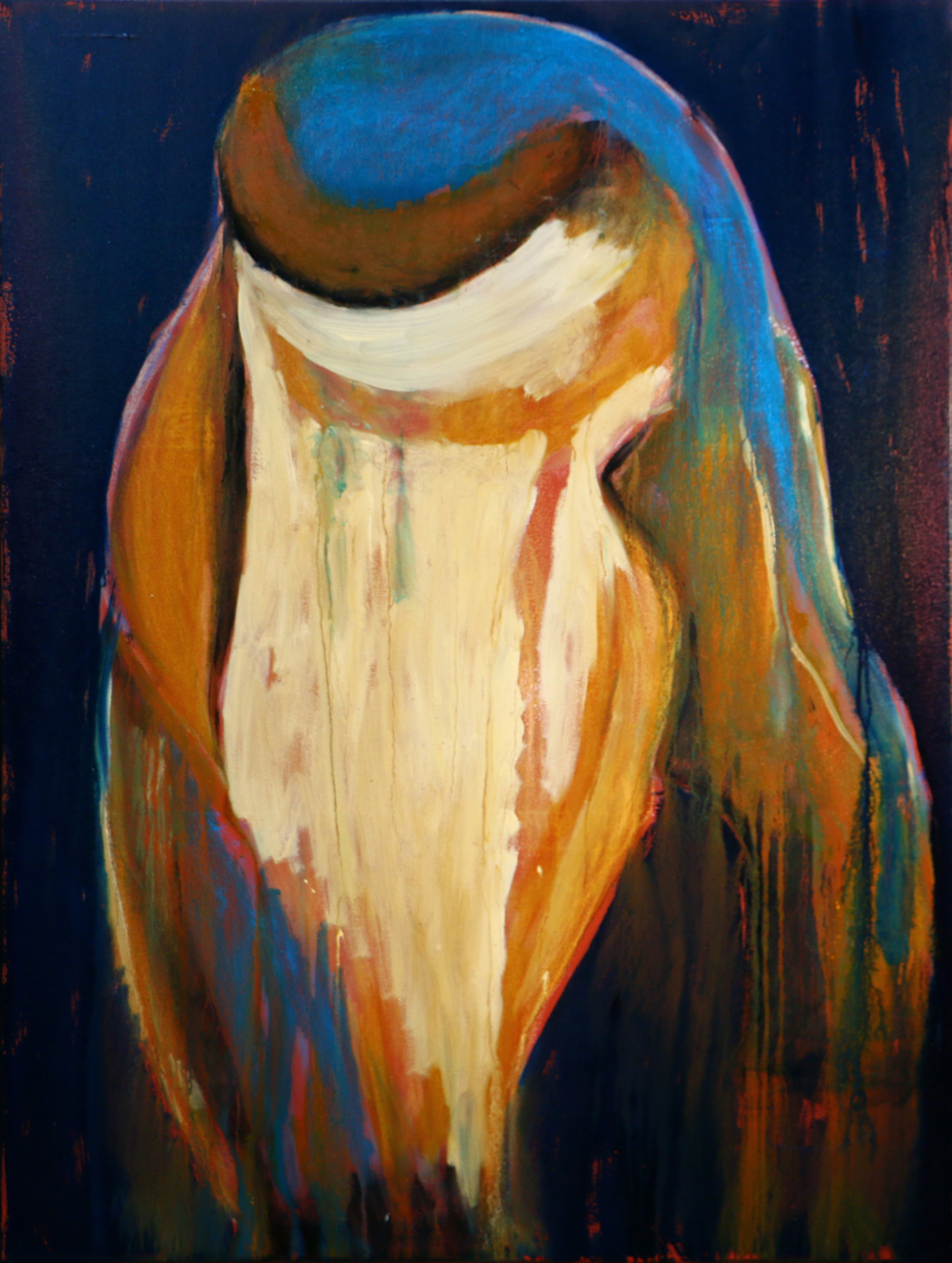
6.7
Void: Bowed
From the midnight blue ground a hooded form rises and bends inward over its own interior darkness. The void here is not external but self-contained — the figure is itself the space of absence, folded around something that cannot be seen. Amber and teal mark the edges of the form like a membrane between the filled and the empty. The body as its own void.
Oil on canvas · c. 1998
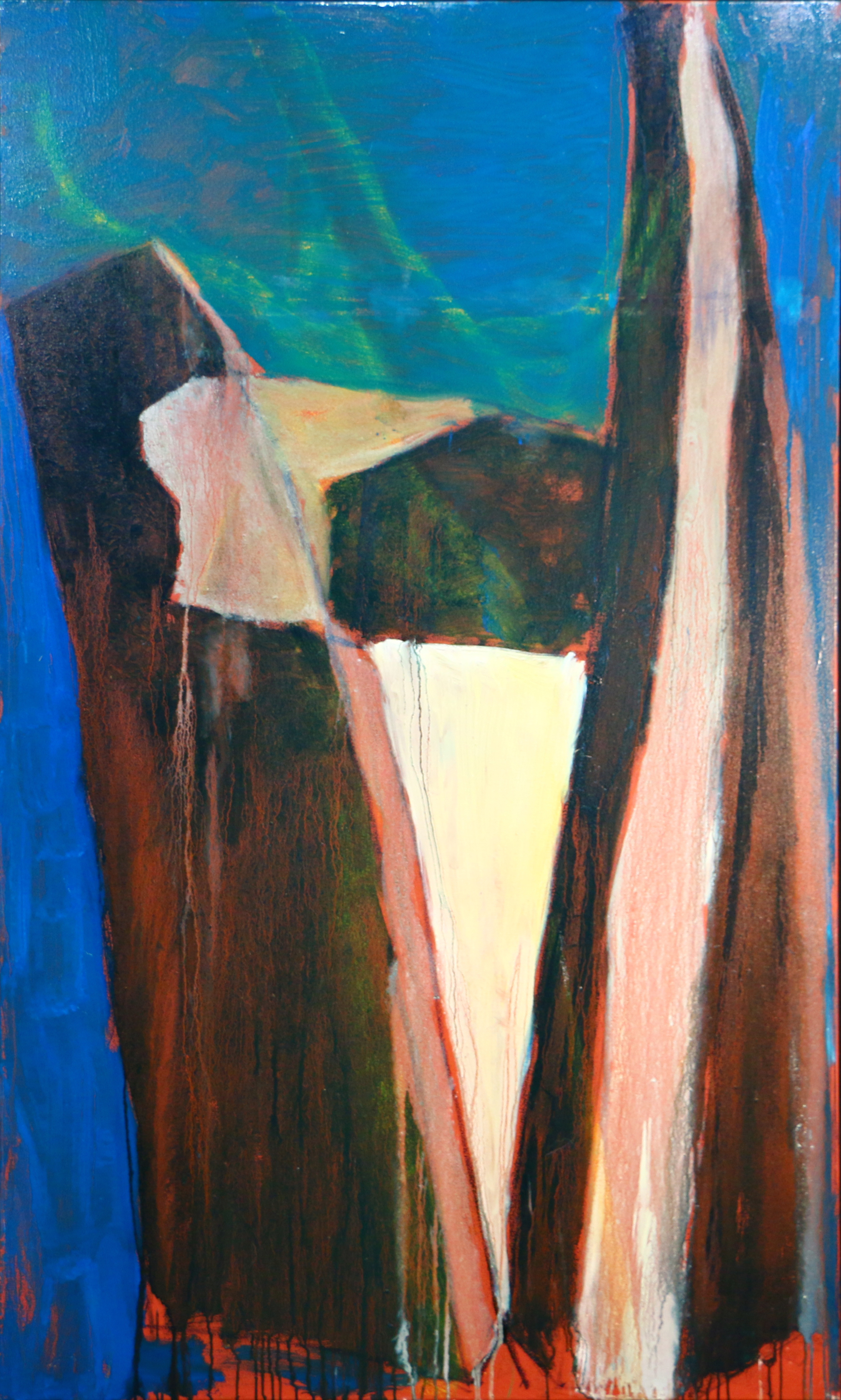
6.8
Void: Split
The void opens vertically: two dark masses part to reveal a deep triangular darkness at the center — a chasm, a wound, the negative space between two things that were once joined. Blue sky presses from above, brown earth below, green at the margins — the world continues around the void, indifferent to it. Darmstadt's most structurally stark painting in the series, and among her most uncompromising.
Oil on canvas · c. 1999
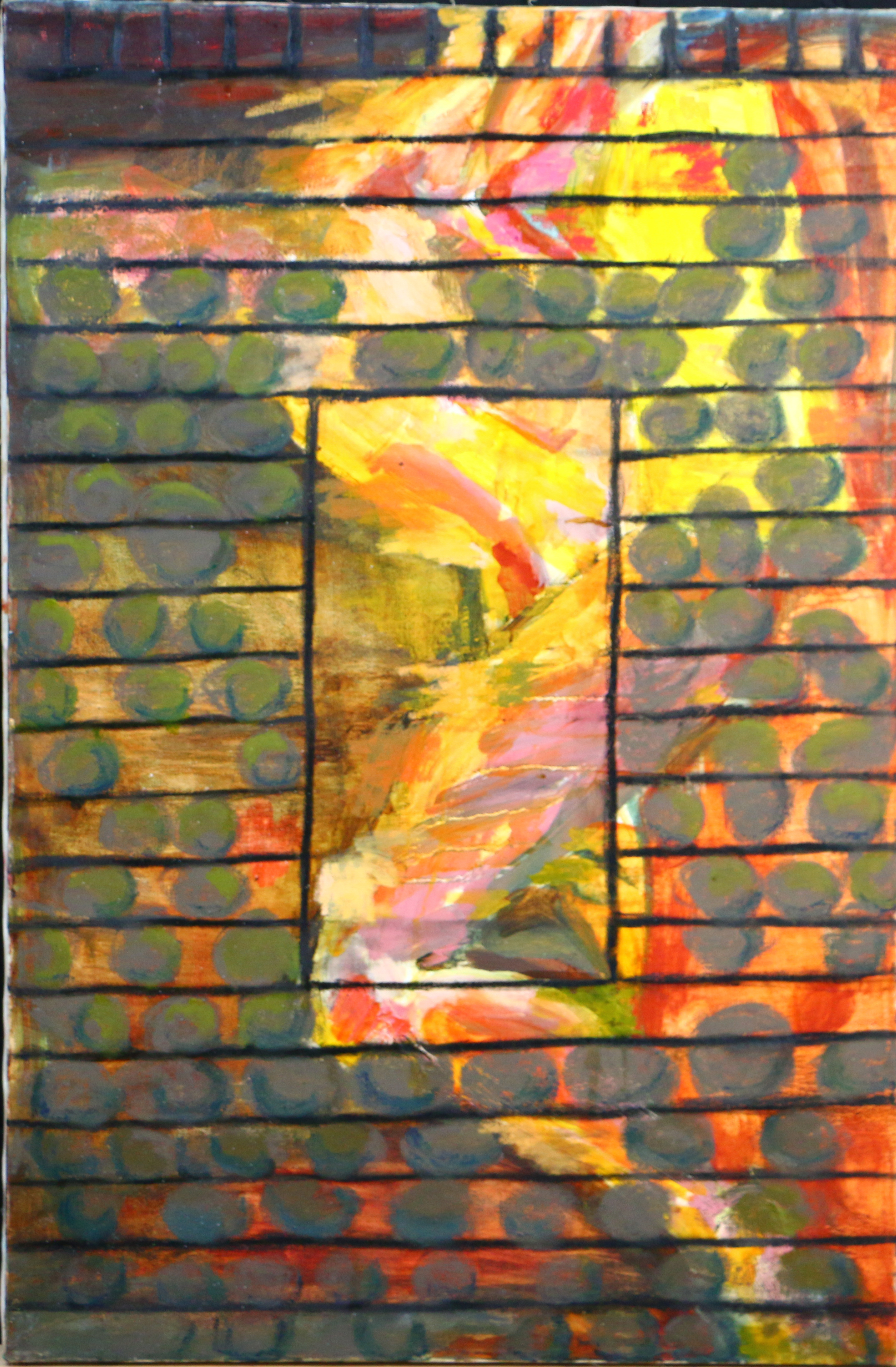
6.9
Portal: Cell Window
A dense grid of olive and gray circles — cellular, repetitive, a surface of regulated pattern — is breached at its center by a rectangular portal blazing with yellow, orange, and red. The portal is not cut through the grid; it erupts from within it, as though the energy on the other side could no longer be contained by the ordered surface above. What lies beyond the opening is not visible — only its light.
Oil and acrylic on canvas · c. 2000
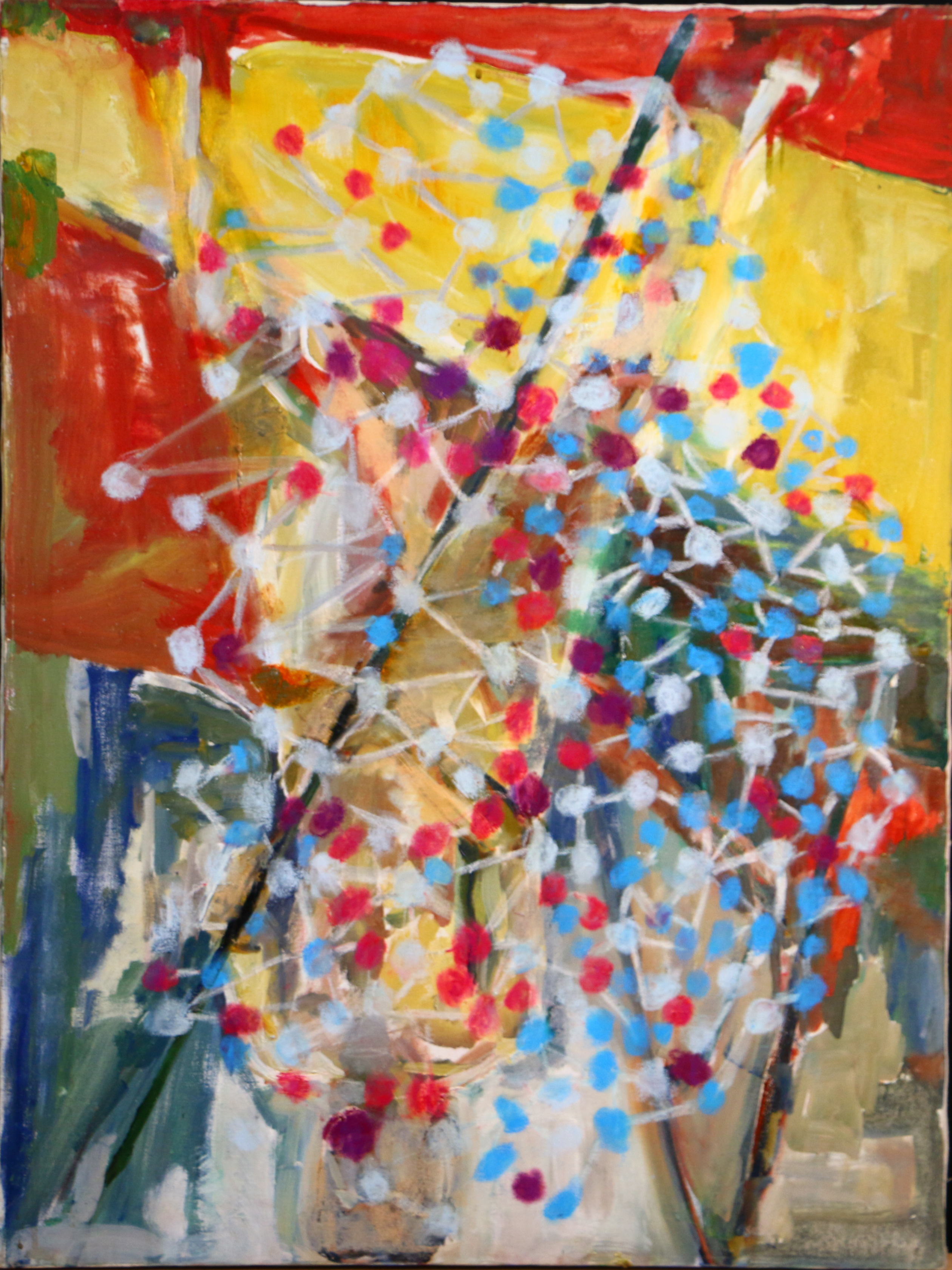
6.10
Body: Molecule
The body rendered at its smallest legible scale: pink, blue, and white nodes connected by fine white lines map the interior chemistry of living tissue across a field of yellow, red, and green. Each dot carries the warmth of a fingerprint. This is the body not as silhouette or surface but as structure — the invisible architecture that sustains everything visible above it.
Oil and acrylic on canvas · c. 2001
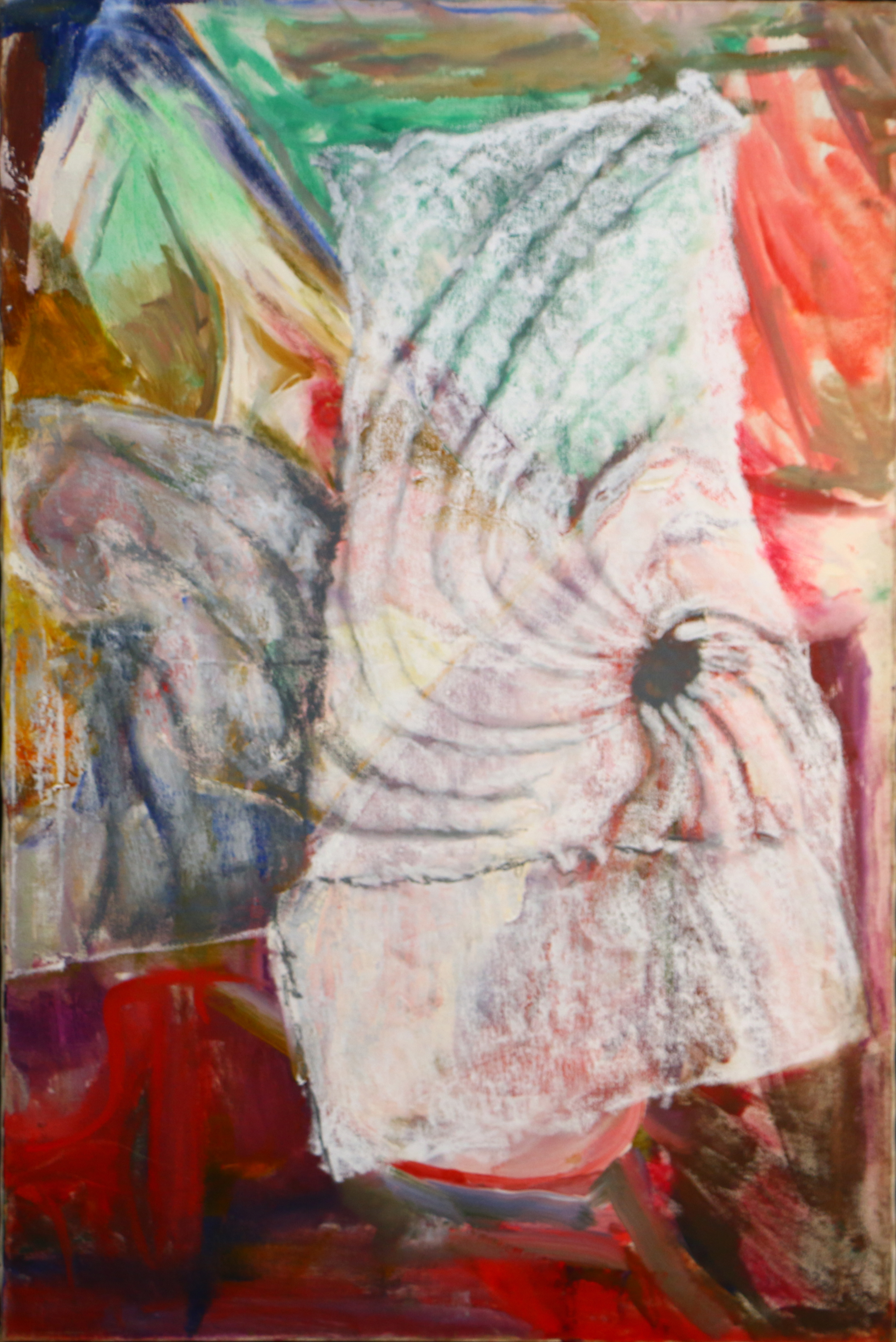
6.11
Body: Coiled
A large shell or coiled organ — pink, gray, and cream — dominates the canvas, its surface built from layered, almost sculptural paint. The form is unmistakably bodily: the curve of it is the curve of the ear, the nautilus, the cochlea, the interior of the wrist. Darmstadt does not identify the organ; she paints the quality of interiority itself — the feeling of being on the inside of something living.
Oil and acrylic on canvas · c. 2002
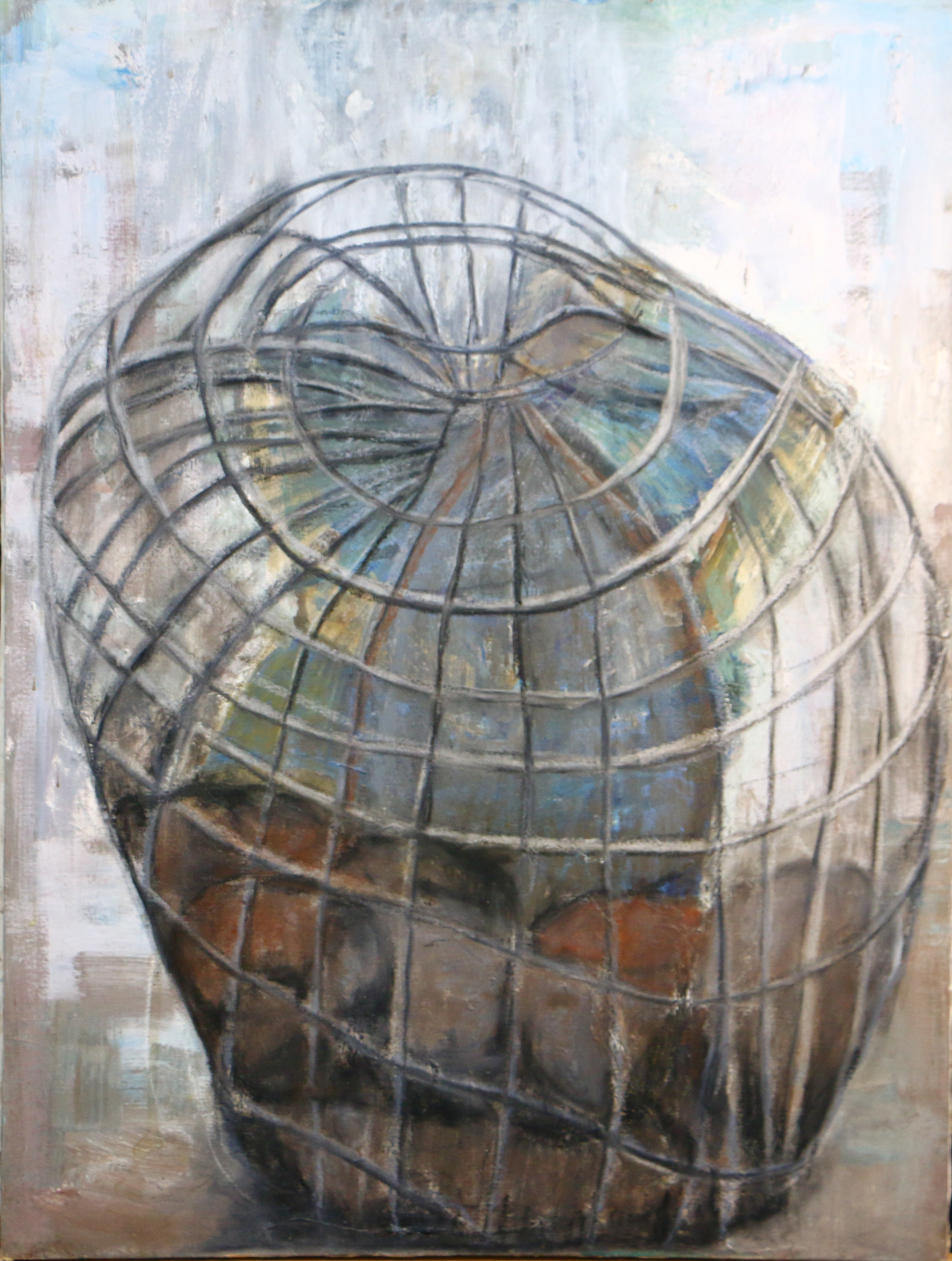
6.12
Body: Caged Globe
A rounded bodily form — the globe of a skull, a belly, a planet — is mapped by a cage of drawn lines: meridians and parallels that divide its surface into territories. The form beneath the grid is painted in soft blues, teal, and brown; the cage lines are drawn over it in charcoal, matter-of-fact. The body as something that can be surveyed, subdivided, administered — and that endures all of it.
Oil on canvas · c. 2003
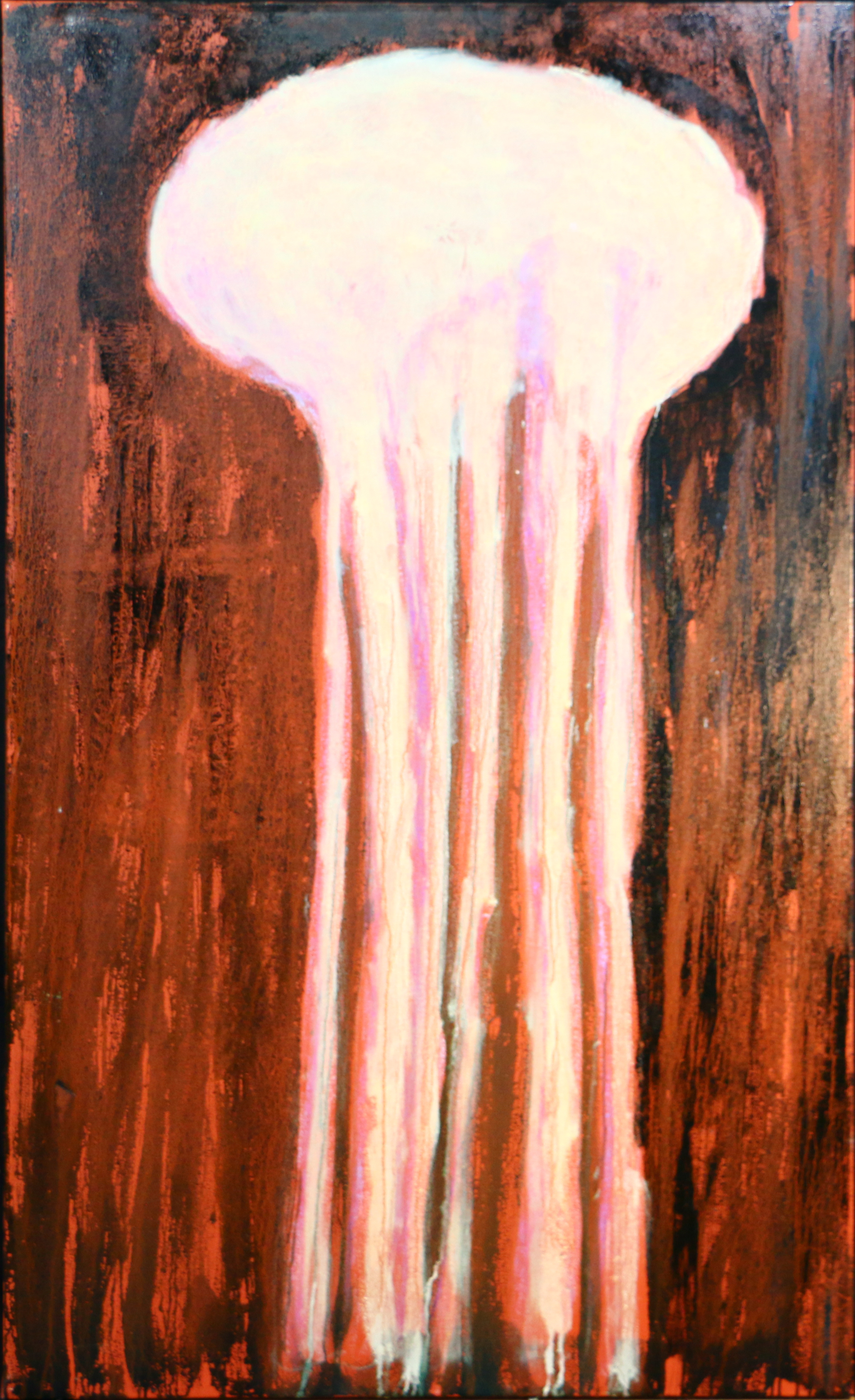
6.13
Void: Luminous
A pale, luminous form — mushroom-shaped, risen from below — floats against a ground of deep burned sienna that is itself a void: warm, consuming, surrounding. The white-pink form trails thin fingers of color downward into the dark, as if reluctant to separate from what generated it. The void here is not cold but furnace-hot, and what emerges from it carries its heat.
Oil and acrylic on canvas · c. 2004
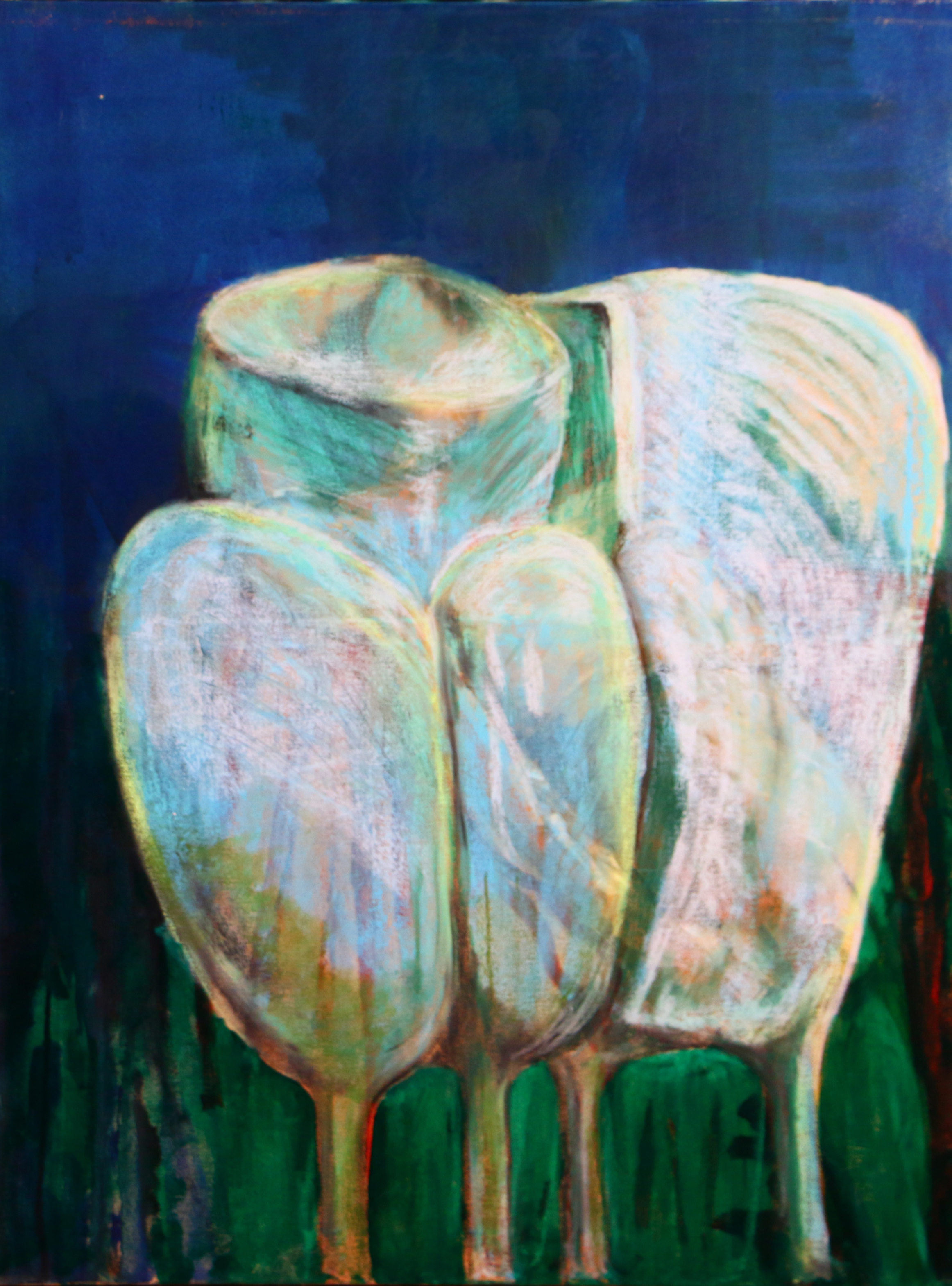
6.14
Body: Grouped
Three or four rounded bodily forms — teal, cream, and blue — press together against a deep blue ground, their surfaces striated with the marks of growth or compression. The forms cluster like organs, like cells in mitosis, like figures huddled in proximity. They are neither separated nor merged: each retains its own boundary while leaning into the others. The body as community of parts.
Oil and acrylic on canvas · c. 2005
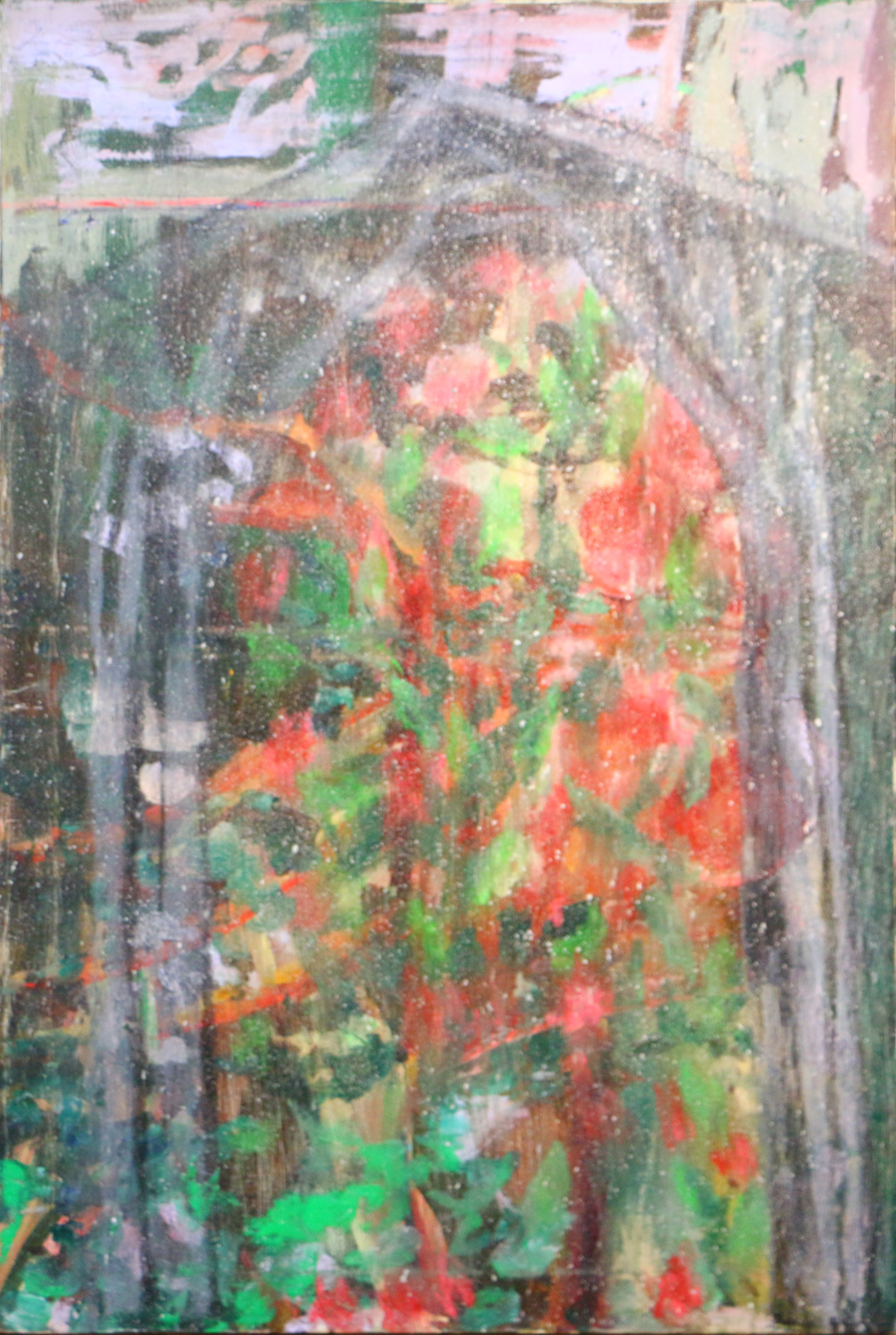
6.16
Portal: Garden Gate
A Gothic arch — painted in gray and silver, scattered with white points of light — frames an interior blazing with red, green, and gold: a garden glimpsed through a portal, or a body's interior seen through the arch of its own ribs. The portal is narrow, the light beyond it excessive, almost violent in its abundance. Darmstadt places us at the threshold and does not invite us further.
Oil on canvas · c. 2007
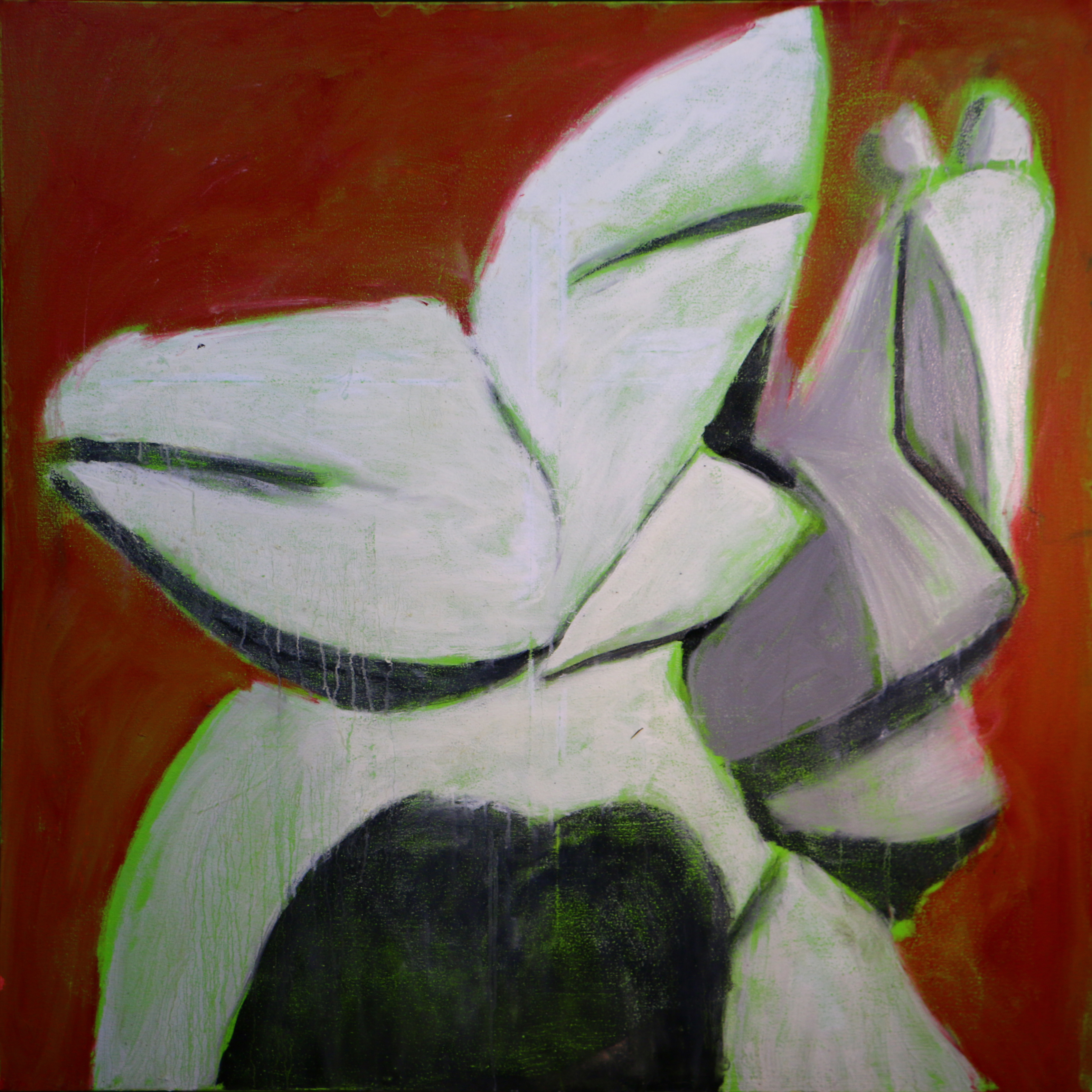
6.17
Body: Fragments
White angular forms — lobes, planes, sections — float against a saturated red ground, edged in black and acid green. The body here is not whole but assembled: each fragment retaining its own weight and edge, the spaces between them as significant as the forms themselves. Darmstadt paints the body in the act of being known — partially, provisionally, one piece at a time.
Oil and acrylic on canvas · c. 2008
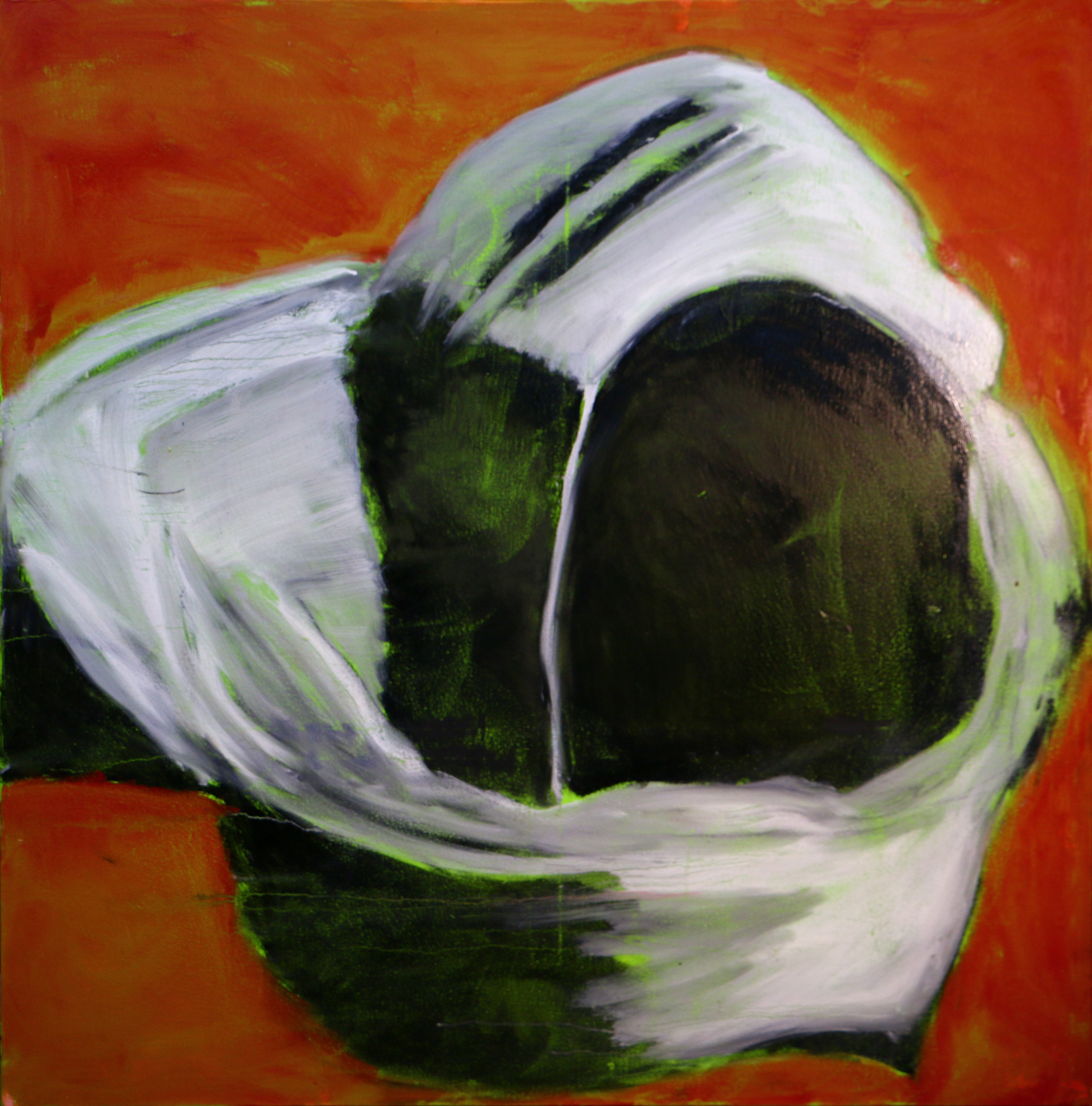
6.18
Void: Cave
White and gray brushstrokes curve around a central darkness — deep green-black, impenetrable, the void at the heart of a form that seems both open and closed simultaneously. The orange ground burns at the edges, pressing inward. This is the void as interior space: not absence but depth, not emptiness but the darkness that is necessary for what grows in the dark.
Oil on canvas · c. 2009
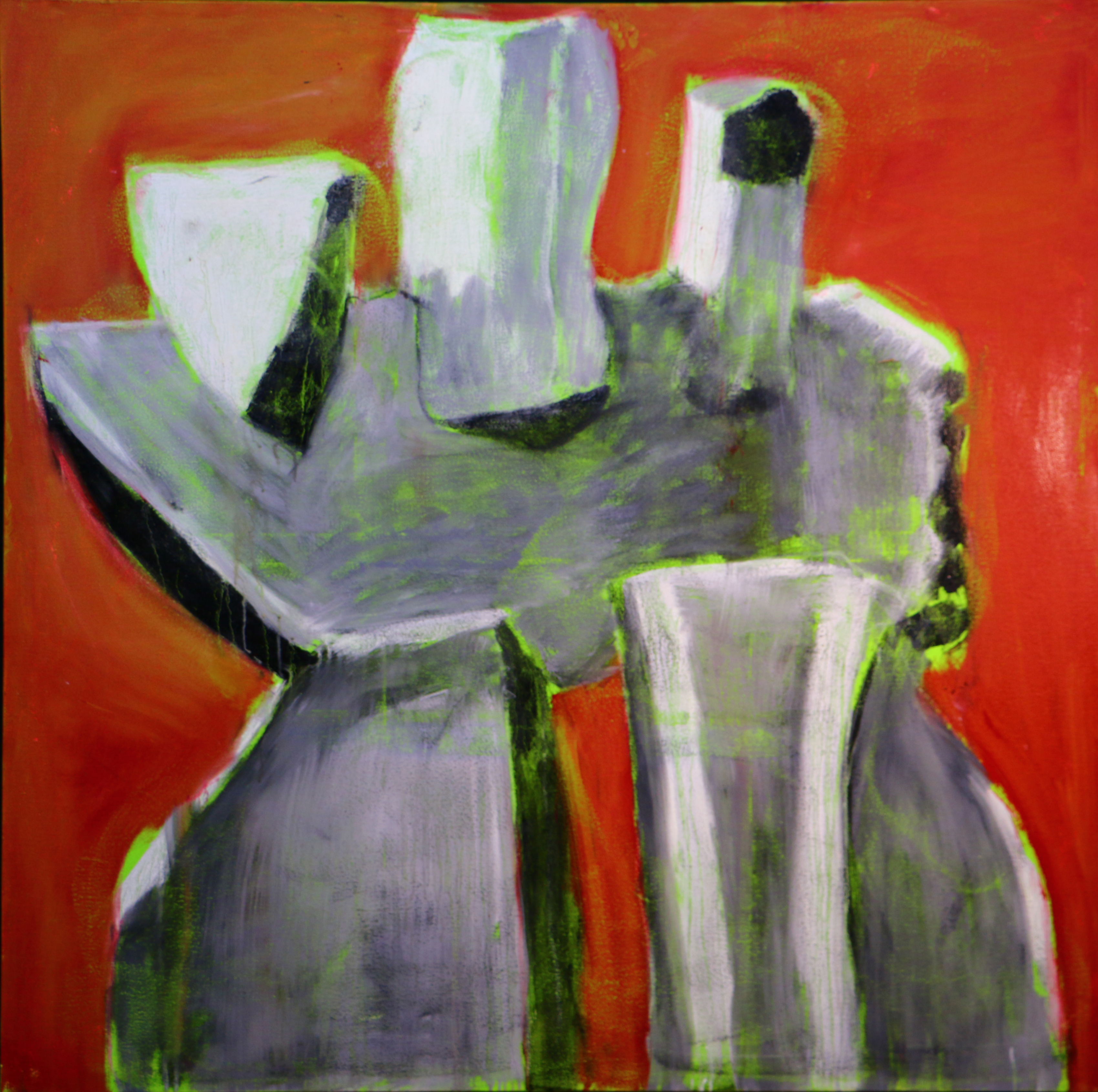
6.19
Body: Assembly
Gray-white forms — blocky, upright, jointed — stand together against a blazing red-orange ground, edged in acid green. The forms suggest bodies in the aggregate: torsos without heads, presences without faces, assembled as if for inspection or commemoration. The neon green outlines give each form an urgency, a refusal to recede. These are bodies insisting on being seen.
Oil and acrylic on canvas · c. 2010
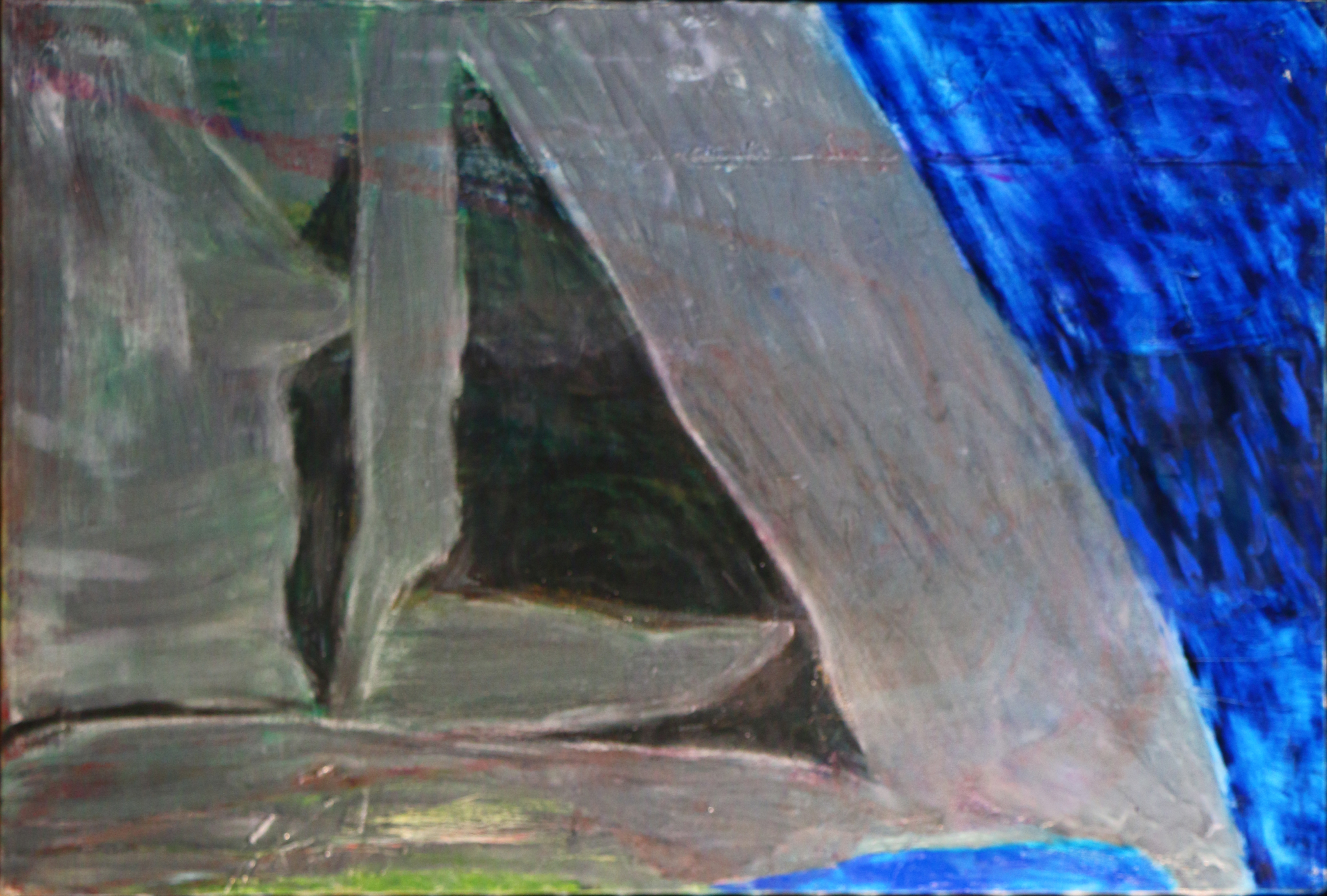
6.20
Portal: Threshold
Two gray planes open at an angle — a tent flap, a curtain parted, a body's cavity briefly exposed — to reveal a triangular darkness within. To the right, a field of electric blue. The portal here is mundane and intimate: not a cathedral arch but a fold in fabric, a gap in a surface that was closed a moment ago. The darkness inside is complete. What was there before we looked is now gone.
Oil on canvas · c. 2012
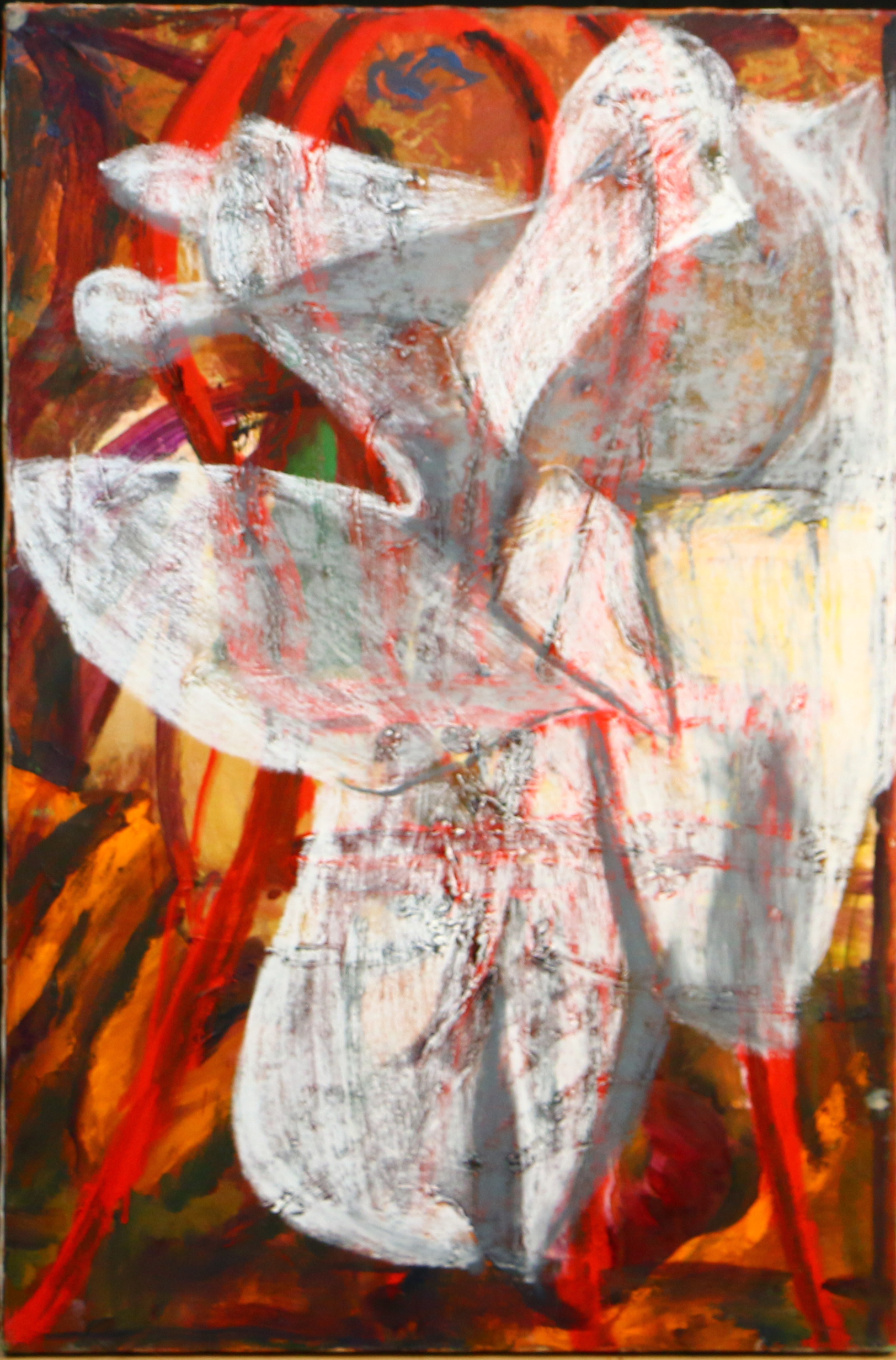
6.21
Body: In Fire
White bodily forms — lobed, winged, overlapping — tumble through a ground of red, orange, amber, and gold. A red vortex traces the background; small eyes or faces appear embedded in the white forms. This is the body in extremis — heated, pressured, not destroyed but transformed. The painting is among the most physically intense in the series, the body refusing to be consumed by the energy that surrounds it.
Oil and acrylic on canvas · c. 2014
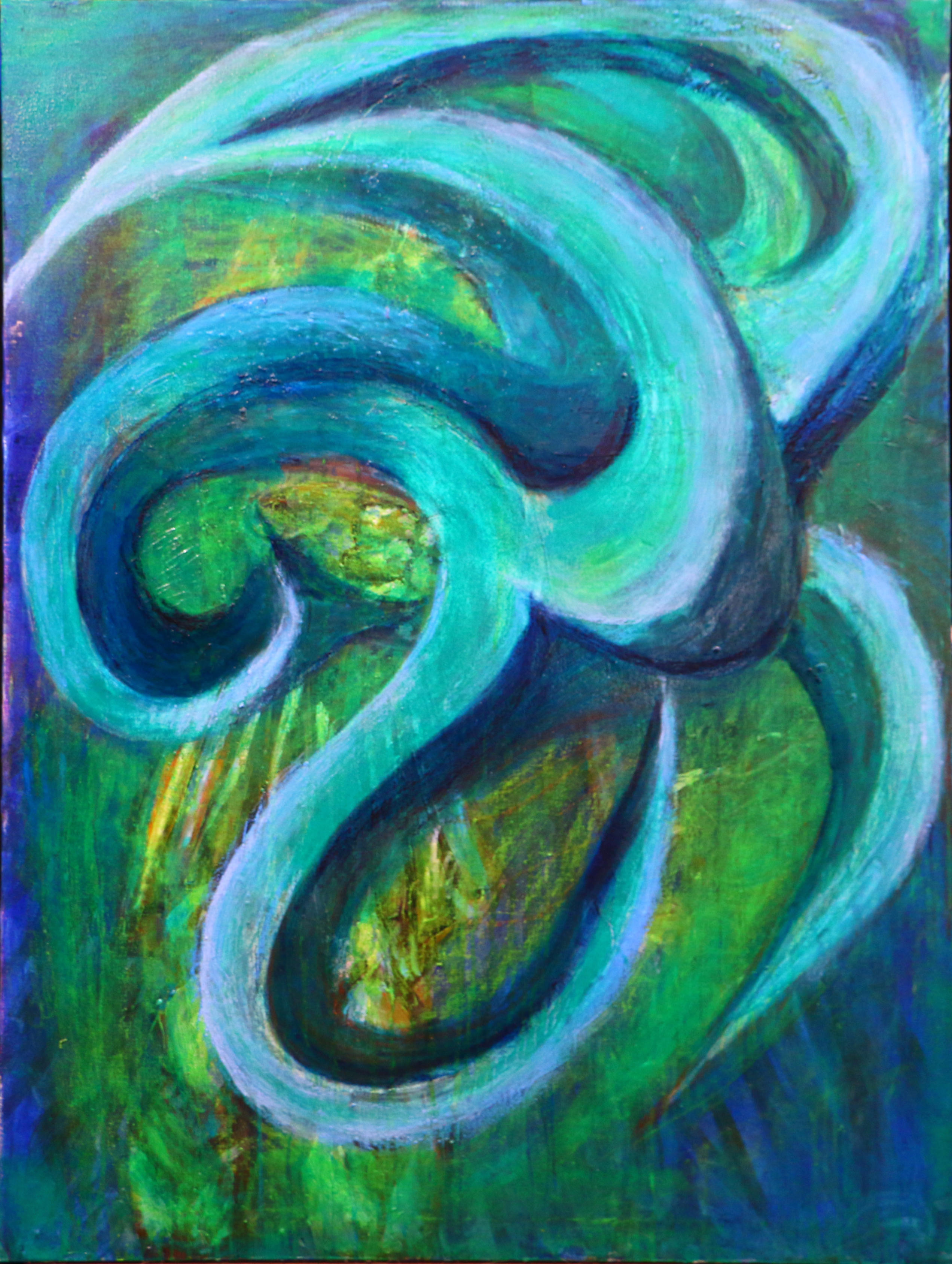
6.23
Vortex: Teal
A teal and blue vortex unfurls across the canvas in long, sweeping arcs — the motion of water draining, of a galaxy seen from above, of the ear's interior. The vortex does not close: it opens at the bottom into two outward curves, releasing what it gathered. The green ground pulses beneath the turning form. This is the vortex at its most fluid, its most oceanic, with the least violence.
Oil on canvas · c. 2016
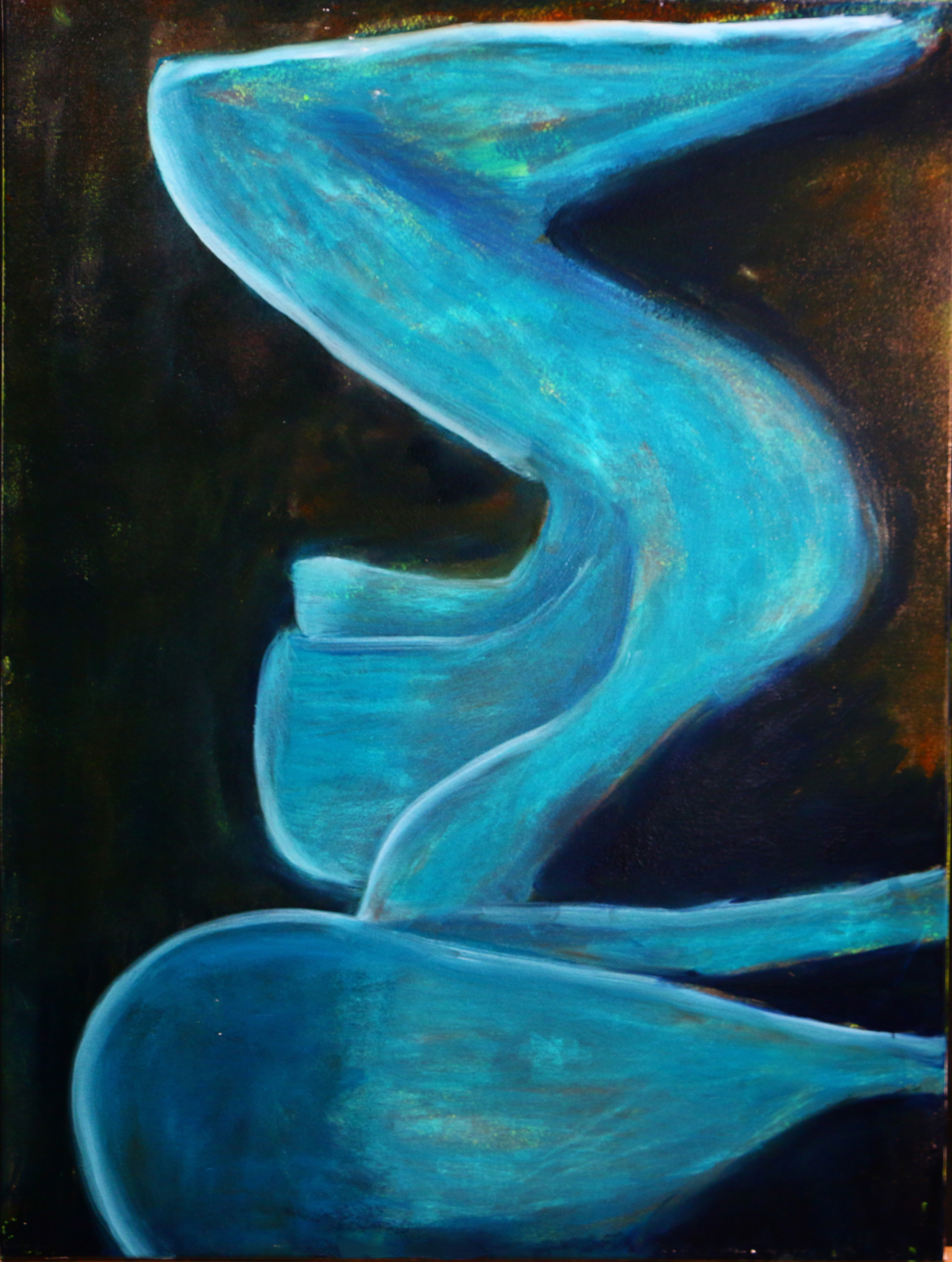
6.24
Vortex: Blue Descent
A luminous S-curve of cerulean blue descends through absolute darkness — twisting, slowing, pooling at the bottom into two quiet lobes. The vortex here is not violent but gravitational: a slow turning, a descent that is also a settling. Against the black ground the blue is brilliant, self-sufficient, the only light in the painting. The last vortex in the series — energy not spinning out but spiraling inward, finding its level.
Oil and acrylic on canvas · c. 2018
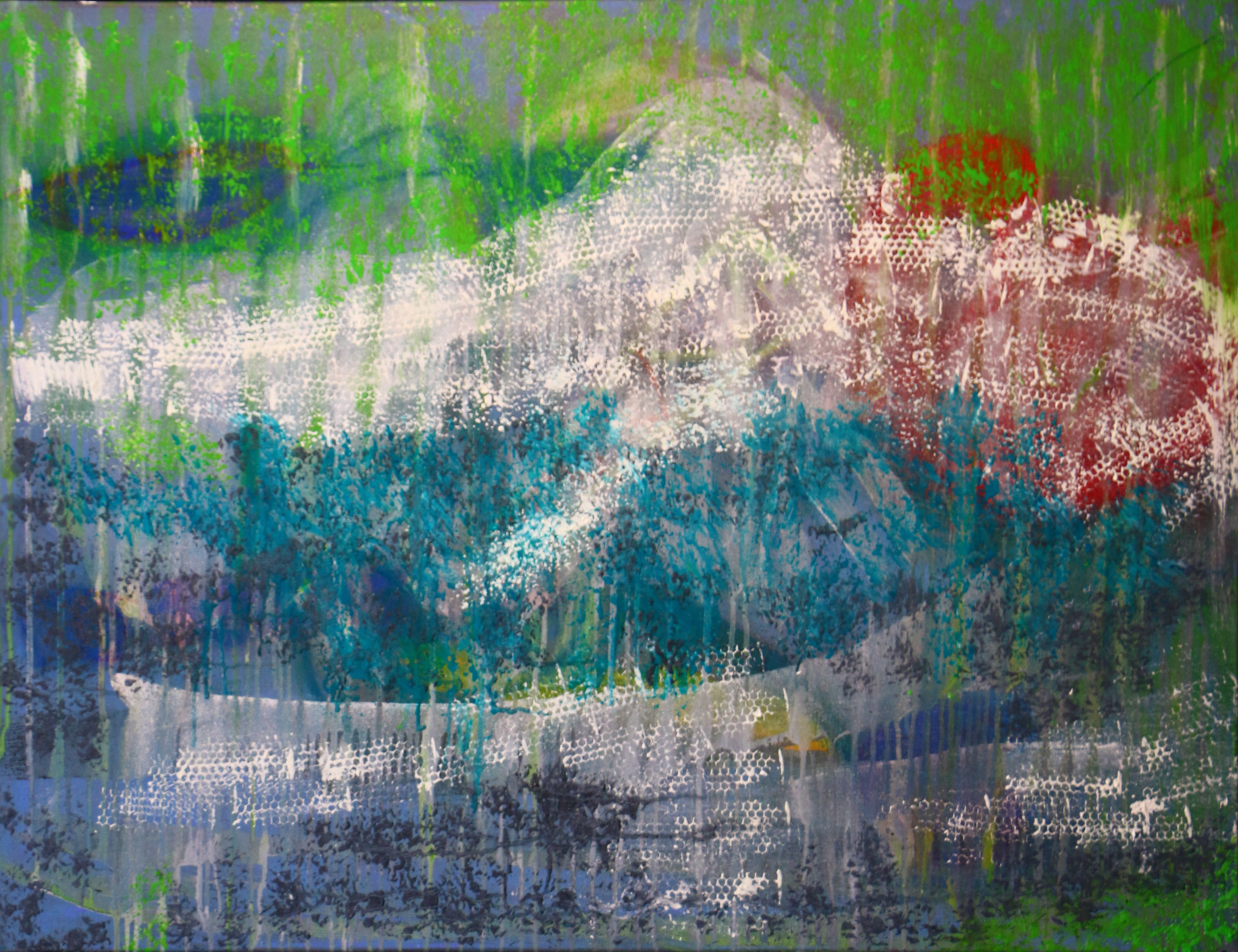
6.26
Body: Landscape
The final work: the body dissolved into landscape, landscape dissolved into body. A horizontal form — part torso, part terrain — is layered with the marks of netting, brushwork, stain, and drip in green, teal, blue, and red. The surface is dense with the evidence of making. After all the vortexes and portals and voids, the body persists — not as an ideal but as accumulated fact, as the thing that remains.
Oil on canvas · c. 2019
Catalog Three — Barbara Darmstadt: Selected Works 1985–2020
Works in mixed media, oil on canvas, installation, and painted river stone.
Sections: Rocks (1.1–1.24) · Gourds (2.1–2.6) · Fence (3.1–3.13) · Male Figure (4.1–4.7) · Early Works (5.1–5.5) · Abstractions (6.1–6.26)
Designed in the editorial tradition of the Whitney Biennial catalog.
Typography: EB Garamond (body & titles) · Space Mono (captions & labels)
All works courtesy the artist, Princeton, New Jersey.
Photography of works © Barbara Darmstadt. All rights reserved.
No portion of this catalog may be reproduced without permission of the artist.
Contact the Artist
bvdarmstadt@gmail.com · 609.216.4816